

TL;DR:
- UK offshore professionals must obtain mandatory certifications such as BOSIET, MIST, OGUK medical, and GWO BST before contracting.
- Contract clarity and understanding IR35, SED, and payroll options are essential to maximize pay and avoid legal pitfalls.
- Proper contract management, certification tracking, and sector knowledge enhance security, earnings, and career progression.
The difference between a weak offshore contract and a strong one can be worth tens of thousands of pounds over a single rotation. For UK professionals entering the offshore industry or looking to improve their current position, the stakes are real: tax exposure, unclear terms, and missing certifications can cost you money, compliance, and career momentum. This guide walks you through everything you need to know, from mandatory certifications and IR35 rules to contract structuring and pay negotiation, so you can approach your next offshore role with confidence and clarity.
Table of Contents
- What you need before improving your offshore contract
- Structuring your offshore contract for maximum benefit
- Understanding tax and legal status: IR35, SED, and payroll options
- Maximising pay, security and progression in offshore roles
- Why most offshore contracts fail UK professionals and how to avoid the pitfalls
- How Offstep can help you secure and improve your offshore contracts
- Frequently asked questions
Key Takeaways
| Point | Details |
|---|---|
| Prioritise certifications | BOSIET, MIST, OGUK medical, and GWO are essential for UK offshore entry and future-proofing your credentials. |
| Clarify contract terms | Explicit, well-drafted contracts help avoid IR35 pitfalls and ensure fair, secure working conditions. |
| Understand tax position | Evaluating IR35 and SED status could legally boost your take-home pay and simplify compliance. |
| Negotiate for stability | Target the best rates, rotations, and benefits to maximise pay, career progression, and work-life balance. |
What you need before improving your offshore contract
Before you can improve your offshore contract, you need to know exactly what you are bringing to the table. Contractors who skip this step often find themselves accepting terms they cannot legally or practically fulfil, or worse, losing work because their paperwork is out of date.
The non-negotiable certifications for UK offshore work include:
- BOSIET with CA-EBS (Basic Offshore Safety Induction and Emergency Training with Compressed Air Emergency Breathing System): mandatory for most oil and gas platforms
- MIST (Minimum Industry Safety Training): required for North Sea operations
- OGUK medical certificate: confirms you are fit for offshore duties
- GWO BST (Global Wind Organisation Basic Safety Training): increasingly required for renewables transition roles in offshore wind
The essential certifications for UK offshore contractors form the baseline that every hiring company checks before offering a contract. Getting these right before you negotiate anything else is not optional.
Beyond certifications, you need to assess your physical fitness, technical skills, and documentation. Career changers often underestimate how much of their existing toolkit transfers. Mechanical, electrical, and construction backgrounds are genuinely valued, but you still need to close any certification gaps before approaching operators.
| Document or requirement | Status to check |
|---|---|
| BOSIET with CA-EBS | Valid within 4 years |
| MIST certificate | Valid within 2 years |
| OGUK medical | Valid within 2 years |
| GWO BST modules | Valid within 2 years |
| CV and skills evidence | Updated and role-specific |
| Proof of technical qualifications | Originals and copies |
For career change guidance tailored to the offshore sector, understanding which certifications apply to your target role is the smartest first step.
Pro Tip: Set calendar reminders six weeks before any certificate expires. Letting even one lapse mid-contract can result in immediate removal from a platform, which damages your reputation with operators far more than a gap on your CV.
Structuring your offshore contract for maximum benefit
Once your prerequisites are sorted, attention turns to the structure and wording of your offshore contract. This is where most contractors make costly mistakes, either by accepting vague terms or by failing to read what they are actually signing.
Contract clarity is not a legal luxury. Contractual clarity is paramount in offshore construction projects, particularly when distinguishing between indicative schedules (which are not binding) and actual obligations. If your contract says you may be required to work certain hours but does not commit the client to providing those hours, you are exposed.
Here is how to review and improve a contract before you sign:
- Identify every schedule and annex: Check whether each one is described as indicative or binding. Ambiguous language here can mean unpaid gaps.
- Check the substitution clause: Can you send a qualified replacement if you are unavailable? This is critical for IR35 purposes.
- Review mutuality of obligation (MOO): Does the client have to offer work, and do you have to accept it? If yes to both, you are likely inside IR35.
- Assess financial risk clauses: Are you responsible for rectifying defective work at your own cost? Genuine contractors carry this risk.
- Compare written terms against actual practice: If you work 9 to 5 every day under supervision, the contract wording matters less than the reality.
| Contract type | IR35 risk | Control level | Typical structure |
|---|---|---|---|
| Oil and gas platform (direct) | High if poorly drafted | High | PAYE or umbrella |
| Offshore wind (project-based) | Medium | Medium | Limited company or umbrella |
| Specialist technical (short-term) | Low if structured correctly | Low | Limited company |
Important: Ignoring MOO is one of the most common and expensive errors UK offshore contractors make. HMRC can reclassify your entire contract history if your actual working pattern contradicts your written terms. Use the HMRC CEST tool to check your IR35 status before signing anything.
For help with improving contract structure, speaking to a specialist before you sign is always worth the cost.
Understanding tax and legal status: IR35, SED, and payroll options
With your contract structure robust, it is equally vital to understand the tax and legal implications. Getting this wrong does not just reduce your take-home pay. It can result in backdated tax bills and penalties.
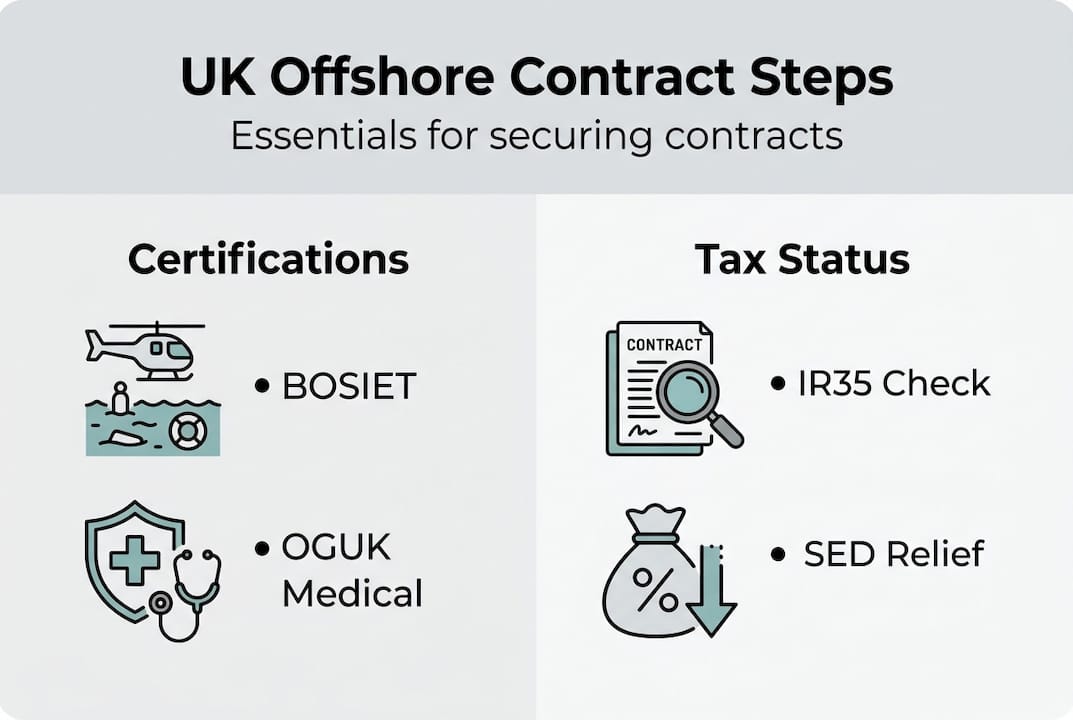
IR35 explained simply: IR35 is the off-payroll working legislation that determines whether HMRC treats you as an employee for tax purposes, even if your contract says otherwise. For medium and large clients, the IR35 status determination is the client's responsibility, not yours. If you are found to be inside IR35, income tax and National Insurance are deducted at source, reducing your take-home pay by 15 to 25%.
Key factors that push you outside IR35:
- No control: You decide how the work gets done
- Right of substitution: You can send a qualified replacement
- No mutuality of obligation: Neither party is locked into ongoing work
- Financial risk: You bear the cost of errors or poor work
The Seafarers' Earnings Deduction (SED) is a separate but equally important consideration. SED can offer 100% tax relief on qualifying earnings if you spend sufficient time working outside UK territorial waters. Tracking your qualifying days carefully using tools like Vantage or MAPS is essential for claiming this relief correctly.
| Payroll structure | Tax efficiency | Admin burden | IR35 relevance |
|---|---|---|---|
| Sole trader | High | Medium | Outside IR35 only |
| Umbrella company | Low to medium | Low | Inside or outside |
| Limited company | High | High | Outside IR35 only |
For tailored offshore IR35 guidance, understanding which structure suits your specific contract type can make a significant difference to your annual earnings.
Pro Tip: Always cross-check your contract wording against your actual daily working pattern. HMRC audits look at both. A contract that says you are outside IR35 but a working pattern that suggests otherwise is a red flag that can trigger a full investigation.
Maximising pay, security and progression in offshore roles
Understanding your legal and tax position, you can now focus on boosting your pay and long-term security. Offshore work rewards those who know their value and negotiate accordingly.

The average UK offshore oil worker earns £65,000 per year, with the North Sea supporting approximately 200,000 UK jobs across the sector. That is a substantial market, and knowing where you sit within it is the starting point for any negotiation.
Day rates vary significantly by role, experience, and sector. Renewables roles are increasingly competitive, and specialist technical contractors often command premium rates. To benchmark your position:
- Research published offshore day rates for your specific role and experience level
- Compare oil and gas rates against offshore wind equivalents
- Factor in rotation patterns, typically two weeks on and two weeks off, when calculating annual earnings
- Account for travel, accommodation, and subsistence allowances in your total package
Here are the steps to maximise stability and progression:
- Build a reputation with two or three key operators: Repeat work is more valuable than constantly chasing new clients.
- Upskill for renewables: The offshore wind sector is growing rapidly, and transferable skills from oil and gas are in demand.
- Negotiate rotation terms in writing: Verbal agreements on rotations are worthless. Get everything documented.
- Track your performance and certifications: Operators notice contractors who proactively manage their compliance.
- Review your rate annually: Market rates shift. If you have not renegotiated in two years, you are likely undercharging.
For career changers, the path is genuinely accessible. Mechanical, electrical, and construction skills translate well. The main gaps are usually certifications and fitness, both of which are fixable with the right preparation.
Why most offshore contracts fail UK professionals and how to avoid the pitfalls
After working through the facts and frameworks, here is a frank view on what actually goes wrong for UK offshore contractors.
The majority of contract failures do not stem from bad luck or a difficult client. They come from vague terms that nobody questioned at the point of signing, compliance gaps that were ignored until they became urgent, and a complete failure to track actual working practices against written contract terms. These are all avoidable.
The contractors who do best are not always the most technically skilled. They are the ones who treat their contract as a live document, not a formality. They review it, track it, and update it when the working reality shifts.
Career changers consistently underestimate the renewables opportunity. The offshore wind sector is not a consolation prize for those who cannot get oil and gas work. It is a genuinely well-paid, growing sector where transferable skills are actively sought. Ignoring it narrows your options unnecessarily.
For real-world offshore contract lessons grounded in actual industry experience, the most important thing you can do is combine your own preparation with expert review. No article replaces a specialist looking at your specific contract and working pattern.
The long-term cost of ignoring contractual clarity is not just financial. It is reputational. Operators talk. Contractors who create compliance problems, even unintentionally, find it harder to secure repeat work.
How Offstep can help you secure and improve your offshore contracts
Putting this guide into action is straightforward when you have the right support alongside you.

At Offstep, we work directly with individuals who are entering the offshore industry for the first time and with experienced contractors who want to strengthen their position. Whether you need clarity on certifications, help reviewing contract terms, or guidance on structuring your tax position correctly, our expert offshore contracting help is built around the realities of the UK sector. We offer free strategy calls for those who want to understand their options before committing to a programme, and structured mentorship for those ready to move fast. Your next offshore contract should work harder for you.
Frequently asked questions
What certifications are required for offshore contractors in the UK?
You will need BOSIET with CA-EBS, MIST, an OGUK medical, and potentially GWO BST if you are targeting offshore wind roles. Each has its own renewal timeline, so tracking expiry dates is essential.
How does IR35 affect UK offshore contracts?
If you are inside IR35, income tax and National Insurance are deducted at source by the client, reducing your take-home pay by 15 to 25% compared to operating outside IR35 through a limited company.
What is the Seafarers' Earnings Deduction (SED) and do I qualify?
SED can provide 100% income tax relief on qualifying earnings if you spend sufficient qualifying days working offshore outside UK territorial waters. You must track your days carefully to make a valid claim.
What are typical offshore work rotations and pay?
Most contractors work a two weeks on and two weeks off rotation, with average annual pay of £65,000 in oil and gas roles. Renewables and specialist technical roles can command higher rates depending on experience.
How can I make my offshore contract more tax-efficient?
Choose the right payroll structure for your IR35 status, track your qualifying days for SED, and get specialist advice to ensure your contract wording matches your actual working pattern.