

Securing offshore work in the UK energy sector is genuinely competitive. Employers receive hundreds of applications for every vacancy, and most CVs are screened in under 30 seconds before a decision is made. If your CV does not immediately signal the right certifications, experience, and sector knowledge, it will be passed over regardless of your actual ability. This article walks you through the practical steps to build a CV that gets noticed, from listing the correct qualifications to optimising your LinkedIn profile and connecting with the right recruiters.
Table of Contents
- Identify key selection criteria for offshore roles
- Essential certifications and qualifications to highlight
- Showcase transferable skills and sector adaptability
- Optimise CV formatting, keywords and LinkedIn presence
- Network strategically with recruiters and professional groups
- Summary comparison: CV checklist for offshore roles
- Get tailored help with your offshore CV
- Frequently asked questions
Key Takeaways
| Point | Details |
|---|---|
| Certifications matter most | Always list and attach key certificates like BOSIET and OGUK medical to your CV. |
| Highlight transferable skills | Show adaptability (e.g., oil-to-renewables) by emphasising engineering, HSE, and continuous development. |
| Leverage LinkedIn and recruiters | Optimise your profile and network actively with specialist recruiters to maximise employment chances. |
| Use clear CV formatting | Structure your CV for easy reading, use sector keywords, and bullet achievement points for maximum impact. |
Identify key selection criteria for offshore roles
Before you write a single word on your CV, you need to understand what offshore employers are actually looking for. The criteria are specific, and guessing will cost you interviews.
UK offshore employers consistently prioritise the following:
- Valid safety certifications such as BOSIET (Basic Offshore Emergency Training)
- A current OGUK medical certificate confirming offshore fitness
- Relevant engineering, technical, or HSE (Health, Safety and Environment) experience
- Demonstrated adaptability across sectors, particularly oil and gas to renewables
- Evidence of continuous professional development and upskilling
As offshore role criteria confirm, UK offshore employers value certification, medical fitness, and sector-specific experience above almost everything else. A CV that does not address these points directly will rarely progress past the initial screening stage.
"The offshore sector rewards candidates who can prove they are safe, competent, and ready to work from day one. Employers do not have time to train people in the basics."
Pro Tip: Read each job description carefully and mirror the exact language used for required qualifications and skills. Many applications are filtered by keyword matching before a human ever reads them.
With these criteria in mind, let us break down how to express them clearly on your CV.
Essential certifications and qualifications to highlight
Certifications are the first thing a recruiter checks on an offshore CV. Missing or poorly presented qualifications will end your application immediately.
Here are the core certifications you must include:
- BOSIET (Basic Offshore Emergency Training, including HUET)
- OGUK medical certificate (current and valid)
- MIST (Minimum Industry Safety Training)
- H2S awareness certification if applicable
- Sector-specific qualifications such as GWO BST (Global Wind Organisation Basic Safety Training) for renewables
- Any relevant engineering licences or trade qualifications
According to UK offshore certifications guidance, copies of key certificates including BOSIET and OGUK medical should be included with applications wherever possible. Submit them as clearly labelled PDF attachments when applying by email.

| Certification | Relevance | Validity period |
|---|---|---|
| BOSIET | Mandatory for most offshore roles | 4 years |
| OGUK medical | Required for all offshore workers | 2 years |
| MIST | Industry safety standard | 3 years |
| GWO BST | Essential for wind energy roles | 2 years |
| H2S awareness | Required for oil and gas sites | Varies |
Avoid padding your CV with outdated or irrelevant qualifications. A first aid certificate from 2009 adds no value and takes up space that could be used for something meaningful.
Pro Tip: Create a dedicated "Certifications" section near the top of your CV, directly below your personal profile. Recruiters should not have to hunt for this information.
Certifications are only part of the picture. The way you present your experience matters just as much.
Showcase transferable skills and sector adaptability
The UK energy sector is changing rapidly. Oil and gas professionals are increasingly expected to demonstrate relevance in renewables, carbon capture and storage (CCS), and hydrogen projects. Your CV needs to reflect this shift.
Key transferable skills to highlight include:
- HSE culture and safety leadership: Offshore employers treat safety as non-negotiable
- Engineering and technical expertise: Mechanical, electrical, and instrumentation skills transfer well across sectors
- Project management: Coordinating offshore operations, maintenance schedules, and crew logistics
- Problem-solving under pressure: Demonstrating calm, effective decision-making in demanding environments
- Communication and teamwork: Working in confined, high-stakes environments requires strong interpersonal skills
The transferable offshore skills framework recommends emphasising HSE culture and engineering competencies for wind, CCS, and hydrogen roles, alongside evidence of continuous learning. If you have completed any upskilling courses in these areas, list them explicitly.
| Oil and gas skill | Renewables equivalent |
|---|---|
| Rig safety management | Wind turbine HSE protocols |
| Subsea engineering | Offshore wind foundation work |
| Pipeline inspection | Cable and array maintenance |
| Emergency response | Marine coordination and rescue |
Frame your achievements with numbers wherever possible. "Reduced equipment downtime by 18% over six months" is far more compelling than "responsible for maintenance."
Pro Tip: Add a short "Career development" subsection to your CV listing any recent courses, webinars, or industry events. It signals that you are proactive and engaged with where the sector is heading.
Once you have highlighted your qualifications and skills, optimising your CV format is crucial.
Optimise CV formatting, keywords and LinkedIn presence
A well-structured CV is easier to read and more likely to pass through ATS (Applicant Tracking System) screening. ATS software scans CVs for specific keywords before a recruiter ever sees them. If your CV lacks the right terms, it will be filtered out automatically.
Follow these formatting principles:
- Use reverse chronological order for your work history, most recent role first
- Keep your CV to two pages maximum for most roles
- Use bullet points for achievements rather than dense paragraphs
- Choose a clean, professional font such as Arial or Calibri at 10 to 12 point size
- Include a concise personal profile at the top summarising your offshore experience and key certifications
- Incorporate sector keywords such as "BOSIET certified," "offshore HSE," "OGUK medical," and "dynamic positioning" where relevant
Your LinkedIn profile deserves equal attention. Optimising LinkedIn profiles with sector-specific keywords and joining relevant professional groups significantly increases your visibility to offshore recruiters. Studies suggest that recruiters spend an average of just 7 seconds reviewing a LinkedIn profile before deciding whether to engage further, so your headline and summary must be sharp.
Pro Tip: Use your LinkedIn headline to list your top certification and target role, for example: "BOSIET Certified Offshore Mechanical Engineer | Seeking North Sea Roles." This makes you immediately searchable.
For broader offshore networking tips, connecting with the right people online is just as important as having a polished CV.
Network strategically with recruiters and professional groups
Your CV gets you noticed. Your network gets you hired. Many offshore roles in the UK are filled through direct recruiter relationships before they are ever advertised publicly.
Here is how to build that network effectively:
- Connect with specialist offshore recruiters such as Visuna and WTS Energy, who focus specifically on the UK offshore market
- Join LinkedIn groups dedicated to offshore oil and gas, renewables, and North Sea operations
- Engage with professional bodies such as the Energy Institute or the Society of Petroleum Engineers
- Reach out to alumni networks from your training providers or previous employers
- Attend industry events such as Offshore Europe or All-Energy to meet recruiters face to face
As specialist offshore recruiters guidance notes, using LinkedIn groups and specialist recruiters like Visuna and WTS Energy is one of the most effective strategies for securing offshore positions in the UK.
"A warm introduction from a recruiter who already knows your profile is worth ten cold applications. Build the relationship before you need the job."
When making initial contact with a recruiter, keep your message brief and specific. Mention your key certification, your target role, and your availability. Do not send a generic message asking if they have any jobs.
Pro Tip: After connecting with a recruiter on LinkedIn, follow up with a short voice note or personalised message referencing something specific about their recent posts or placements. It stands out in a sea of copy-paste messages.
For more offshore recruiter advice, understanding how to position yourself with the right agencies can significantly shorten your job search.
Summary comparison: CV checklist for offshore roles
Use this table to cross-check your CV before submitting any application.
| CV element | Why it matters | Priority level |
|---|---|---|
| BOSIET and OGUK medical | Mandatory for most roles | Critical |
| Sector-specific certifications | Demonstrates role readiness | High |
| Transferable skills section | Shows adaptability | High |
| Reverse chronological work history | Easy for recruiters to follow | High |
| ATS-friendly keywords | Passes automated screening | High |
| LinkedIn profile optimised | Increases recruiter visibility | Medium |
| Specialist recruiter contacts | Access to unadvertised roles | Medium |
| Continuous learning evidence | Signals proactive attitude | Medium |
Last-minute CV checks before you apply:
- Have you listed all current certifications with expiry dates?
- Is your OGUK medical certificate valid and attached?
- Does your personal profile mention your target role and top qualification?
- Have you used sector keywords throughout the document?
- Is your LinkedIn profile consistent with your CV?
- Have you removed any outdated or irrelevant qualifications?
- Is the document saved as a clearly named PDF?
Get tailored help with your offshore CV
Putting all of this into practice takes time, and it is easy to miss something important when you are doing it alone. That is where specialist support makes a real difference.
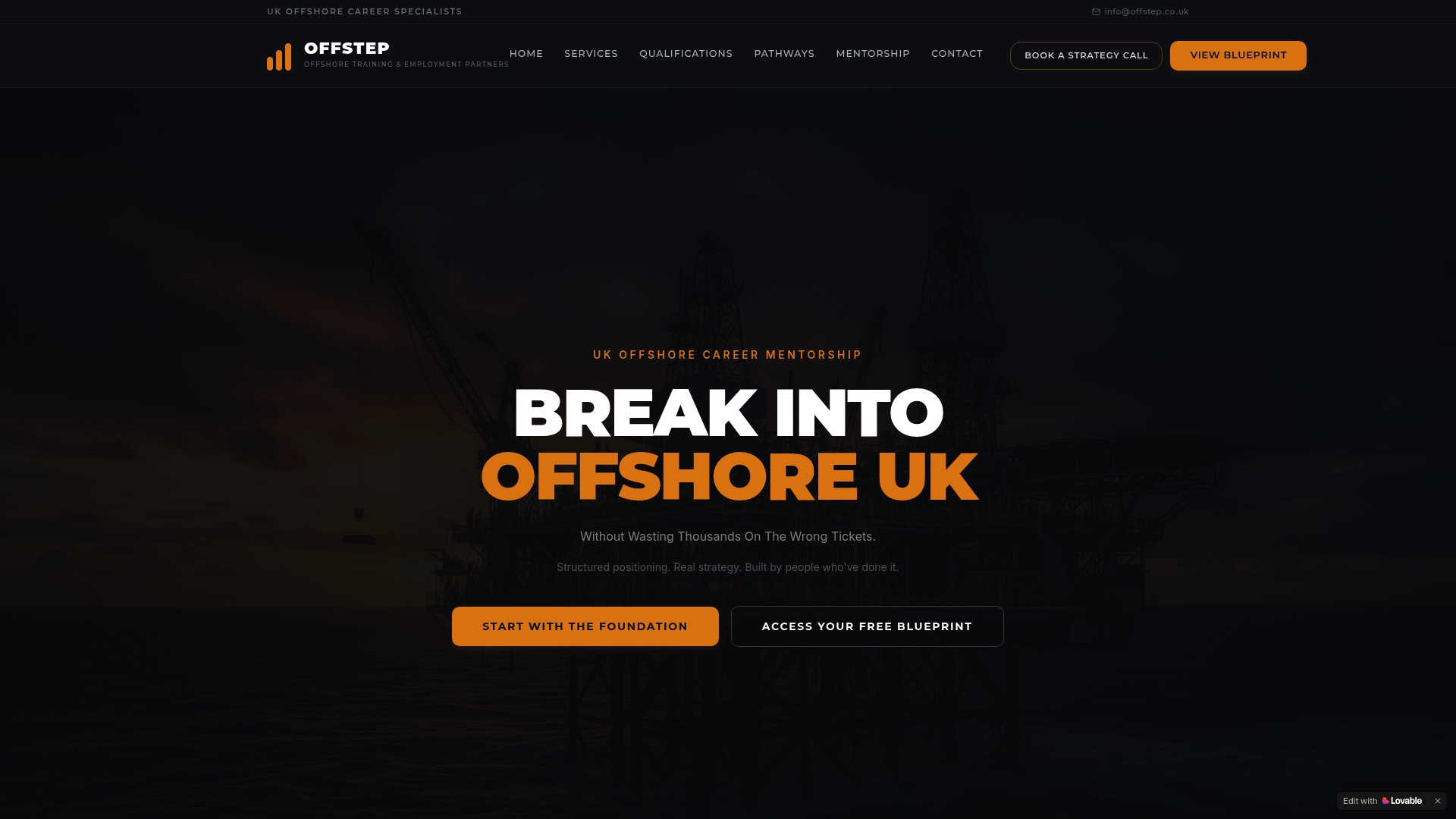
Offshore CV support from Offstep UK gives you access to expert guidance built specifically for the UK offshore energy sector. Whether you are entering the industry for the first time or looking to move into renewables from oil and gas, the platform offers CV optimisation, recruiter connections, certification pathway advice, and mentorship from people who have actually worked offshore. You do not have to figure this out by yourself. Visit Offstep UK today and take the next step towards securing the offshore role you are working towards.
Frequently asked questions
What certifications must I include in a UK offshore CV?
Always include BOSIET, your OGUK medical certificate, and any sector-specific qualifications relevant to the role. Key certs should be included as attachments or copies wherever the application process allows.
How should I demonstrate transferable skills for renewables?
Highlight engineering competencies, HSE experience, and any training in wind, CCS, or hydrogen projects. Transferable skills for wind/CCS are increasingly valued as the sector transitions away from purely oil and gas operations.
Is LinkedIn important for offshore jobseekers?
Yes, absolutely. LinkedIn optimisation with keywords and active participation in relevant groups significantly raises your visibility with offshore recruiters who use the platform daily.
Should I use a specialist recruiter or apply directly?
Doing both gives you the best chance. Specialist recruiters for offshore roles understand the UK market and often have access to vacancies that are never publicly advertised.