
TL;DR:
- Certifications backed by recognized bodies like OPITO or NOGEPA are essential for offshore employability.
- BOSIET is the primary qualification for offshore workers, valid for four years with a required refresher.
- Targeted, current certifications relevant to your region and role are more valuable than multiple miscellaneous courses.
Getting hired offshore is not simply about turning up with a hard hat and a willingness to work. Recruiters and operators screen candidates fast, and the first filter is nearly always your certification stack. With thousands of people competing for rig roles, platform positions, and support contracts every year, the right qualifications are the difference between a callback and silence. This guide walks you through how to evaluate offshore certifications, covers the essential ones in detail, compares the leading options side by side, and helps you build a targeted plan that actually moves your career forward.
Table of Contents
- How to evaluate offshore qualifications
- BOSIET: The foundation for every offshore worker
- Alternative and advanced offshore qualifications
- Comparison: Which qualifications do offshore companies prefer?
- Why your qualification choice matters more than you think
- Take your offshore career further with trusted partners
- Frequently asked questions
Key Takeaways
| Point | Details |
|---|---|
| Prioritise OPITO centres | Global employers recognise OPITO certificates, giving you flexibility and credibility. |
| Stay on top of renewals | Ensure you complete your FOET refresher before your BOSIET expires to avoid extra costs. |
| Pick the right certification | Match your course to your job and region to avoid unnecessary spending or missed opportunities. |
| Regional variances matter | Check for modules like CA-EBS if you work in the UK or North Sea to remain compliant. |
How to evaluate offshore qualifications
Not every certificate carries the same weight. Before you spend money on training, you need a clear framework for judging which qualifications will genuinely improve your employability and which ones will collect dust in a folder.
The single most important factor is recognition. Certifications backed by established bodies like OPITO (Offshore Petroleum Industry Training Organisation) or NOGEPA are accepted across multiple operators and regions. A certificate from an unaccredited provider may satisfy one employer and be rejected by the next. Always validating offshore emergency training certificates through the issuing body before you book a course.
Here is what to assess before committing to any qualification:
- Regulatory alignment: Does the certification meet the legal requirements for your target region, such as the UK Continental Shelf or the Dutch sector?
- Operator acceptance: Many major operators publish their own approved training lists. Check these before enrolling.
- Scope of coverage: Does the course include all the modules your role demands, including specialised units like CA-EBS (Compressed Air Emergency Breathing System)?
- Renewal pathway: Is there a refresher route, or will you need to retake the full course when it expires?
- Cost versus market value: A more expensive OPITO-approved course often pays back faster in job offers than a cheaper, less recognised alternative.
The gap between minimum and competitive qualifications is real. Minimum means you meet the legal threshold. Competitive means operators actively prefer you. OPITO-approved centres for BOSIET ensure global recognition, which matters enormously if you plan to work across multiple regions or with international contractors.
Pro Tip: Always check for the most updated syllabus when booking. Some courses have added regional modules, such as the CA-EBS unit, and older versions of the same certificate may not satisfy current operator requirements.
BOSIET: The foundation for every offshore worker
If there is one qualification that appears on virtually every offshore job description, it is BOSIET (Basic Offshore Safety Induction and Emergency Training). Think of it as the entry ticket to the offshore world. Without it, most operators will not even consider your application.
BOSIET covers four core areas:
- Safety induction: Offshore hazard awareness, permit-to-work systems, and emergency procedures.
- Firefighting: Practical fire suppression techniques using offshore-specific equipment.
- Sea survival: Liferaft deployment, survival in water, and helicopter ditching scenarios.
- CA-EBS: Use of compressed air emergency breathing systems, mandatory for helicopter transport in many regions post-2014.
BOSIET certification is valid for four years, after which you must complete a FOET (Further Offshore Emergency Training) refresher to maintain your certification without retaking the full course.
The FOET refresher is significantly shorter and cheaper than the original BOSIET. However, the critical detail most people miss is timing. If your BOSIET lapses before you complete the FOET, you lose the refresher option entirely and must sit the full course again. That is an avoidable cost and delay.
OPITO approval is what gives BOSIET its international currency. An OPITO-accredited training centre follows a standardised syllabus, meaning your certificate is recognised whether you are working in the North Sea, West Africa, or Southeast Asia. Non-OPITO providers may be cheaper, but their certificates are frequently rejected outside their home market.
The CA-EBS module post-2014 became a requirement for helicopter operations in certain regions, particularly the UK sector. If your BOSIET predates this change, check whether your certificate includes it. Many operators now treat it as non-negotiable for any role involving helicopter transfers.
Pro Tip: Book your FOET refresher at least three months before your BOSIET expiry date. Training centres fill up quickly, and leaving it too late is one of the most common and costly mistakes in offshore career management. You can find practical guidance on offshore training best practices to help you stay ahead of renewal deadlines.
Alternative and advanced offshore qualifications
BOSIET is the baseline, but it is not the whole picture. Depending on your target region, your role, and your career ambitions, you will likely need additional or alternative certifications.
HUET (Helicopter Underwater Escape Training) is sometimes used as a standalone qualification in regions where the full BOSIET is not mandated. It covers helicopter ditching and underwater escape only. In the US Gulf of Mexico, non-OPITO HUET variants are common, while OPITO dominates the North Sea and NOGEPA covers the Dutch sector. Knowing which standard your target operator uses before you book saves both time and money.
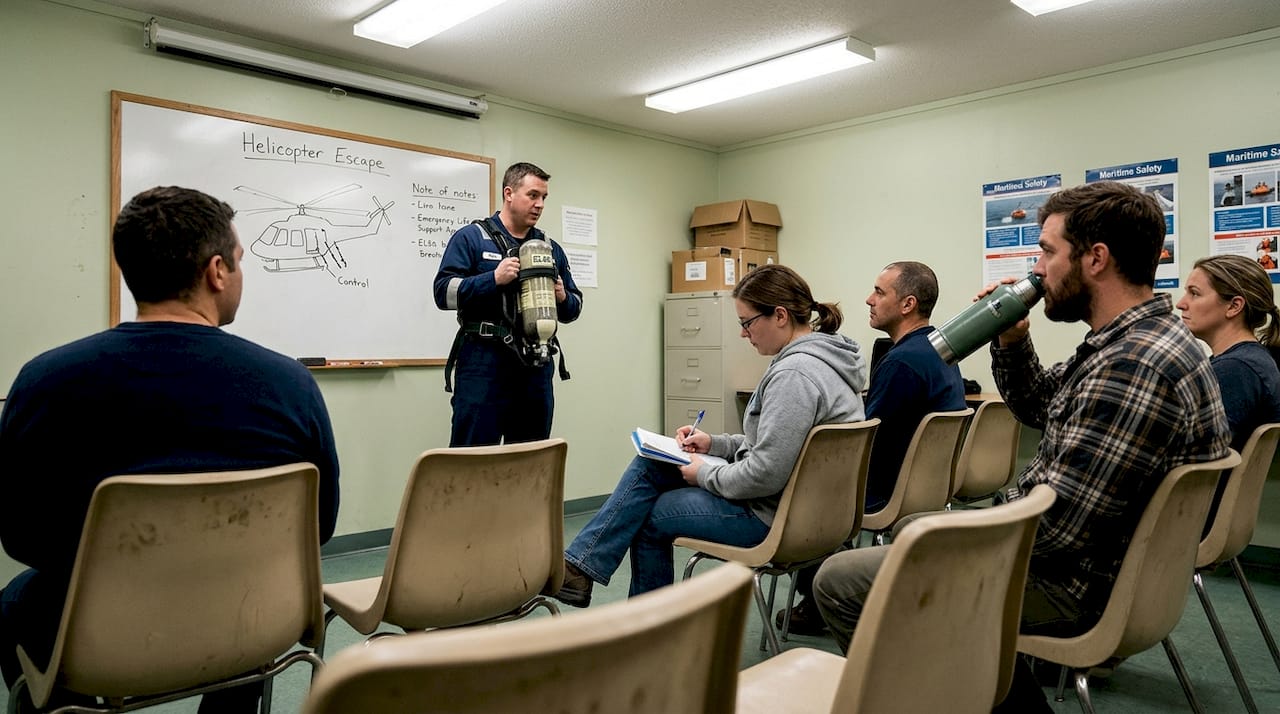
NOGEPA is the Dutch equivalent of BOSIET and is required for work on the Dutch Continental Shelf. If you plan to work with Dutch operators or on cross-border projects, NOGEPA certification alongside your BOSIET significantly broadens your options.
Beyond the baseline, advanced and stackable qualifications include:
- MIST (Minimum Industry Safety Training): Required for onshore oil and gas sites in the UK, sometimes requested for nearshore roles.
- GWO BST (Global Wind Organisation Basic Safety Training): Essential for offshore wind roles, covering manual handling, first aid, fire awareness, sea survival, and working at height.
- OPITO MFOET: Advanced firefighting refresher for emergency response team members.
- Offshore medic certification: Required for dedicated medic roles; typically involves a recognised pre-hospital care qualification plus offshore-specific modules.
- IWCF/IADC well control: Critical for drilling roles, covering well pressure management and blowout prevention.
- Rigging and lifting certificates: Valued for deck crew and crane operator positions.
You can explore a full offshore qualifications overview to match these certifications to specific job families and understand which combinations operators look for most.
Comparison: Which qualifications do offshore companies prefer?
Choosing between certifications becomes clearer when you see them side by side. Here is a direct comparison of the three most common baseline qualifications:
| Qualification | Validity | Core modules | Main markets | Approximate cost |
|---|---|---|---|---|
| BOSIET (OPITO) | 4 years | Safety, fire, sea survival, CA-EBS | UK, Norway, West Africa, Asia-Pacific | £800 to £1,200 |
| HUET (non-OPITO) | Varies | Helicopter underwater escape only | US Gulf of Mexico | £200 to £400 |
| NOGEPA | 4 years | Safety, fire, sea survival, Dutch-specific modules | Dutch Continental Shelf | £700 to £1,000 |
The table makes one thing clear: BOSIET offers the widest market coverage for the investment. HUET is cheaper but narrower. NOGEPA is essential for Dutch sector work but less useful elsewhere.
Operator requirements vary by region and company, so always verify before booking. A certificate that satisfies one major operator may not satisfy another working in the same field.
Here is a practical action plan for deciding which qualification you need:
- Identify your target region: North Sea, Dutch sector, US Gulf, or elsewhere. This narrows your options immediately.
- Research two or three target operators: Download their supplier or contractor requirements and note which certifications they list as mandatory.
- Check job boards: Search for roles matching your trade and note which certificates appear in 80% or more of listings.
- Assess your current stack: Identify gaps between what you hold and what operators require.
- Book in order of priority: Start with the qualification that unlocks the most opportunities, typically BOSIET for UK and international roles.
You can get tailored guidance on offshore company requirements to make sure your plan reflects current operator expectations rather than outdated assumptions.
Why your qualification choice matters more than you think
Most guides stop at listing certifications. Here is what they rarely say: collecting the wrong qualifications is just as damaging as having none at all.
We have seen candidates spend thousands of pounds on certificates that their target operators simply do not recognise. They assumed that more training equals more employability. It does not. What matters is targeted, current, and regionally relevant training. A candidate with BOSIET, a relevant trade certificate, and a GWO BST for offshore wind will outperform someone with five miscellaneous safety courses every single time.
The other trap is letting qualifications lapse through poor planning. An expired BOSIET does not just inconvenience you. It removes you from consideration entirely until you retake the full course, which can take weeks to arrange and costs significantly more than a timely FOET refresher.
The professionals who build strong offshore careers treat their qualification portfolio like a business asset. They audit it annually, track expiry dates, and align new certifications with where the market is heading, not where it was five years ago. Offshore wind is growing fast. Decommissioning is expanding. If your certification plan still only reflects traditional oil and gas, you are narrowing your options unnecessarily.
Using professional service validation tips to sense-check your portfolio against live operator requirements is one of the most underused strategies in offshore career planning.
Take your offshore career further with trusted partners
Knowing which qualifications you need is only half the challenge. Booking the right course, through an accredited provider, at the right time, while aligning it with your broader career plan, is where most candidates struggle.
At Offstep UK, we help aspiring and transitioning offshore professionals cut through the confusion. From identifying which offshore qualifications services match your target roles to connecting you with OPITO-approved training centres and validating your existing certificates, our team provides the structured support that turns a qualification plan into real job offers. Whether you are starting from scratch or looking to advance, book a free strategy call today and get a clear, personalised roadmap for your offshore career.
Frequently asked questions
How long is BOSIET certification valid?
BOSIET certification is valid for four years; you must complete the FOET refresher before it expires, or you will need to retake the full BOSIET course from scratch.
What is the difference between BOSIET and HUET?
BOSIET is the full basic offshore survival course covering safety, fire, sea survival, and CA-EBS; HUET covers only helicopter underwater escape and is used as a regional alternative primarily in the US Gulf of Mexico.
Is OPITO approval necessary for offshore work?
OPITO approval is strongly preferred for international roles, particularly in the North Sea, because OPITO-approved centres ensure your certificate is recognised across multiple operators and regions.
What happens if my BOSIET expires?
If your BOSIET lapses, the FOET refresher option is no longer available and you must retake the full BOSIET course, which costs significantly more and takes longer to complete.