

TL;DR:
- Many offshore roles now prioritize skills and certifications over years of experience due to an industry talent shortage. Entry pathways like apprenticeships, Greenhand schemes, and transferable onshore skills offer practical routes into the sector. The industry is increasingly adopting competency-based hiring, valuing practical ability and attitude alongside traditional experience.
The offshore industry has long carried a reputation for being a closed shop, reserved for those with years of rig time and a thick stack of certifications. But that picture is changing fast. 80% of offshore employers now face hiring challenges, largely because the workforce is ageing and not enough new talent is coming through. If you've been told you need a decade of experience before anyone will look at you, this guide is here to challenge that. We'll walk through how experience is actually weighed, what transferable skills count for, and the practical routes available to you right now.
Table of Contents
- Why experience still matters: industry hiring pressures
- Pathways for those with limited experience
- How transferable are onshore skills and certifications?
- Experience vs skills: what do offshore employers actually want?
- A fresh look: why experience isn't always the deal-breaker
- Take the next step in your offshore career
- Frequently asked questions
Key Takeaways
| Point | Details |
|---|---|
| Skills shortage opens doors | Aging offshore workforce means more chances for those with less direct experience. |
| Mentorship programmes matter | Entry schemes like ECITB, OPITO and Greenhand offer structured on-the-job development. |
| Transferable skills valued | Onshore engineering and technical experience transfer easily with proper certification. |
| Skills-based hiring is rising | Employers increasingly look for practical abilities, not just years in the industry. |
Why experience still matters: industry hiring pressures
The offshore oil and gas sector is facing a genuine talent crisis. It's not just a matter of a few vacancies here and there. The problem runs deep, and it's creating real openings for people who might previously have been overlooked.
Nearly half the workforce is over 50 years old, and with retirements accelerating, operators are scrambling to replace experienced hands. That pressure means employers are increasingly willing to look at candidates who show potential, not just a long CV. The talent gap is, in a strange way, your opportunity.
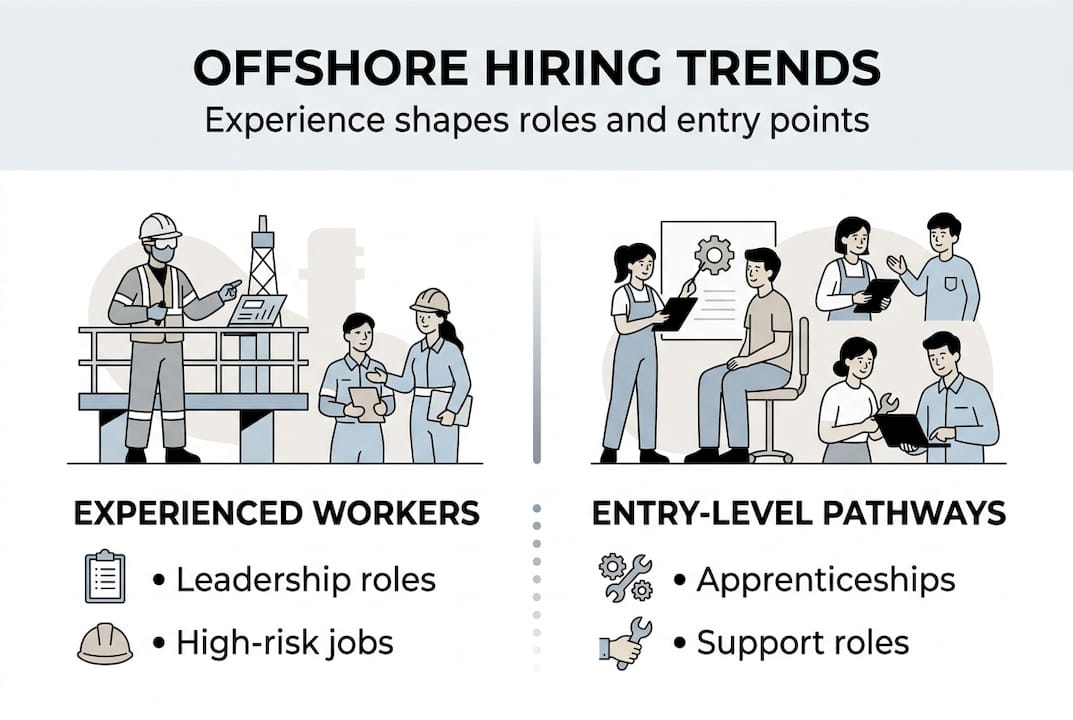
Here's a quick look at how offshore compares to renewables in terms of pay and demand:
| Factor | Offshore oil and gas | Offshore renewables |
|---|---|---|
| Average starting salary | £35,000 to £50,000 | £28,000 to £40,000 |
| Experience required | Moderate to high | Low to moderate |
| Growth rate | Steady | Rapidly growing |
| Certification overlap | High | High |
"The offshore sector cannot afford to wait for perfectly experienced candidates. The pipeline of talent must be built now, or operations will suffer within the decade."
The key roles most affected by this shortage include:
- Mechanical and electrical technicians with transferable onshore backgrounds
- Scaffolders and riggers willing to complete offshore safety training
- HSE officers moving from construction or manufacturing
- Catering and logistics support roles with no prior offshore requirement
- Trainee instrument technicians entering via apprenticeship routes
For younger candidates, the opportunities for under 30s are particularly strong right now. Operators know they need to invest in the next generation, and many are actively building entry pipelines to do exactly that. Experience still matters for complex roles, but the industry's survival depends on bringing in fresh talent and training them up properly.
The pay premium in oil and gas remains significant compared to renewables. That gap is a strong incentive for career changers willing to put in the work to get certified and get started.
Pathways for those with limited experience
So how do people with little or no offshore experience actually break in? The good news is that several well-established routes exist, and each one is designed to take you from where you are now to where you want to be.
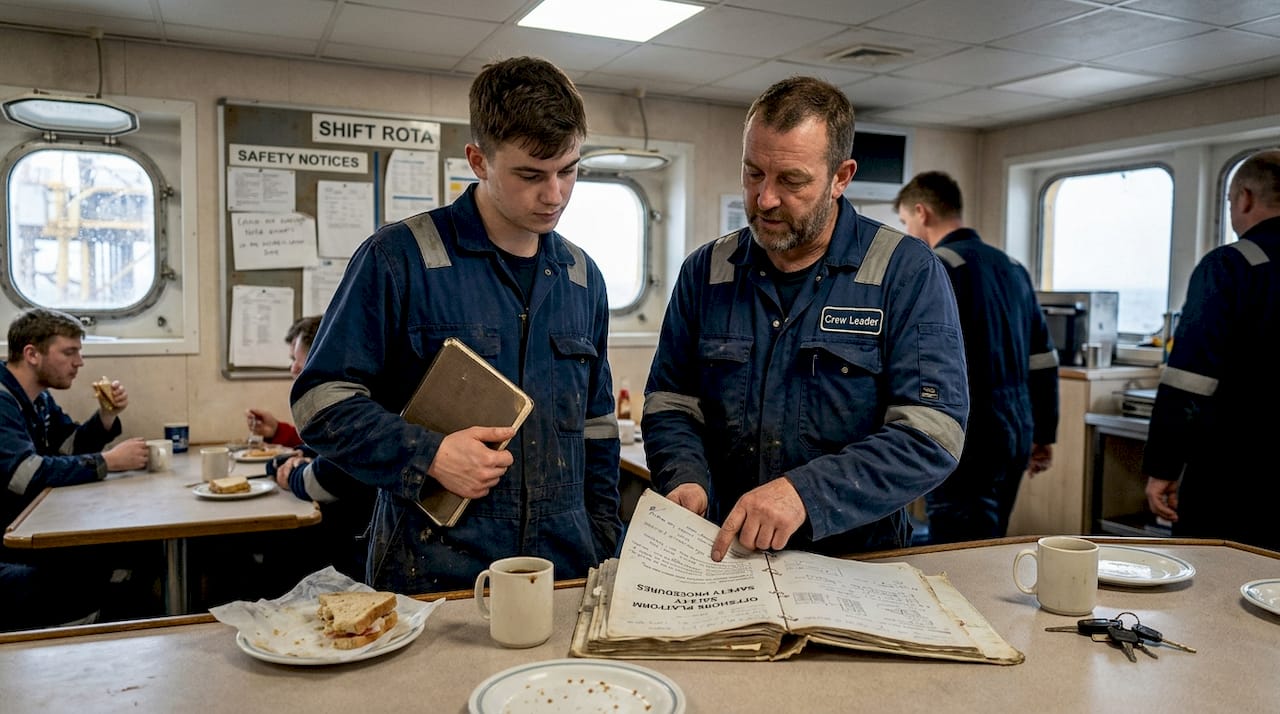
Mentorship through on-the-job training in apprenticeships and early-career rotations is one of the most effective ways to build offshore-ready skills. These programmes structure your learning around real work, so you're not just sitting in a classroom. You're gaining practical competence alongside experienced colleagues.
Here's how the main entry routes compare:
| Route | Time to first offshore role | Mentorship level | Cost to candidate |
|---|---|---|---|
| ECITB apprenticeship | 2 to 4 years | High | Low (funded) |
| OPITO Greenhand scheme | 6 to 12 months | High | Low to medium |
| Direct hire with certs | 3 to 6 months | Medium | Medium |
| Self-funded training | 1 to 3 months | Low | High |
The numbered steps below show the most practical sequence for a new entrant:
- Assess your current skills and identify which offshore roles they map to
- Complete your core safety certifications, starting with BOSIET or GWO BST
- Apply for structured career programmes that include mentorship and job placement support
- Target ECITB or OPITO apprenticeships if you want a funded, structured route
- Build your offshore CV with any relevant onshore project experience highlighted
- Apply to Greenhand schemes, which are specifically designed for first-timers
Pro Tip: Don't overlook support roles as your entry point. Catering assistants, storekeepers, and logistics coordinators often work offshore without needing heavy technical backgrounds. Once you're on the platform, you can cross-train into technical roles far more easily.
ECITB and OPITO apprenticeships remain the gold standard for structured entry. They combine formal training with real mentorship and are recognised by virtually every major operator in the UK sector. If you can get onto one, do it.
How transferable are onshore skills and certifications?
One of the biggest misconceptions is that offshore work is so specialised that nothing from your onshore career counts. That's simply not true. In fact, technical skills transfer 90% across sectors when paired with the right industry certifications.
If you've worked in mechanical engineering, electrical installation, construction, or HSE management, you already have a foundation that offshore employers recognise. The gap is usually a handful of offshore-specific certifications, not a complete career rebuild.
Here are the skills and backgrounds that transfer most effectively:
- Mechanical and pipefitting experience from oil refineries or industrial plants
- Electrical and instrumentation work from manufacturing or utilities
- Health and safety qualifications such as NEBOSH or IOSH
- Welding and fabrication from construction or shipbuilding backgrounds
- Project management skills from any large-scale engineering environment
Pro Tip: If you already hold industry-standard certifications from onshore work, get them formally assessed against OPITO or ECITB frameworks before you apply. You may need fewer top-up courses than you think, which saves both time and money.
The additional offshore-specific training you'll typically need includes BOSIET (Basic Offshore Safety Induction and Emergency Training), medical clearance, and possibly a role-specific competency assessment. For most technically qualified candidates, that's a matter of weeks, not years.
Renewables is also growing rapidly, and the certification overlap with traditional oil and gas is high. If you're considering wind farm or tidal energy roles, your existing technical background is just as relevant there.
Experience vs skills: what do offshore employers actually want?
This is the question that keeps most career changers up at night. The honest answer is: it depends on the role, but the balance is shifting.
For complex deepwater operations, subsea engineering, and high-risk safety-critical roles, experience genuinely matters. Employers in those areas want people who've seen problems before and know how to handle them under pressure. That's not going to change overnight.
But for a wide and growing range of roles, skills-based hiring is growing, particularly in renewables and support functions. Employers are increasingly assessing what you can actually do, not just counting the years on your CV.
Here's how the preference breaks down:
- High experience required: Deepwater drilling, subsea operations, well control, complex HSE management
- Balanced experience and skills: Maintenance technician roles, scaffolding, rigging, inspection
- Skills and potential prioritised: Renewables technician, catering, logistics, entry-level support
- Certifications as the primary filter: Rope access, electrical, HVAC, and instrumentation roles
"Competency-based frameworks are replacing the old 'years served' mentality in many parts of the sector. Employers want evidence of what you can do, not just where you've been."
For career changers, this shift is significant. If you can demonstrate practical competence through certifications, assessments, and a well-presented CV, you can compete with candidates who have more offshore time. The key is presenting your skills in the right language and targeting the right roles for your current level.
A fresh look: why experience isn't always the deal-breaker
Here's something the job boards won't tell you. The offshore industry's obsession with experience has, for years, been partly a gatekeeping mechanism rather than a genuine operational requirement. Many roles that demanded five years of offshore time could have been filled by a well-trained, motivated newcomer. The industry is only now acknowledging that openly, because it has no choice.
The most effective offshore workers we've seen come through structured programmes weren't always the most experienced. They were adaptable, willing to ask questions, and took mentorship seriously. Attitude and coachability matter enormously in a high-stakes, team-dependent environment.
Many of today's senior offshore engineers and installation managers started in entry-level positions with no offshore background. What separated them wasn't a head start in experience. It was how seriously they took every learning opportunity once they were on the platform.
The sector genuinely needs fresh perspectives right now. Energy transition, new technologies, and changing safety standards mean that experience from ten years ago doesn't always apply cleanly to today's operations. Newcomers who arrive with current training and an open mind often outperform veterans who are resistant to change. Don't let the experience myth hold you back from starting.
Take the next step in your offshore career
Understanding the landscape is one thing. Taking action is another. If you're serious about breaking into the offshore industry or accelerating a career that's stalled, the right support makes all the difference.
At mentorship and training with Offstep UK, we work directly with people at every stage of their offshore journey, from those with zero experience to those looking to move into senior roles. Our structured programmes cover certification guidance, CV optimisation, and direct mentorship from professionals who've worked in the UK offshore sector. You don't need to figure this out alone. Book a free strategy call and find out exactly which route suits your background and goals.
Frequently asked questions
Do I need offshore experience to get my first job?
No, many employers value relevant technical skills, certifications, and a willingness to start in entry-level training schemes. Apprenticeships and early-career rotations are specifically designed to bring in candidates without prior offshore time.
Which offshore entry routes offer the best mentorship?
ECITB and OPITO apprenticeships, plus Greenhand programmes, provide direct mentorship and hands-on learning for starters. These routes are widely recognised by UK operators and offer the most structured support for new entrants.
How well do onshore skills transfer to offshore work?
Technical skills transfer at 90% across sectors when paired with the correct industry certifications. Most technically qualified candidates only need a small number of offshore-specific top-up courses before they're eligible to apply.
Is experience more important in oil and gas than renewables?
Experience is critical for high-risk oil and gas roles such as deepwater drilling, but skills-based hiring is growing rapidly in renewables. Practical skills and transferable knowledge are highly valued across both sectors for entry and mid-level positions.