

TL;DR:
- Entry-level offshore rig roles in the UK primarily require safety certifications and physical fitness, not extensive experience.
- Success depends on demonstrating safety awareness, reliability, honest attitude, and understanding offshore rotations.
- Proper preparation includes obtaining certifications, tailoring your CV, practicing interview questions, and building physical and mental resilience.
Landing your first offshore rig role in the UK is not easy, but it is far more achievable than most people assume. The candidates who succeed are rarely those with the most experience on their CV. They are the ones who walk into the interview room having done the work beforehand: holding the right certifications, understanding how rotations operate, and projecting the attitude that offshore employers actually look for. Whether you have spent years in construction or are fresh from a warehouse job, this guide covers exactly what you need to know about requirements, CV strategy, interview preparation, and building the physical and mental readiness that recruiters notice immediately.
Table of Contents
- Understand the requirements for UK offshore rig roles
- Prepare your CV and application for maximum impact
- Practice for common rig interview questions
- Demonstrate readiness: physical, mental and onshore prep
- What most rig interview guides miss
- Find your next step with Offstep UK
- Frequently asked questions
Key Takeaways
| Point | Details |
|---|---|
| Focus on certificates | Securing OGUK medical and OPITO BOSIET certifications is essential before applying. |
| Use transferable skills | Emphasise construction or warehouse experience, teamwork, and reliability on your CV. |
| Expect safety questions | Rig interviews prioritise safety attitudes and examples over technical knowledge. |
| Prepare physically | You must be ready for fitness tests, long shifts, and demanding work conditions. |
| Honesty stands out | Be open about your offshore experience and show genuine willingness to learn. |
Understand the requirements for UK offshore rig roles
Before you write a single word of your CV or book a single certification course, you need to understand what the industry requires. The good news is that the barrier to entry is clearer than you might expect, and much of it comes down to completing the right mandatory steps rather than having years of offshore experience behind you.
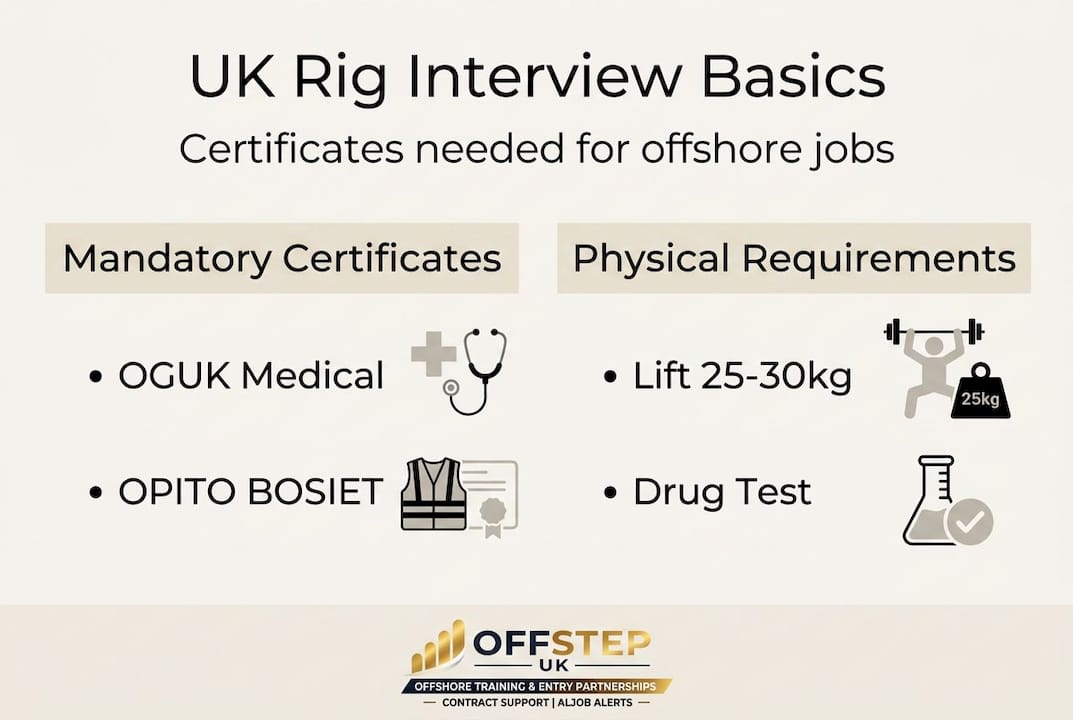
The two non-negotiable requirements for any UK offshore role are an OGUK medical certificate and an OPITO BOSIET certificate. The OPITO BOSIET (Basic Offshore Safety Induction and Emergency Training) is the standard safety qualification for offshore workers in the UK sector, valid for four years before a refresher is required. Without both of these documents, no reputable operator will even shortlist you.
| Requirement | Detail |
|---|---|
| OGUK medical | Offshore-specific fitness certificate |
| OPITO BOSIET | Mandatory safety training, valid 4 years |
| Age minimum | 18 years old |
| Education | High school diploma or equivalent |
| Physical standard | Ability to lift 25 to 30kg |
Beyond the certificates, entry-level roles like roustabout require you to be at least 18 years old, physically fit, and able to demonstrate a labour background. You do not need prior rig experience. What you do need is to be honest about where you are starting from, because recruiters have heard every exaggerated story and they respect straightforwardness far more than bluster.
Some additional qualifications that strengthen your profile include:
- GWO BST (Basic Safety Training, used in renewables but increasingly valued across offshore sectors)
- First aid certificate (any recognised UK provider)
- Forklift or manual handling certificates from previous employment
- H2S Alive or other gas safety awareness training
Pro Tip: Book your OGUK medical before your BOSIET course. If a medical issue prevents certification, you will have avoided paying for training you cannot yet use.
Being honest about your experience level in an application is not a weakness. It is a signal that you understand professional standards, which is exactly what safety-critical environments demand.
Prepare your CV and application for maximum impact
With your documents sorted, your CV becomes your first real opportunity to make an impression. The mistake most newcomers make is treating the lack of offshore experience as a gap they need to hide. Recruiters see through that approach instantly. Instead, the goal is to translate what you have done into the language offshore employers already speak.
Here is how to structure your approach:
- Lead with your certifications. Place your OGUK medical and BOSIET prominently near the top. This tells a recruiter immediately that you are cleared and ready.
- Highlight physical, labour-intensive roles. Construction, warehousing, agriculture, manufacturing, and logistics all demonstrate the kind of reliability and endurance that rig supervisors value.
- Frame teamwork with specifics. Do not just write "team player." Describe a situation where you coordinated a task with others under pressure or in a physically demanding setting.
- Include any safety training. Even a manual handling course from a previous employer signals that you take safety seriously.
- Tailor each application. Research the specific company and mention relevant operational areas such as the North Sea or any service line they operate in.
Recruiters looking at entry-level applications are assessing work ethic and reliability far more than technical knowledge. An offshore roustabout role is, at its core, about doing hard physical work safely, consistently, and without complaint. Your CV needs to prove you understand that.
Worth knowing: Around 70% of offshore hiring decisions at entry level are influenced by attitude indicators in both the CV and interview, not prior rig-specific qualifications.
Pro Tip: Add a short personal statement at the top of your CV that mentions rotations by name, such as 14/14 or 28/28. This shows you understand how offshore life actually works and that you are genuinely prepared for it.
Avoid padding your CV with irrelevant roles. Keep it to two pages, use clean formatting, and prioritise clarity over creativity. Rig recruiters are often reviewing dozens of applications and they reward conciseness.
Practice for common rig interview questions
The interview is where most unprepared candidates fall apart. Not because the questions are particularly hard, but because they have never thought seriously about how to answer them in a way that reflects offshore values. Safety, reliability, physical resilience, and commitment to rotations are the themes that run through every question a recruiter asks.
The most common rig interview questions you are likely to face include:
- Why do you want to work on a rig?
- Can you give an example of hard physical work you have completed?
- Describe a time you followed a safety procedure under pressure.
- Are you comfortable with rotations such as 14/14 or 21/21?
- How do you handle working away from home for extended periods?
Here is how strong and weak answers compare:
| Question | Weak answer | Strong answer |
|---|---|---|
| Why rig work? | "The money is good." | "I want a physical career with clear progression and I am prepared for the lifestyle." |
| Safety example | "I always follow rules." | "In my last warehouse role, I flagged a forklift hazard before a shift and stopped a potential injury." |
| Rotations | "I think I can manage." | "I have researched 14/14 schedules and spoken to workers online. I am ready for the commitment." |
"The candidates who succeed in offshore interviews are those who can show they have already thought about the realities of the job, not just the wages."
When answering questions about safety and motivation, be specific and grounded. Vague answers suggest you have not thought it through. Recruiters are not looking for passion speeches. They want evidence that you are reliable, safety-aware, and genuinely informed about what you are walking into.
Demonstrate readiness: physical, mental and onshore prep
Passing the interview is only part of the challenge. Offshore work is physically and mentally demanding in ways that are hard to appreciate until you are actually out there. Showing readiness on both fronts before you have even set foot on a rig will separate you from other candidates who only prepared their words.
Here is a realistic preparation plan:
- Build functional fitness. Focus on strength and endurance rather than aesthetics. Squats, deadlifts, loaded carries, and stair climbing all mimic the physical demands of rig work. Aim to train five days a week.
- Prepare for drug and alcohol testing. All offshore operators require pre-employment and random testing. Avoid substances well in advance and treat this as non-negotiable.
- Work on mental resilience. Practice being away from familiar comforts. Reduce phone dependency, build tolerance for monotony, and develop routines that keep you mentally stable without external entertainment.
- Consider onshore alternatives first. Starting onshore with a land rig or a service company is a legitimate route into the offshore world. Companies like Enermech regularly hire entry-level workers and provide a stepping stone to offshore roles.
- Engage with the offshore community. Reading genuine discussions such as those in the UK offshore community gives you realistic expectations and helps you ask the right questions at interview.
Pro Tip: During your interview, mention that you have spoken to offshore workers and researched what life on rotation genuinely looks like. This demonstrates initiative and separates you from candidates who are chasing an idea rather than a career.
"Fitness and mental fortitude are not bonuses in offshore work. They are baseline requirements that every candidate is expected to meet before they arrive."
Long shifts, tight spaces, sleep disruptions, and extended time away from family are real parts of this life. The candidates who last are those who went in clear-eyed, not those who were surprised by the reality.

What most rig interview guides miss
Most preparation advice tells you to polish your CV, practise your answers, and get your certificates in order. That is all correct, but it misses the single biggest differentiator in offshore hiring at entry level: cultural fit.
Recruiters are not just assessing whether you can do the job. They are assessing whether they would trust you on a platform with twelve other people, 200 kilometres offshore, when something goes wrong. That is a very different question.
Honesty is more powerful than any rehearsed answer. Being transparent about your experience level while showing genuine research into rotations, safety culture, and the company's training opportunities signals maturity. It tells the interviewer that you are not just chasing a pay cheque. You are choosing this career deliberately.
The candidates who get offers are often not the most qualified on paper. They are the most self-aware, the most honest, and the most genuinely prepared for what offshore life actually demands. Humility and a willingness to learn, expressed clearly and backed by real preparation, will take you further than any scripted answer.
Find your next step with Offstep UK
If you have read this far, you are already ahead of most people applying for offshore roles. The next step is putting this preparation into action with the right support behind you.
Offstep UK's job tools are built specifically for aspiring offshore workers in the UK who want structured guidance rather than generic advice. From CV optimisation and certification pathways to mentorship from people with real rig experience, the platform gives you a clear route forward. Whether you are starting from scratch or trying to convert onshore experience into an offshore career, Offstep UK offers the focused, practical support that makes the difference between applying blindly and actually getting hired.
Frequently asked questions
What certificates do I need before my first rig interview in the UK?
You must hold an OGUK medical certificate and an OPITO BOSIET certificate, both of which are mandatory for any offshore role in the UK sector.
Can I get an offshore rig job in the UK with no experience?
Yes. Entry-level roles such as roustabout do not require prior rig experience, provided you can demonstrate physical fitness, a strong work ethic, and a relevant labour background.
What physical tests will I be asked to pass for a rig job?
You will need to prove you can lift 25 to 30kg, pass an OGUK medical assessment, and complete pre-employment drug and alcohol screening as standard requirements.
How should I answer rig interview questions about safety and teamwork?
Draw on specific examples from any previous labour or team-based role, focusing on following safe practices and working reliably under instruction rather than trying to impress with offshore-specific knowledge you do not yet have.