
TL;DR:
- Demand for offshore workers in the UK is high with clear career progression paths.
- Essential certifications include BOSIET, MIST, OGUK medical for oil and gas, and GWO BST for wind.
- Success depends on managing Soft skills, reliability, and teamwork, not just technical qualifications.
Breaking into the UK offshore industry is one of those goals that feels simultaneously exciting and impenetrable. You know the jobs exist, you've heard the salaries are strong, and you've seen the adverts. But nobody seems to explain clearly what certifications you actually need, which sector suits you best, or how the hiring process works. The good news is that demand for offshore workers is genuinely high, the career progression can be faster than almost any other trade, and the path in is far more structured than it appears. This guide covers everything from essential certificates to job search tactics and long-term career growth.
Table of Contents
- Understanding the UK offshore industry landscape
- Essential certifications and safety passports
- The step-by-step route into offshore work
- Building your offshore career: progression and future trends
- A realistic outlook: what most guides won't tell you about offshore careers
- Ready to launch your UK offshore career?
- Frequently asked questions
Key Takeaways
| Point | Details |
|---|---|
| Certifications unlock jobs | Having BOSIET or GWO BST, plus the Energy Skills Passport, is essential for starting work offshore. |
| Rapid progression possible | With the right training, new entrants can often reach senior positions in just 2-3 years. |
| Wide career choice | The UK offshore industry offers roles in oil, gas, wind, and maritime sectors—many with transferable skills. |
| Offshore work is demanding | Jobs offshore involve tough shifts and a strong safety culture, so adaptability is key to success. |
Understanding the UK offshore industry landscape
The UK offshore industry is larger and more varied than most people realise. The industry jobs data shows the UK offshore workforce supports 133,000 to 154,000 direct and indirect jobs, with the majority concentrated in Scotland, particularly around Aberdeen. That is a significant talent pool, but it also means there is real, sustained demand for new entrants across multiple disciplines.
The industry splits broadly into three sectors:
- Oil and gas: The traditional backbone, covering exploration, drilling, production, and decommissioning. Roles range from roustabout and roughneck at entry level to drilling engineer and installation manager at senior level.
- Offshore wind: The fastest-growing sector in the UK, with major projects across the North Sea, Irish Sea, and Scottish waters. Technician and engineering roles are expanding rapidly.
- Maritime and subsea: Covering vessel operations, ROV (remotely operated vehicle) piloting, and underwater inspection work.
A typical career path might look like this: you enter as a deck hand or maintenance technician, gain your core safety certifications within the first six months, move into a specialist technical role within one to two years, and reach supervisory level within three to four years. That kind of progression would take a decade in many onshore industries.
| Sector | Entry role | Typical salary range | Progression timeline |
|---|---|---|---|
| Oil and gas | Roustabout | £28,000 to £38,000 | 2 to 3 years to senior |
| Offshore wind | Wind turbine technician | £30,000 to £45,000 | 2 to 4 years to senior |
| Maritime/subsea | Deck hand or ROV trainee | £25,000 to £35,000 | 3 to 5 years to senior |
The future outlook is genuinely positive. The UK government's net zero commitments are driving massive investment in offshore renewables, and the oil and gas sector continues to require skilled workers for both active production and decommissioning. Explore the full range of offshore job roles to understand which sector aligns with your background and ambitions.
Essential certifications and safety passports
With the industry overview in mind, it is crucial to understand the certifications that unlock offshore work. This is where many aspiring candidates get stuck, because the requirements differ depending on which sector you are targeting.
For oil and gas, you need three core qualifications:
- BOSIET (Basic Offshore Safety Induction and Emergency Training): Covers helicopter underwater escape, firefighting, sea survival, and first aid. Typically a two-day course costing £600 to £900.
- MIST (Minimum Industry Safety Training): An online induction covering offshore safety culture and procedures. Usually completed in a day.
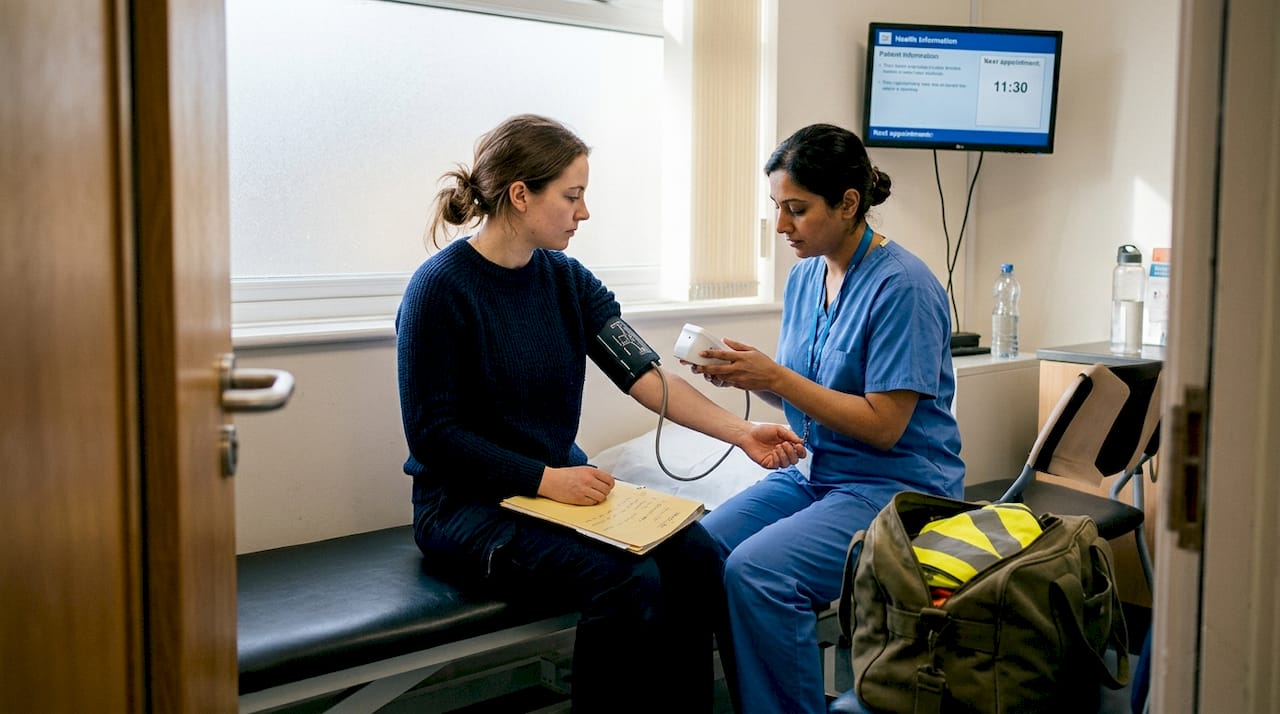
- OGUK medical certificate: A fitness-to-work assessment carried out by an approved medical examiner. Valid for two years initially.
For offshore wind, the key qualification is the GWO BST (Global Wind Organisation Basic Safety Training). This covers manual handling, first aid, fire awareness, working at height, and sea survival. It is widely recognised across European wind projects, not just the UK.
As OEUK's Workforce Insight confirms, oil and gas requires BOSIET, MIST, and OGUK, whilst wind needs GWO BST, and the Energy Skills Passport enables cross-sector transitions by recognising equivalent competencies across both sectors.
The Energy Skills Passport is arguably the most important development in offshore workforce flexibility in years. It allows workers to demonstrate their skills in a standardised format that is accepted across oil, gas, and wind employers, making it far easier to switch sectors as market demand shifts.
Pro Tip: Book your BOSIET and OGUK medical at the same time. Many training centres are co-located with approved medical examiners, and scheduling them together saves you travel time and keeps your start date on track.
| Certification | Sector | Duration | Approximate cost | Renewal |
|---|---|---|---|---|
| BOSIET | Oil and gas | 2 days | £600 to £900 | Every 4 years |
| MIST | Oil and gas | 1 day | £100 to £200 | Every 2 years |
| OGUK medical | Oil and gas | Half day | £200 to £350 | Every 2 years |
| GWO BST | Wind | 5 days | £700 to £1,100 | Every 2 years |
Check the full offshore job requirements on our platform for the most current course providers and booking guidance.
The step-by-step route into offshore work
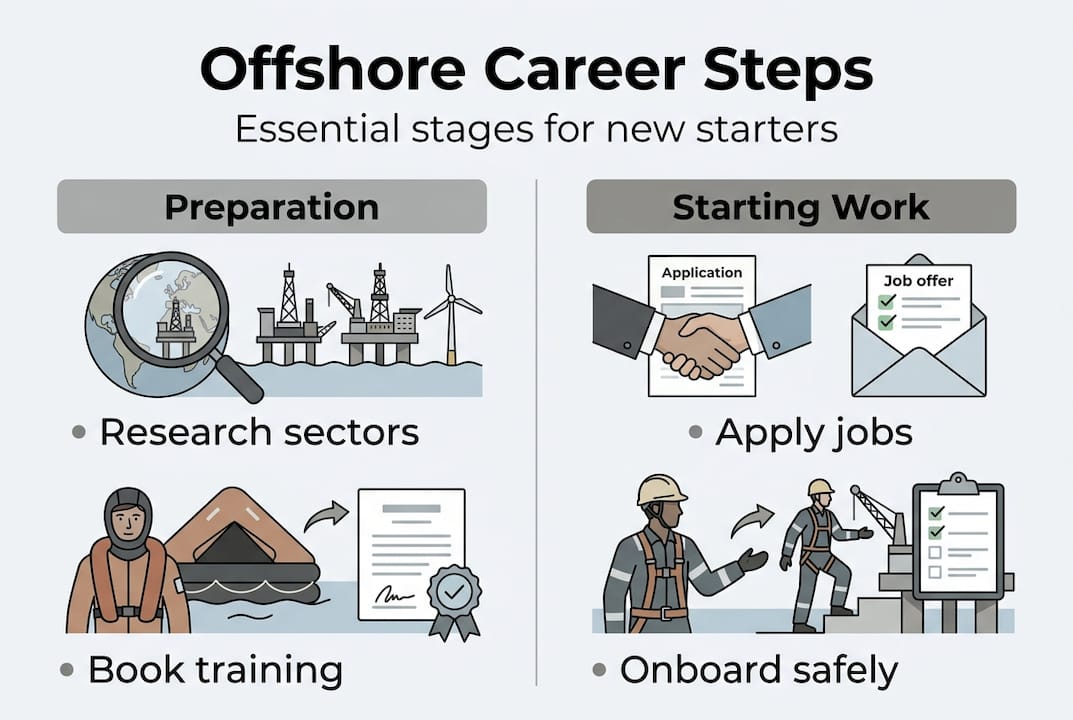
Armed with your certificates, let us map out the process from preparation to landing your first offshore job.
- Assess your sector fit. Consider your existing skills, physical fitness, and tolerance for shift patterns. Oil and gas typically runs two-weeks-on, two-weeks-off rotations. Wind technician roles can involve shorter rotations or day trips depending on the project.
- Research employers and entry programmes. Major operators include BP, Shell, TotalEnergies, and Equinor for oil and gas. For wind, look at Ørsted, Vattenfall, and SSE Renewables. Apprenticeships and graduate schemes are a key entry pathway, with foundation and higher-level options available across both sectors.
- Complete your required safety training. Do not apply for roles before you have at least your BOSIET or GWO BST booked. Many employers will not progress your application without proof of booking.
- Build your application documents. Your CV needs to highlight physical fitness, any relevant technical qualifications, and transferable skills such as working in high-pressure environments, mechanical aptitude, or team-based roles.
- Prepare for offshore-specific interviews. Expect competency-based questions around safety awareness, how you handle emergencies, and your ability to follow procedures under pressure.
- Understand onboarding. Once offered a role, you will typically complete a company induction, further site-specific training, and a buddy period with an experienced colleague before working independently.
Pro Tip: Do not overlook contract and agency roles as your entry point. Many permanent offshore workers started through staffing agencies such as Orion Group or Fircroft. Agency work builds your logbook quickly and gets your name known with operators.
| Step | Action | Typical timeframe |
|---|---|---|
| 1 | Sector research and decision | 1 to 2 weeks |
| 2 | Book and complete certifications | 4 to 8 weeks |
| 3 | CV preparation and applications | 2 to 4 weeks |
| 4 | Interview and offer | 2 to 6 weeks |
| 5 | Onboarding and first rotation | 2 to 4 weeks |
For tailored offshore job application tips, our platform provides sector-specific CV templates and interview preparation resources.
Building your offshore career: progression and future trends
Once in the industry, how do you progress and what future opportunities can you expect?
The offshore career ladder moves quickly for those who invest in upskilling. Within your first two years, you should be targeting additional OPITO (Offshore Petroleum Industry Training Organisation) qualifications relevant to your role, whether that is rigging, scaffolding, instrumentation, or process operations. GWO further training modules are available for wind technicians who want to specialise.
As OEUK's Workforce Insight confirms, typical progression to senior roles takes 2 to 3 years, with a strong focus on DE&I (diversity, equity, and inclusion) and fair pay across the sector.
Here is what a realistic progression might look like:
- Year 1: Entry-level technician or roustabout, building core competencies and completing mandatory training
- Year 2 to 3: Senior technician or specialist role, taking on more responsibility and mentoring newer colleagues
- Year 3 to 5: Supervisory or lead engineer position, overseeing teams and managing safety compliance
- Year 5 and beyond: Installation manager, operations superintendent, or specialist consultant
The offshore sector is actively working to attract a more diverse workforce. The offshore Workforce Charter sets out commitments from major employers around fair pay, inclusive workplaces, and career development support, which is genuinely changing the culture on many installations.
Sector transitions are increasingly common and well-supported. Oil and gas workers with mechanical or electrical backgrounds are finding their skills directly transferable to wind turbine maintenance. The Energy Skills Passport makes this transition formally recognised rather than relying on informal conversations with hiring managers.
For structured career development offshore, understanding the upskilling pathways available to you from day one is what separates those who plateau from those who advance consistently.
A realistic outlook: what most guides won't tell you about offshore careers
Most articles about offshore careers focus on the salary figures and the exciting locations. Few talk honestly about what the work actually demands of you day to day.
Offshore life involves long shifts, often 12 hours on, 12 hours off, for two weeks straight, in an environment where you cannot simply go home if you are having a bad day. The accommodation is functional, the food is usually decent, but the isolation is real. Your soft skills, particularly your ability to adapt, communicate under pressure, and stay committed when conditions are tough, matter just as much as your technical certifications.
Here is the uncomfortable truth: your BOSIET gets you through the door. What keeps you employed and moving upward is your reputation on the installation. Offshore teams are small and tight-knit. Being reliable, safety-conscious, and easy to work with will do more for your career than any single qualification.
We have seen candidates with impressive CVs struggle because they underestimated the teamwork and communication demands. We have also seen candidates with modest backgrounds thrive because they showed up, worked hard, and earned trust quickly. For honest offshore career tips grounded in real experience, the difference between those who make it and those who do not is rarely about qualifications alone.
Ready to launch your UK offshore career?
You now have a clear picture of what the UK offshore industry looks like, which certifications you need, how to apply, and how to grow once you are in. The next step is taking action rather than waiting until everything feels perfect.
At OffstepUK, we specialise in helping aspiring offshore workers turn preparation into placement. From CV optimisation and certification guidance to one-to-one mentorship and free strategy calls, our platform is built around getting you offshore faster and keeping you progressing once you are there. Browse the latest offshore opportunities and access our full library of sector-specific guides, application resources, and career development tools today.
Frequently asked questions
What is the Energy Skills Passport and why does it matter?
The Energy Skills Passport is a recognised document that allows offshore workers to transfer skills between oil, gas, and wind sectors, making moving between roles simpler and faster. It is particularly valuable as the industry shifts towards renewables and workers need to demonstrate cross-sector competency.
How long does it take to progress to a senior role offshore?
Career progression can be rapid, with many new entrants reaching senior roles within 2 to 3 years if they complete the right training and gain consistent experience. Proactively pursuing additional OPITO or GWO qualifications accelerates this timeline significantly.
Which certificate do I need for offshore oil and gas jobs?
You will need the BOSIET, MIST, and OGUK medical certificates to work in oil and gas sectors offshore. All three are mandatory before you can be deployed to an installation.
Are offshore jobs only for engineers?
While engineering skills are in high demand, the UK offshore workforce includes a wide range of roles covering technicians, catering staff, logistics coordinators, medics, and HSE professionals. There is a route in for many different skill sets.