

TL;DR:
- The UK offshore industry offers accessible entry routes mainly through offshore wind and safety certifications.
- Key certifications like GWO BST for wind and OPITO BOSIET for oil and gas are essential for job eligibility.
- Building sector-specific skills and verified training track records accelerates entry into offshore careers.
Breaking into the offshore industry feels straightforward until you actually try it. You search job boards, find roles that require experience you don't have, certifications you've never heard of, and safety training that nobody explained to you. The confusion is real, and it puts many capable people off entirely. But the offshore sector in the UK is genuinely expanding, particularly in offshore wind, and structured routes into entry-level work are more accessible than ever. This guide cuts through the noise and shows you exactly how to spot real opportunities, get the right training, and submit applications that employers actually take seriously.
Table of Contents
- Understanding the offshore job landscape
- Essential safety certifications and practical requirements
- Where to find and assess offshore job opportunities
- Preparing a strong offshore application
- A fresh perspective: Why practical pathways trump endless searching
- Build your offshore career with the right support
- Frequently asked questions
Key Takeaways
| Point | Details |
|---|---|
| Focus on safety training | GWO and OPITO certifications are essential for most offshore entry-level jobs in the UK. |
| Use reliable job sources | Trusted industry platforms help you find credible openings and avoid scams. |
| Practical experience matters | Hands-on training and cross-skilling set you apart more than generic applications. |
| Showcase relevant skills | Highlight every completed certification and practical pathway on your CV for maximum impact. |
Understanding the offshore job landscape
The UK offshore industry is not a single employer or a single role type. It spans oil and gas platforms, offshore wind farms, support and crew transfer vessels, inspection and maintenance operations, and subsea engineering. Understanding which part of the sector you're targeting is the first step, because each area has different entry requirements, different hiring patterns, and different training expectations.
Offshore wind is the fastest-growing segment and arguably the most accessible for people making a career change. The UK currently has the largest installed offshore wind capacity in Europe, and the pipeline of new projects means consistent demand for entry-level workers. Support vessels carry technicians out to turbines daily. Safety support roles, trainee wind turbine technicians, and basic deck crew positions are all credible starting points for people with the right training and the right attitude.
Oil and gas, while going through a longer-term transition, still employs tens of thousands of people across the UK Continental Shelf. Roles here include assistant drilling, catering, logistics, safety, and deck operations. These positions tend to have more formal competency frameworks and stricter medical and certification requirements. They're not impossible for new entrants, but they demand a clearer preparation plan.
Here's a breakdown of the main entry-level offshore categories:
- Trainee wind turbine technician (offshore wind, typically requires GWO BST)
- Safety support officer (both sectors, requires safety certifications and first aid)
- Vessel crew or deck hand (support vessels, requires maritime or industry-specific safety training)
- Catering and logistics assistant (oil and gas, one of the most accessible entry points)
- Assistant rig hand or roustabout (oil and gas, physically demanding, requires OPITO BOSIET)
| Role | Sector | Key certification | Experience needed |
|---|---|---|---|
| Trainee technician | Offshore wind | GWO BST | None to minimal |
| Deck crew | Support vessels | STCW or GWO | Some mechanical or outdoor work |
| Safety support | Both | First aid, GWO or OPITO | Safety awareness background |
| Catering assistant | Oil and gas | OPITO BOSIET | Kitchen or hospitality |
| Roustabout | Oil and gas | OPITO BOSIET | Physical, practical work |
What's driving new opportunity is investment at the structural level. Wind developers are increasingly required to fund local skills training, which is directly shaping where jobs appear and which regions benefit most. This means that if you live near a coastal region with active wind development, credible, employer-backed training programmes may be closer than you think.
For career changers from oil and gas, the transition pathway support developed by the offshore wind sector is specifically designed to bridge the competence gap. These are not generic retraining programmes. They identify which skills transfer and which gaps need filling. This matters enormously because it means experienced offshore workers from oil and gas can often reach wind-ready status faster than complete newcomers.
Knowing the landscape well also tells you where not to focus. Many entry-level applicants waste months targeting deepwater or highly specialised roles that require years of sector experience. Focus on offshore wind careers at the entry level and build from there.
Essential safety certifications and practical requirements
With a clear sense of the roles available, you need to understand which certifications and training genuinely open doors, and which ones are optional extras that employers rarely prioritise.
GWO stands for Global Wind Organisation. The GWO Basic Safety Training, or BST, is the baseline requirement for working in the offshore wind sector. It covers five modules: manual handling, first aid, fire awareness, working at height, and sea survival. Without this, you will not be considered for most offshore wind roles. It is that simple. GWO training is a core requirement for wind safety readiness, and OPITO certification is the equivalent standard for oil and gas work.
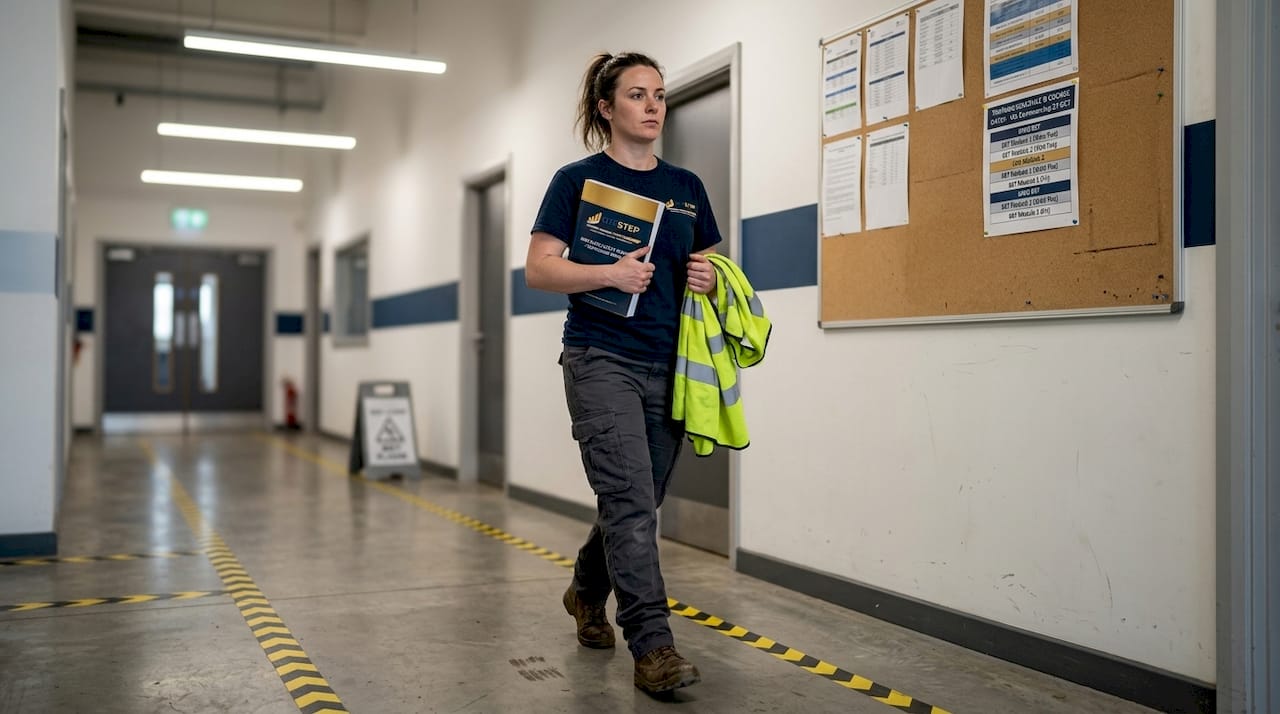
OPITO is the industry body that sets competency and training standards for oil and gas. Their BOSIET (Basic Offshore Safety Induction and Emergency Training) is the primary entry-level certification for working on oil and gas installations. It includes helicopter underwater escape training (HUET), sea survival, firefighting, and first aid. Some employers also ask for FOET (Further Offshore Emergency Training) for more experienced hires.
Here's a direct comparison to help you decide which certification to pursue first:
| Certification | Sector | Duration | Key modules | Renewal period |
|---|---|---|---|---|
| GWO BST | Offshore wind | 3 to 5 days | Manual handling, sea survival, first aid, fire, heights | 2 years |
| OPITO BOSIET | Oil and gas | 4 to 5 days | HUET, fire, sea survival, first aid | 4 years |
| OPITO FOET | Oil and gas | 1 to 2 days | Refresher for BOSIET holders | 4 years |
| STCW Basic Safety | Maritime/vessels | 4 to 5 days | Fire, survival, first aid, personal safety | 5 years |
Choosing the wrong certification is one of the most common and costly mistakes new entrants make. If you complete OPITO training while targeting offshore wind roles, you may find your certification is not accepted without the GWO modules. Always verify what the specific employer or job listing requires before booking any course.
Here's a practical step-by-step to get your certifications right:
- Identify your target sector (wind, oil and gas, or vessels) before booking anything.
- Research three to five specific employers or roles in that sector and list their stated certification requirements.
- Book GWO BST if targeting wind; book OPITO BOSIET if targeting oil and gas.
- Add a first aid qualification (minimum HSE First Aid at Work) to strengthen your profile.
- Confirm medical fitness by completing an offshore medical with an approved provider.
"Qualifications that are mutually recognised across sectors give candidates a genuine advantage. When you complete GWO training that also satisfies competency frameworks from your previous sector, you walk into interviews with proof of readiness, not just intent."
Pro Tip: Contact the training centre directly and ask which local employers they work with. Many accredited GWO and OPITO providers have employer partnerships and sometimes refer strong candidates directly. This is one of the most underused advantages in entry-level offshore job searching.
Apprenticeships are another underrated route. Several energy companies now run structured offshore apprenticeship programmes that include on-the-job training alongside funded certification. These are particularly useful if you don't want to pay for training upfront and prefer to earn while you learn. Check directly with major offshore contractors and wind operators for current schemes. Explore industry training pathways to understand what structured options look like before committing to self-funded courses.
Where to find and assess offshore job opportunities
Equipped with the required training, you'll want to pinpoint real-world offshore openings and avoid misleading job offers.
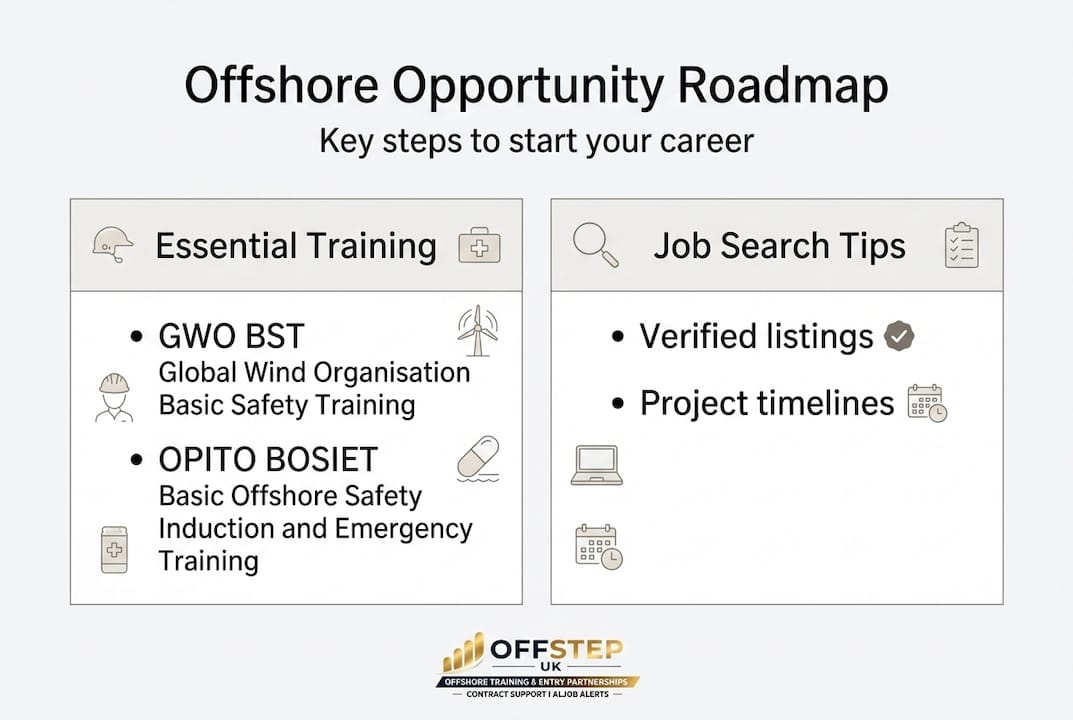
The sheer number of job boards can be overwhelming. Not all of them list genuine offshore roles, and some aggregate poorly verified postings. Start with the most reliable sources and build outward from there.
The most credible places to search:
- Company career pages directly (operators like Ørsted, BP, Equinor, and Repsol all list vacancies directly).
- Industry-specific job boards such as Rigzone, Energy Jobline, and PetroJobs for oil and gas; RenewableUK's job board for wind.
- Staffing agencies that specialise in offshore (Fircroft, OilCareers, Petroplan) often have roles not publicly listed.
- LinkedIn with sector-specific filters (use job titles like "offshore technician," "wind farm operative," or "roustabout" rather than generic energy keywords).
- Training provider networks as mentioned above. Accredited centres often post job alerts to recent graduates.
Here's how to assess whether a job posting is worth your time:
| Signal | What it means |
|---|---|
| Lists specific certifications (GWO, OPITO) | Legitimate, prepared employer |
| Mentions offshore medical requirement | Real offshore role |
| No certifications mentioned | Possibly onshore or misleading |
| Vague location or rotation schedule | Investigate before applying |
| Asks you to pay upfront for training via them | Red flag |
UK wind developer-funded training has created a new category of verifiable job opening: roles attached to publicly announced projects. If a wind farm has received planning approval and secured investment, the associated job creation is real, traceable, and usually tied to local recruitment targets. Search for project announcements in your region and contact the lead contractor directly.
Red flags to watch for: any job that does not mention offshore safety certification requirements, any listing that is vague about rotation patterns (the standard is typically 2 weeks on, 2 weeks off or 3 weeks on, 3 weeks off), and any recruiter who pressures you to pay for courses through their "recommended" provider without verification.
Pro Tip: Set up job alerts on at least three platforms simultaneously. Many offshore roles are filled within days of being posted. Speed of application genuinely matters, particularly for entry-level positions where competition is high and employers move fast.
Use the offshore job market dynamics to understand how hiring cycles work, especially around project start dates when multiple entry-level roles open simultaneously.
Preparing a strong offshore application
Finding a good opportunity is only half the battle. Your application must showcase your true offshore readiness, not just your enthusiasm.
The biggest mistake entry-level applicants make is submitting a generic CV with a vague objective statement. Offshore employers want specificity. They want to see exactly which certifications you hold, when they were completed, and when they expire. They want to know your medical status. And they want evidence that you understand what the role actually involves.
Key elements of a strong offshore CV:
- Certifications section near the top, listing GWO BST or OPITO BOSIET with issue and expiry dates.
- Offshore medical status clearly stated (valid, provider, date).
- Relevant practical experience, even if not directly offshore (working at height, maritime, construction, engineering).
- Safety awareness training beyond the baseline (e.g., manual handling, COSHH, first aid at work).
- Concise role descriptions using offshore-relevant language rather than generic job duties.
Mutually recognised qualifications allow candidates from other sectors to present their existing competencies alongside their new offshore training. If you've come from construction, manufacturing, or maritime, highlight the overlap explicitly. Don't make the hiring manager figure out the connection themselves.
"The candidates who stand out are those who treat their application as proof of readiness, not an expression of hope. Dates, certification numbers, medical validity, practical examples: these details tell an employer you're already thinking like someone who belongs offshore."
A cover letter for offshore roles should be short and targeted. Three paragraphs: why you want this specific role in this specific sector, what certifications and practical experience make you ready, and what you're committing to in terms of training and development. Avoid generic statements about being a "hard worker" or "team player" without evidence.
Highlighting participation in transition pathway programmes is especially powerful. If you've completed cross-skilling training that bridges oil and gas with offshore wind, say so explicitly. It shows initiative, sector awareness, and a willingness to invest in your own development, all qualities employers in this sector genuinely value.
Seek entry-level career guidance if you're unsure how to position transferable skills from an unrelated industry. Getting the framing right often makes the difference between being shortlisted and being ignored.
A fresh perspective: Why practical pathways trump endless searching
Here is something most offshore career advice gets wrong: it focuses almost entirely on where to look for jobs rather than on becoming someone employers want to hire.
Job board trawling, sending dozens of applications per week, and refreshing LinkedIn are not strategies. They're avoidance disguised as activity. The real competitive edge in entry-level offshore work comes from verified, sector-specific training and a credible track record, even if that track record is only a few months old.
We've seen this pattern repeatedly. Candidates who spend three months completing GWO BST, getting their offshore medical, shadowing a training course, and speaking directly to accredited providers tend to land roles faster than those who spend the same three months applying to everything available. Employers can tell the difference between someone who is job-ready and someone who is job-hungry.
The offshore sector, especially offshore industry frameworks around safety and competency, rewards people who demonstrate commitment before they get the job. Proof of that commitment is your training record, your certifications, and the quality of your application. Build that foundation and the searching becomes far more efficient.
Build your offshore career with the right support
Getting into offshore work is genuinely achievable, but trying to navigate it alone wastes time and risks costly missteps.
Offstep UK exists to shortcut that process. We help aspiring offshore professionals plan their training, understand which offshore job opportunities are genuinely worth pursuing, and build the application profile that gets them shortlisted. From GWO and OPITO pathway planning to CV optimisation and employer connections, our programmes are built around practical outcomes, not theory. Whether you're brand new to the industry or transitioning from another sector, we offer free strategy calls to assess where you are and map out exactly what to do next.
Frequently asked questions
What training do I need for offshore wind jobs in the UK?
You need GWO Basic Safety Training as a core requirement, as GWO training is essential for becoming deployable on offshore wind projects, and some employers add their own safety or competence courses on top.
How do oil and gas workers transition into offshore wind?
Structured transition programmes support cross-skilling and mutual recognition of qualifications, and wind developers fund skills training that helps experienced oil and gas workers fill the competency gaps specific to wind operations.
Where can I find genuine entry-level offshore job postings?
Check company career pages, specialist offshore job boards, and accredited training provider networks for verified vacancies, particularly in regions where locally funded training schemes are connected to active wind projects.
What are common mistakes to avoid when applying for offshore jobs?
Don't submit a generic CV without clear certification details, and don't apply before completing the required safety training, since GWO and OPITO certifications are non-negotiable requirements that employers check before progressing any application.