

TL;DR:
- Networking is crucial for offshore careers, enabling access to hidden opportunities and trusted referrals.
- Participation in industry events, online communities, and mentorship schemes builds relationships that accelerate career progression.
- Consistent effort, genuine engagement, and strategic follow-up are key to overcoming barriers and establishing credibility offshore.
Technical qualifications matter in offshore work, but they rarely tell the whole story. The truth is, nearly 47% of early-career professionals entered the industry through outreach initiatives that blend training with relationship-building. If you have been focusing solely on certifications and CV polish, you may be missing the single most powerful lever available to you. This article breaks down why networking is fundamental to offshore career entry and progression, where the best opportunities to connect actually exist, and how to build a strategy that works whether you are brand new to the sector or looking to move up.
Table of Contents
- Why networking is essential in offshore careers
- Key platforms and events for offshore networking
- Networking strategies for entry and progression
- Overcoming networking challenges offshore
- Our perspective: what most guides miss about offshore networking
- Advance your offshore career with the right support
- Frequently asked questions
Key Takeaways
| Point | Details |
|---|---|
| Personal connections matter | Networking drives offshore hiring and fast-tracks career progress. |
| Structured events enable access | Speed networking and webinars are effective, especially for newcomers. |
| Persistence pays off | Sustained relationship building leads to more opportunities offshore. |
| Different sectors, different focus | Oil prioritises referrals; renewables favour open events and training. |
Why networking is essential in offshore careers
The offshore sector is not like most industries. Roles are remote, conditions are demanding, and the consequences of placing the wrong person on a rig can be severe. That reality shapes how hiring works. Employers and crew managers lean heavily on trust, and trust is built through relationships, not job boards.
The UK offshore sector supports roughly 200,000 jobs, with growing demand for skilled tradespeople transitioning from onshore roles as the energy transition accelerates. That sounds like plenty of opportunity, and it is. But quality roles attract serious competition, and many of the best positions are filled before they ever appear on a public listing.
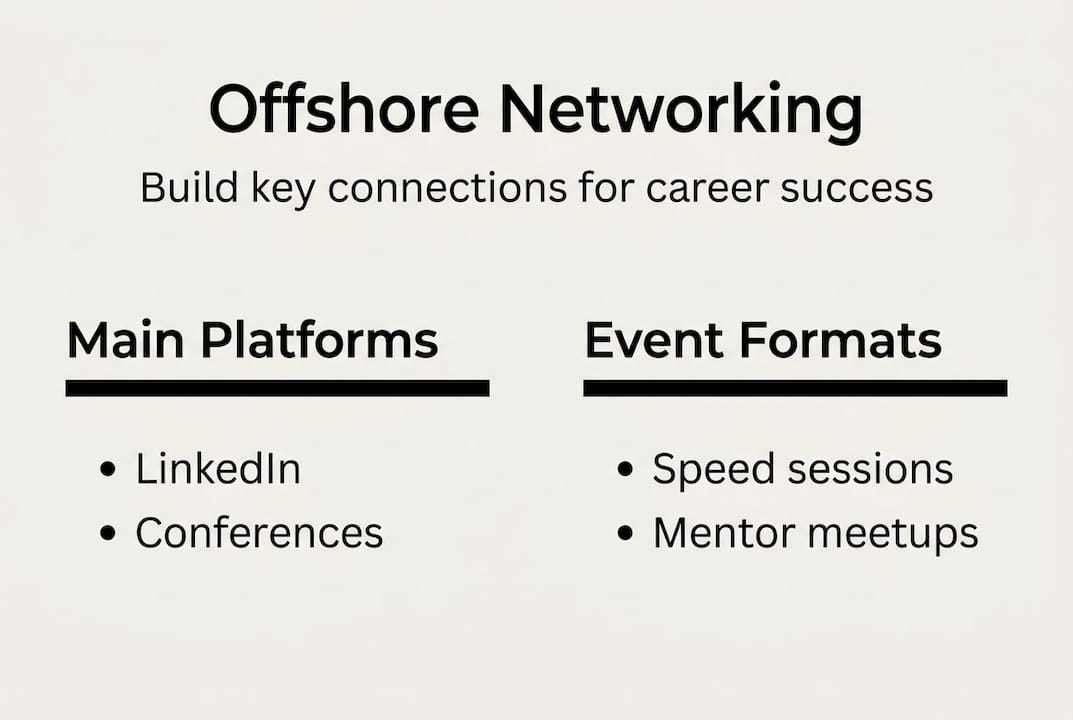
This is where networking changes everything. When a hiring manager needs a roustabout or a safety technician, their first instinct is often to ask someone they already know. A referral from a trusted colleague carries far more weight than an anonymous application. For you, that means being visible and known within the right circles is not just helpful. It is often essential.
Structured outreach initiatives have recognised this reality. IMCA's career support network, for example, was designed specifically to connect newcomers with experienced professionals in a structured way, blending mentorship with genuine career access. These programmes do not just teach skills. They put you in rooms, virtual or physical, with people who can open doors.
Here is what networking actually gives you in offshore:
- Access to unadvertised roles before they go public
- Insider knowledge about which companies are hiring and what they value
- Mentorship from experienced offshore workers who have navigated the same path
- Referrals that carry real weight with hiring managers
- Reputation building within a tight-knit professional community
"In offshore, your name travels faster than your CV. Being known as reliable, proactive, and well-connected is worth more than any single qualification."
The offshore world rewards those who invest in structured outreach in offshore consistently. The sooner you start building those connections, the sooner opportunities begin to find you.
Key platforms and events for offshore networking
Knowing why networking matters is one thing. Knowing exactly where to do it is another. The offshore sector has a surprisingly rich ecosystem of events, platforms, and communities built specifically for career-focused connection.
In-person events remain the gold standard. Conferences like Offshore Europe, All-Energy, and OEUK's own professional events bring together operators, contractors, and new entrants in one place. These are not just trade shows. They are career-launching opportunities if you approach them with intention.

For those who find large events intimidating, OEUK speed networking sessions offer a lower-pressure format. You rotate through short, structured conversations rather than navigating an open floor. For newcomers and introverts, this format is genuinely game-changing.
Online platforms have expanded what is possible, especially for those outside Aberdeen or London. LinkedIn remains the primary professional network, but offshore-specific communities on forums and industry groups add real depth. Virtual webinars hosted by organisations like OEUK allow you to ask questions, introduce yourself, and follow up with speakers without ever leaving your home.
Here is a comparison of the main networking channels available to offshore professionals:
| Platform or event | Best for | Accessibility | Effort required |
|---|---|---|---|
| OEUK speed networking | Newcomers and introverts | In-person, UK | Low to medium |
| LinkedIn groups | Ongoing visibility | Online, global | Low |
| Offshore Europe conference | Mid to senior level | In-person, Aberdeen | High |
| Industry webinars | All levels | Online | Low |
| Alumni and mentorship schemes | Entry level | Mixed | Medium |
To get the most from structured events for networking, follow this approach:
- Research attendees and speakers before the event
- Prepare two or three specific questions relevant to your career stage
- Introduce yourself with a clear, honest statement of where you are and what you are looking for
- Follow up within 48 hours with a personalised message
- Engage consistently online between events to stay visible
Pro Tip: Do not attend one event and wait for results. Repeat engagement is what builds recognition. The people who get remembered are those who show up regularly, ask thoughtful questions, and contribute to discussions.
Persistence is not just a nice quality here. It is a practical requirement. First roles through networking often take several months of consistent effort, but the connections you build along the way compound over time.
Networking strategies for entry and progression
Having the right platforms is only half the equation. How you engage makes all the difference between being a face in the crowd and being someone people actively want to help.
Informational interviews are one of the most underused tools available to offshore newcomers. Reach out to someone working in the role you want and ask for 20 minutes of their time to learn about their experience. Most people are willing to share. You are not asking for a job. You are asking for insight. That distinction removes pressure from both sides and often leads to referrals naturally.
Mentorship and alumni schemes offer structured relationship-building with built-in accountability. Many offshore companies and industry bodies run formal mentorship matching programmes. Getting matched with someone who has navigated your target role gives you both tactical advice and a warm introduction network.
When it comes to industry events, your goal for any first conversation is simple: be genuinely curious and easy to talk to. Do not lead with what you want. Lead with what you find interesting about their work. That approach is disarming and memorable.
It is also worth understanding that oil and gas and renewables operate with different networking cultures. Relationships accelerate advancement in both, but oil and gas hiring is heavily referral-driven, meaning internal recommendations carry enormous weight. Renewables, by contrast, places greater emphasis on open events, training networks, and community participation.
"Certifications prove you can do the job. Relationships prove you are the kind of person people want working alongside them offshore."
Here is what a strong networking strategy looks like in practice:
- Be consistent: Show up to events, forums, and discussions regularly
- Add value first: Share useful information, answer questions, support others
- Follow up promptly: A connection not followed up is a connection lost
- Stay visible between events: Post updates, comment on industry news, engage with content
- Seek career support communities that keep you connected to active professionals
Pro Tip: When following up after meeting someone, reference something specific from your conversation. It shows you were genuinely listening and makes you far more memorable than a generic message.
Overcoming networking challenges offshore
Not everyone finds networking natural. For many people entering offshore for the first time, the combination of unfamiliar industry jargon, a tight-knit community culture, and the fear of seeming inexperienced makes the whole thing feel daunting. That is completely understandable, and it is also very solvable.
The most common obstacles people face are:
- Having no existing contacts in the sector
- Not knowing what to say or how to start conversations
- Feeling intimidated by more experienced professionals
- Living far from major offshore hubs like Aberdeen
- Being naturally introverted
Each of these has a practical workaround. If you have no contacts, start with structured environments like OEUK webinars and support events where introductions are built into the format. You do not need to cold-approach anyone. The structure does the work for you.
Here is a practical guide to common challenges and solutions:
| Challenge | Practical solution |
|---|---|
| No existing contacts | Join structured events and mentorship schemes |
| Introversion | Set a goal of two meaningful conversations per event |
| Geographic distance | Prioritise online communities and virtual webinars |
| Lack of industry knowledge | Follow industry publications and ask questions in forums |
| Fear of rejection | Reframe outreach as learning, not asking for favours |
For introverts specifically, setting a small, achievable goal per event works far better than trying to work the entire room. Two genuine conversations are worth more than ten forgettable ones. Quality over volume is always the right approach.
Pro Tip: After any networking interaction, send a follow-up message that offers something of value, whether that is a useful article, a shared connection, or a relevant observation. Giving before asking builds goodwill that pays off over time.
Access to offshore career entry tips and community support can also significantly reduce the isolation that many newcomers feel. You do not have to figure this out alone, and you should not try to.
Our perspective: what most guides miss about offshore networking
Most career guides treat networking as a supplementary activity, something you do after you have sorted your qualifications. In offshore, that logic is backwards.
We have seen candidates with outstanding CVs and every relevant certification struggle for months, while others with fewer credentials but strong community connections land roles quickly. The difference is almost always relationships. Technical credentials unlock the door. Relationships get you inside.
What is also changing is the culture itself. The renewables sector is actively building more inclusive, structured networking environments. Speed networking, mentorship matching, and online communities are normalising participation for people who would have found traditional offshore networking inaccessible. That is a genuine shift, and it benefits newcomers enormously.
Introverts and career changers are not at a disadvantage in this new landscape. They are actually well-positioned to thrive, because the skills that make someone good at listening, asking thoughtful questions, and following up carefully are exactly the skills that build lasting professional relationships. Chasing community experiences rather than just CV upgrades is what separates those who progress steadily from those who stay stuck.
Advance your offshore career with the right support
Understanding the value of networking is one thing. Having the right infrastructure to act on it is another entirely.
Offstep UK's support network is built specifically for people at every stage of the offshore career journey, from those taking their first steps to experienced professionals aiming higher. Through structured mentorship, career event access, CV optimisation, and job-matching support, Offstep UK gives you the tools and the community to turn networking from an abstract concept into real career progress. If you are serious about breaking into or advancing within the offshore sector, a free strategy call is the most direct next step you can take.
Frequently asked questions
What are the best events for networking in the offshore industry?
OEUK speed networking sessions and industry webinars are highly effective, especially for newcomers and introverts, as the structured format removes the pressure of open-floor networking.
How important are referrals compared to formal applications offshore?
Referrals remain the primary route into oil and gas roles, while renewables increasingly values networking at events and training programmes as a route to employment.
How long does it take to secure an offshore role through networking?
Persistence is essential, as many candidates secure their first role after several months of sustained networking, particularly through structured outreach events and mentorship schemes.
Is networking valuable for those transitioning from other trades?
Absolutely. Networking gives tradespeople access to insider advice, mentorship, and transition schemes that are especially relevant given the 200,000 jobs the UK offshore sector supports and its growing demand for skilled workers.