

Starting an offshore career in the UK can feel like trying to solve a puzzle with half the pieces missing. The certification landscape is genuinely complex, with different standards for oil and gas versus wind, medical requirements that must come first, and consequences for getting the order wrong. Many candidates waste months and money by jumping in without a clear plan. This guide cuts through the confusion, laying out exactly what you need, the correct sequence to follow, and the mistakes that quietly derail even well-prepared candidates.
Table of Contents
- What offshore certification is and why it matters
- Essential prerequisites and tools for UK offshore roles
- Step-by-step guide to the offshore certification process
- Common pitfalls and expert tips for smooth certification
- Comparing pathways: oil and gas versus offshore wind
- Take the next step in your offshore career
- Frequently asked questions
Key Takeaways
| Point | Details |
|---|---|
| Certification is essential | Working offshore requires specific UK-recognised certificates for safety and employment. |
| Transferable skills | Most oil and gas skills can support a transition to offshore wind roles with the right guidance. |
| Keep certificates current | Regularly update medicals and refresher courses to maintain offshore eligibility. |
| Use digital tools | Platforms like Energy Skills Passport and Offstep UK make tracking and recertification easier. |
What offshore certification is and why it matters
Offshore certification is the formal process of obtaining safety and competency qualifications that prove you are fit to work in a hazardous offshore environment. In the UK, this splits broadly into two tracks: oil and gas, governed by OPITO standards with the Basic Offshore Emergency Training (BOSIET) as the core qualification, and offshore wind, governed by the Global Wind Organisation (GWO) with the Basic Safety Training (BST) as the entry point. These are not optional extras. They are legal and contractual requirements that every employer checks before you set foot on a vessel or installation.
The reasons go beyond box-ticking. Offshore environments carry genuine risks including fire, flooding, and helicopter ditching, and your certifications prove you have trained for these scenarios. From a career perspective, holding the right certificates is the difference between being considered and being ignored. You can explore the full offshore pathway overview to understand how certification fits into a broader career plan.
The industry is also shifting. Oil and gas versus wind represent different standards, but the OEUK Energy Skills Passport now supports workers moving between sectors, recognising that oil and gas commands higher pay while wind offers stronger long-term growth and stability. This matters if you are deciding which track to pursue.
Key risks of working offshore without proper certification:
- Immediate removal from site and potential blacklisting by operators
- Personal liability in the event of an accident or incident
- Invalidated insurance for you and your employer
- Permanent damage to your professional reputation in a small, well-connected industry
- Legal consequences under the Health and Safety at Work Act 1974
Critical warning: No legitimate offshore employer will allow you to work without verified, in-date certifications. There are no exceptions, no grace periods, and no informal arrangements. If someone suggests otherwise, treat it as a serious red flag.
With the importance of certification made clear, let's consider the requirements you will need before starting the offshore certification journey.
Essential prerequisites and tools for UK offshore roles
Before you book a single course, you need to confirm you meet the baseline requirements. Skipping this step is the single most common reason candidates lose time and money. The OGUK offshore medical and a Fit to Train certificate are mandatory prerequisites for BOSIET, meaning you cannot attend the course without them. Many training centres will turn you away at the door if these are not in place.

Here is a clear overview of the core requirements:
| Requirement | Validity | Approximate cost | Notes |
|---|---|---|---|
| OGUK offshore medical | 2 years | £200 to £350 | Must be completed before BOSIET |
| Fit to Train certificate | Per course | Included or £50 | Confirms fitness for physical training |
| BOSIET (oil and gas) | 4 years | £700 to £1,000 | Core OPITO qualification |
| GWO BST (wind) | 2 years | £500 to £800 | Five modules, can be done separately |
| HUET (helicopter underwater escape) | Often included in BOSIET | See BOSIET cost | Sometimes standalone |
Additional preparation steps before booking your course:
- Gather valid photo ID (passport or driving licence)
- Obtain a National Insurance number confirmation if recently arrived in the UK
- Check your swimming ability, as pool-based exercises are part of BOSIET
- Confirm your employer or agency requirements, as some operators specify approved training centres
- Review the UK certification requirements to ensure you are not missing sector-specific additions
Pro Tip: Book your OGUK medical and Fit to Train assessment at least four weeks before your intended course date. Delays in medical processing are the number one reason candidates miss their booked training slots and forfeit deposits.
Once you have gathered the necessary prerequisites, it is time to move into the certification steps themselves.
Step-by-step guide to the offshore certification process
Following the correct sequence matters enormously. Rushing ahead or skipping steps creates costly rework. Here is the process broken down into clear stages, drawing on step-by-step certification guidance developed for UK offshore candidates.
-
Complete your OGUK offshore medical. Visit an approved medical examiner and obtain your offshore medical certificate. This confirms you are physically fit to work offshore and is a hard prerequisite for everything that follows.
-
Obtain your Fit to Train certificate. This is a shorter assessment confirming you can safely participate in the physical elements of BOSIET or GWO BST, including pool exercises and firefighting drills.
-
Book your BOSIET or GWO BST course. Choose an OPITO-approved centre for oil and gas or a GWO-approved centre for wind. Confirm the course includes HUET if you are going the oil and gas route. The BOSIET course details confirm a three-day duration with a four-year validity, with renewal via the Further Offshore Emergency Training (FOET) course.
-
Complete the training. Attend all modules. These include sea survival, firefighting, first aid, and helicopter underwater escape. Pass rates are high for well-prepared candidates, but physical readiness matters.
-
Receive and verify your certificates. OPITO certificates are issued digitally and can be verified by employers online. GWO certificates are similarly digital. Keep copies in multiple locations.
-
Register with OPITO or GWO as appropriate. Both bodies maintain registries that employers use to verify credentials quickly. Registering ensures your certificates are searchable and reduces delays during hiring.
A striking fact worth knowing: 90% of oil and gas skills are directly transferable to offshore wind roles. This means if you are already certified in oil and gas, you are far closer to wind sector readiness than you might think.
Pro Tip: Use the OEUK Energy Skills Passport as a digital wallet for all your certifications and medicals. It allows employers to verify your credentials instantly and keeps your recertification dates visible in one place, so nothing slips through the net.
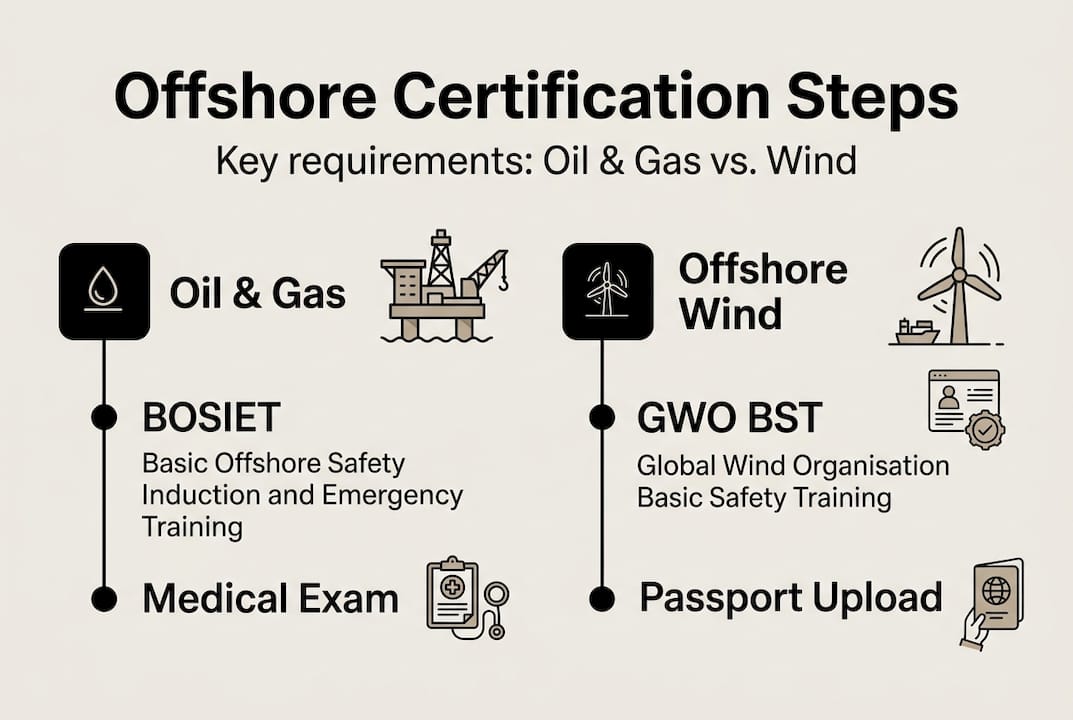
With the formal steps outlined, it is equally important to consider practical advice and avoidable mistakes.
Common pitfalls and expert tips for smooth certification
Even candidates who follow the correct sequence can run into problems. Most of these issues are entirely preventable with a bit of forward planning. The OEUK Energy Skills Passport was specifically designed to help workers transitioning between oil and gas and offshore wind keep their credentials organised and recognised across sectors.
Top mistakes that delay or derail offshore certification:
- Letting the OGUK medical expire mid-contract, which can ground you immediately
- Booking BOSIET before completing the medical, resulting in a wasted course fee
- Forgetting that GWO BST modules have individual expiry dates, not a single renewal date
- Assuming certificates from other countries are automatically recognised in the UK
- Failing to check whether your training centre is on the approved list for your target employer
- Ignoring recertification reminders until it is too late to book before a contract starts
The fix for most of these is a simple tracking system. Set calendar reminders 90 days before each certificate expires. Use the avoiding certification mistakes resources to build a personal renewal schedule.
Expert warning: Letting your BOSIET or medical lapse, even by a single day, can cost you a contract worth thousands of pounds. Operators do not make exceptions, and finding a last-minute training slot is rarely possible. Treat recertification as a non-negotiable business expense.
For those transitioning with the Energy Skills Passport, the tool maps your existing qualifications against the requirements of your target sector, highlighting gaps clearly. This removes the guesswork from cross-sector moves.
Having addressed the main stumbling blocks, you can now understand how the process fits together and compare your journey options.
Comparing pathways: oil and gas versus offshore wind
Choosing between oil and gas and offshore wind is one of the most consequential decisions you will make as an offshore candidate. Both offer strong careers, but they differ significantly in pay, job security, certification costs, and long-term prospects. The offshore wind transition is accelerating, with the UK committing to major expansion of its wind capacity through 2030 and beyond.
| Factor | Oil and gas | Offshore wind |
|---|---|---|
| Entry certification | BOSIET (OPITO) | GWO BST |
| Approximate cert cost | £700 to £1,000 | £500 to £800 |
| Certificate validity | 4 years (BOSIET) | 2 years (GWO BST modules) |
| Average day rate | Higher (£300 to £600+) | Moderate (£200 to £450) |
| Sector growth | Declining long-term | Strong and expanding |
| Skill transferability | High to wind | Moderate to oil and gas |
| Job stability | Variable, contract-heavy | Increasingly permanent roles |
Oil and gas still pays more in the short term, and if you have existing trade skills in pipefitting, electrical work, or mechanical engineering, entry is often faster. Wind offers growth and stability that oil and gas cannot match over a 10 to 20 year horizon. The sector pathways comparison on our platform can help you weigh these factors against your specific background and goals.
If you are early in your career, wind is worth serious consideration. If you are transitioning from an oil and gas trade role, starting in oil and gas and moving to wind later is a well-trodden path, and the OEUK tools make that transition far more manageable than it was even five years ago.
Now that you are clear on all the major routes, find out how to take the next step and act on what you have learned.
Take the next step in your offshore career
Knowing the process is one thing. Staying on top of it across a full career is another challenge entirely. Certificates expire, medicals need renewing, and new sector requirements emerge as the industry evolves.
At Offstep UK, we help candidates at every stage of the offshore journey, from first-timers working through their initial BOSIET to experienced professionals managing multi-sector credentials. Our platform gives you structured guidance on certification timelines, CV optimisation, and career strategy, all tailored to the UK offshore market. Whether you are just starting out or looking to move from oil and gas into wind, a free strategy call can help you build a clear, actionable plan. Do not leave your offshore career to chance when expert support is available.
Frequently asked questions
How long does offshore certification last in the UK?
Most offshore safety certifications like BOSIET are valid for four years, after which a refresher course called FOET is required to maintain your eligibility to work offshore.
Can I transfer my oil and gas skills to offshore wind jobs?
Yes. 90% of skills are transferable from oil and gas to offshore wind, and the OEUK Energy Skills Passport provides a structured tool for mapping and formally recognising those skills.
What happens if my offshore certification expires?
You cannot legally work offshore until your certificates are renewed. For BOSIET, the renewal route is FOET, and you will need to rebook and pass the refresher before any operator will accept you on site.
Do I need different certificates for oil and gas versus offshore wind?
Yes. Oil and gas requires OPITO-standard qualifications like BOSIET, while wind requires GWO BST. However, the OEUK Energy Skills Passport helps you identify gaps and bridge between the two sets of standards efficiently.