

TL;DR:
- Offshore engineering now focuses heavily on renewable energy infrastructure in addition to oil and gas.
- Success requires technical skills, industry-standard certifications, safety training, and effective communication.
- The sector offers diverse career paths, with increasing opportunities in offshore wind and clean energy projects.
Offshore engineering is far bigger than oil rigs. Many people assume this field belongs exclusively to the oil and gas industry, but the reality is quite different. Today, offshore engineering sits at the heart of the UK's renewable energy revolution, covering everything from floating wind turbines to complex subsea cable infrastructure. Offshore engineering involves designing structures and systems for some of the most demanding environments on the planet. If you are considering a career in this sector, this guide will walk you through the fundamentals, the skills you need, the certifications that matter, and the career paths available to you right now.
Table of Contents
- What is offshore engineering?
- Key technical concepts and methodologies
- Skills, training, and certifications for UK offshore engineers
- Career paths, progression, and the future of offshore engineering
- Our perspective: What aspiring offshore engineers should really focus on
- Take your first steps in offshore engineering
- Frequently asked questions
Key Takeaways
| Point | Details |
|---|---|
| Broad career scope | Offshore engineering spans oil, gas, renewables, and marine structures with diverse entry points. |
| Essential technical skills | Proficiency in modelling software and adherence to international standards is crucial for successful engineers. |
| Certifications open doors | Key qualifications like OPITO BOSIET, NEBOSH, and CEng are vital for UK offshore engineering roles. |
| Career progression pathways | Graduates can advance rapidly with the right technical and safety credentials, especially in renewables. |
What is offshore engineering?
At its core, offshore engineering is the discipline concerned with designing, building, and maintaining structures and systems that operate in marine environments. That covers a wide range of assets: oil and gas platforms, offshore wind turbines, subsea pipelines, floating production units, and tidal energy devices. The offshore engineering basics span three major sectors in the UK: oil and gas, offshore wind, and subsea infrastructure.
Each sector has its own technical demands, but they share a common thread. Engineers must account for extreme environmental forces, including waves, tidal currents, storm surges, and corrosive saltwater. These are not conditions you encounter in a standard civil or mechanical engineering role onshore.
Typical activities within offshore engineering include:
- Structural analysis of platforms and foundations
- Design of mooring systems and risers
- Installation engineering for subsea equipment
- Integrity management and inspection planning
- Fatigue and corrosion assessments over an asset's operational life
The UK North Sea remains one of the most technically demanding offshore environments in the world. Water depths, weather windows, and ageing infrastructure all create genuine engineering challenges. But the offshore wind sector, particularly in the North Sea and Irish Sea, is generating an entirely new wave of engineering demand.
Offshore engineering is not just about keeping old platforms running. It is increasingly about designing the next generation of clean energy infrastructure that will power British homes for decades to come.
For aspiring professionals, this breadth is actually good news. It means there are multiple entry points into the sector, and specialising in renewables does not mean starting from scratch. Many of the core engineering principles transfer directly between oil and gas and wind energy projects.
Understanding this scope early on helps you make smarter decisions about your training, your first role, and where you want to specialise over time. Offshore engineering is a long-term career, and the UK market is actively looking for new talent to replace an ageing workforce while simultaneously scaling up renewable capacity.
Key technical concepts and methodologies
Once you understand what offshore engineering covers, the next step is getting to grips with the technical language and tools of the trade. This is where many aspiring engineers feel overwhelmed, but the fundamentals are more accessible than they appear.
Load and stress analysis is central to almost everything in offshore engineering. Structures in marine environments face wave loading, wind pressure, current drag, and dynamic forces that change constantly. Engineers must calculate how these forces interact with a structure over its entire design life, not just under peak conditions.
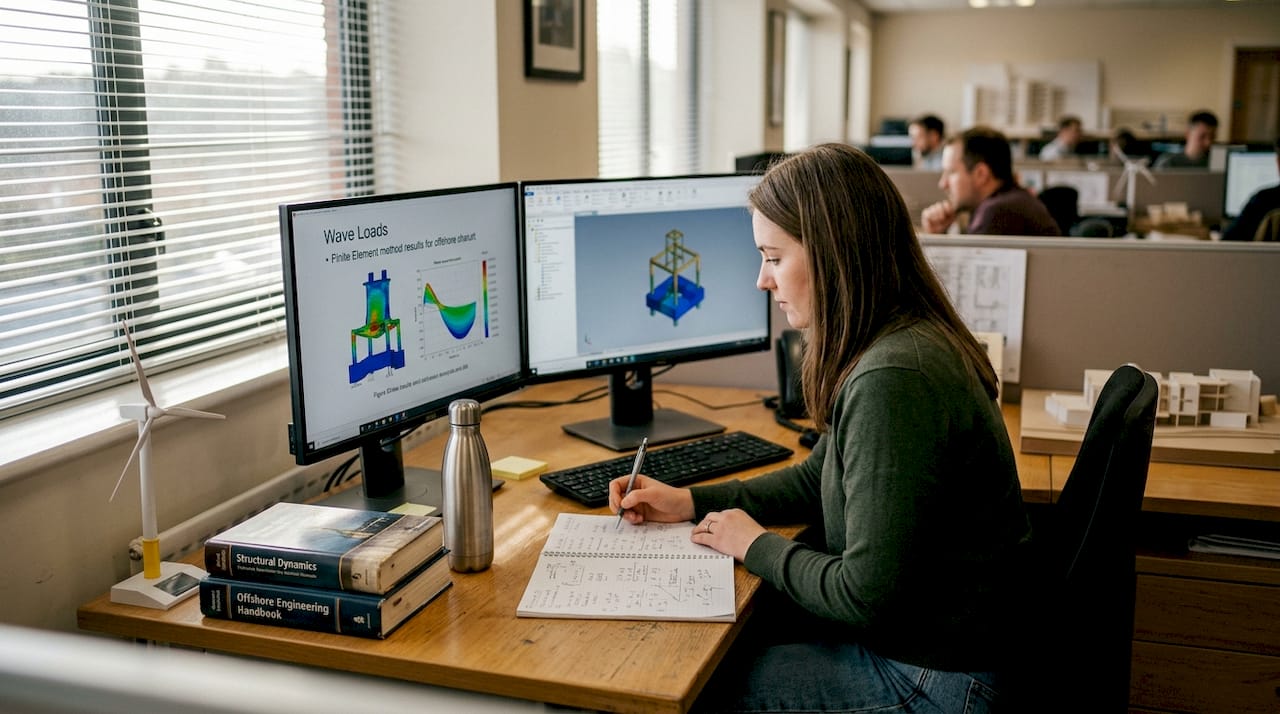
Key mechanics include load and stress analysis for waves, wind, and currents, alongside software tools such as AutoCAD, SolidWorks, STAAD Pro, and ANSYS. These tools allow engineers to model structures digitally and simulate real-world conditions before a single piece of steel is fabricated.
| Software tool | Primary use | Typical application |
|---|---|---|
| AutoCAD | 2D and 3D drafting | Platform layout, piping drawings |
| ANSYS | Finite element analysis | Stress and fatigue modelling |
| SolidWorks | 3D mechanical design | Equipment and component design |
| STAAD Pro | Structural analysis | Jacket and topside frame analysis |
Industry codes and standards are equally important. ISO19901, API RP 2A, and DNVGL-ST are the frameworks that define how offshore structures must be designed, verified, and operated. These are not optional guidelines. They are the legal and contractual backbone of every offshore project, and knowing how to work within them is a core competency.
Design phases also follow a structured sequence. Pre-FEED (Front End Engineering Design) and conceptual design come first, where broad options are assessed and key parameters are set. Detailed design follows, where every component is specified and verified. Understanding where you sit within this process helps you contribute more effectively from day one.
Pro Tip: Dynamic response of turbines under combined wind, wave, current, and seismic loads is one of the most complex challenges in offshore wind engineering. If you want to stand out early in your career, developing even a basic understanding of dynamic analysis will set you apart from candidates who only know static methods.
Fatigue is another area that catches new engineers off guard. Offshore structures experience millions of load cycles over their operational life, and cumulative damage can cause failure even when no single load event was catastrophic. Corrosion compounds this, particularly in splash zones where steel is repeatedly wetted and dried. These edge cases are where experienced engineers earn their reputation.
Skills, training, and certifications for UK offshore engineers
Knowing the theory is one thing. Getting hired and staying safe offshore is another. The UK offshore sector has strict requirements around both technical competence and personal safety, and understanding these requirements early will save you significant time and money.
On the technical side, the skills most in demand include:
- CAD and 3D modelling proficiency
- Structural and stress analysis using industry software
- Knowledge of relevant offshore codes and standards
- Report writing and engineering documentation
- Risk assessment and hazard identification
For safety and regulatory certifications, the picture is equally clear. Professional certifications include Chartered Engineer (CEng) via IMechE or ICE, NEBOSH for health and safety management, and discipline-specific qualifications such as COMPEX for electrical engineers working in explosive atmospheres and welding certifications for structural roles.
For entry-level professionals, OPITO BOSIET (Basic Offshore Safety Induction and Emergency Training) is the minimum requirement for travelling offshore in the UK sector. MIST (Minimum Industry Safety Training) is also widely required. These are not optional extras. Without them, you cannot set foot on an offshore installation.
| Certification | Who needs it | Why it matters |
|---|---|---|
| OPITO BOSIET | All offshore personnel | Mandatory for UK offshore travel |
| MIST | Most offshore workers | Covers safety management basics |
| NEBOSH | Engineers and supervisors | Recognised HSE qualification |
| CEng | Mid to senior engineers | Professional status and credibility |
| COMPEX | Electrical engineers | Required for hazardous area work |
For career and training guidance specific to your discipline, it is worth researching what certifications employers in your target sector actually ask for. Offshore wind employers, for example, may also require GWO BST (Global Wind Organisation Basic Safety Training) alongside BOSIET.
Pro Tip: Do not wait until you have a job offer to book your BOSIET. Completing it in advance signals commitment to employers and removes a common barrier to hiring. Many candidates lose roles simply because they are not immediately deployable.
You can explore offshore engineering careers to understand what entry-level roles look like and which certifications are most commonly requested by UK employers right now.
Career paths, progression, and the future of offshore engineering
Understanding the career ladder in offshore engineering helps you set realistic expectations and plan your development intelligently. The sector rewards technical depth, but it also values people who can lead, communicate, and adapt.
A typical progression looks like this:
- Graduate or junior engineer: Focus on learning software tools, codes, and project processes under supervision
- Offshore design engineer: Taking ownership of specific design tasks, running analyses, and producing deliverables independently
- Senior engineer: Leading technical workstreams, mentoring juniors, and interfacing with clients and contractors
- Lead or principal engineer: Setting technical strategy, approving designs, and managing complex multi-discipline projects
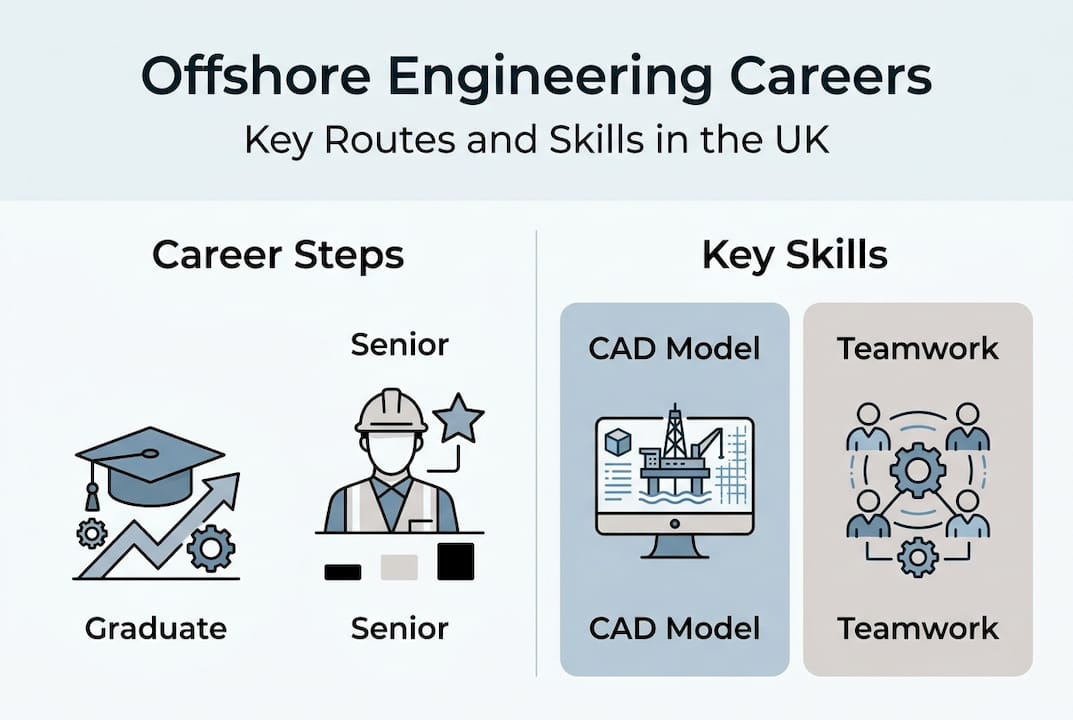
Career progression moves from graduate to senior as engineers build CAD and 3D modelling skills, deepen their knowledge of offshore codes, and demonstrate reliable load analysis capability. Each step requires not just technical growth but also increased accountability.
The offshore wind sector is where the most significant growth is happening right now. Empirical benchmarks for 15MW jacket offshore wind turbines include natural frequencies that must sit between the 1P and 3P excitation bands, soil-pile interaction modelled via API p-y curves, and environmental contour methods used to assess extreme load responses. These are the kinds of technical benchmarks that experienced offshore wind engineers work with daily.
For those entering the field, the key is to build a portfolio of relevant skills rather than waiting for a perfect opportunity:
- Gain exposure to both oil and gas and renewables projects if possible
- Pursue CEng registration early as a long-term goal
- Network within professional bodies like IMechE and the Society for Underwater Technology
- Seek roles with exposure to multiple design phases
The required qualifications for entry-level roles vary by discipline, but a relevant engineering degree combined with BOSIET and demonstrable software skills is a strong starting point. The sector is genuinely hungry for new talent, particularly in renewables.
Our perspective: What aspiring offshore engineers should really focus on
Most guides on offshore engineering give you a checklist: get your degree, book your BOSIET, learn AutoCAD. That checklist is not wrong, but it misses the point of what actually determines whether someone thrives in this industry.
The engineers who progress fastest are not always the most technically gifted. They are the ones who communicate clearly under pressure, who ask good questions, and who take safety culture seriously rather than treating it as a box-ticking exercise. Offshore environments are high-stakes, and teams rely on every individual to behave predictably and responsibly.
We see many candidates who over-invest in accumulating certifications while underestimating the value of genuine teamwork and adaptability. A COMPEX cert will get you through the door. Your ability to work effectively with a diverse crew in challenging conditions will determine whether you build a real career.
Mentorship is also consistently undervalued. Finding someone who has already navigated the entry phase of an offshore career and learning from their specific experience is worth more than any generic training course. Seek it out actively. Continuous professional development matters too, but only when it is targeted and purposeful rather than random course accumulation.
If you are starting out in 2026, prioritise renewables exposure. The energy transition is reshaping the entire sector, and engineers who understand both legacy oil and gas infrastructure and modern wind energy systems will be the most sought-after professionals in the UK market for the next decade.
Take your first steps in offshore engineering
You now have a clear picture of what offshore engineering involves, the tools and certifications that matter, and where the sector is heading. The next step is turning that knowledge into action.

At Offstep UK, we work directly with aspiring offshore professionals to help them cut through the noise and build a focused, realistic plan for entering the sector. Whether you need guidance on which certifications to prioritise, support with your CV, or access to a network of industry contacts, we can help. Explore offshore engineering roles and find out how our structured programmes, mentorship, and career coaching can give you a genuine competitive edge in the UK offshore market. Book a free strategy call and take the first concrete step towards your offshore career today.
Frequently asked questions
What is the main focus of offshore engineering?
Offshore engineering centres on the design and analysis of platforms, wind turbines, and underwater infrastructure in marine environments. It spans oil and gas, wind, and subsea sectors across UK waters.
Which qualifications do I need to start a UK offshore engineering career?
You will typically need a relevant engineering degree, entry-level safety training such as OPITO BOSIET, and may pursue certifications like CEng or COMPEX for progression.
Are offshore engineering roles limited to oil and gas?
No, offshore engineering also includes offshore wind, tidal energy, and new marine infrastructure in the UK. Offshore structures and systems now span multiple clean energy sectors.
What software and standards are commonly used by UK offshore engineers?
Popular tools include AutoCAD, SolidWorks, and ANSYS, with standards like ISO19901 and API RP 2A widely adopted for safety and design across UK projects.
Is offshore wind a good career specialisation?
Yes, offshore wind is a rapidly growing area in UK engineering with high demand for qualified professionals. Renewables growth offers opportunities well beyond traditional oil and gas roles.