
TL;DR:
- Offshore induction is mandatory safety training covering hazard awareness, emergency procedures, sea survival, firefighting, and first aid. The key certification is BOSIET, valid for four years, with training available in classroom, blended, or digital formats. Eligibility requires a medical certificate, swimming ability, and physical fitness; treating induction seriously enhances credibility with employers.
Many people assume that getting into offshore work is purely about having the right technical skills. If you can weld, operate machinery, or read a P&ID, surely you're ready to go? Not quite. Before you set foot on any offshore installation in the UK, you must complete a structured offshore induction programme that covers everything from emergency evacuation to firefighting and sea survival. This guide breaks down exactly what offshore induction involves, which certifications you need, who qualifies, and how the process works in 2026. Whether you're brand new to the industry or switching from onshore roles, this is your starting point.
Table of Contents
- Understanding offshore induction: The basics
- What are the main offshore induction certifications?
- Who needs to complete offshore induction and what are the entry requirements?
- How offshore induction works: Formats and latest developments
- Why offshore induction is more than a tick-box exercise
- Kickstart your offshore career with expert support
- Frequently asked questions
Key Takeaways
| Point | Details |
|---|---|
| Induction is essential | Offshore induction ensures your safety and legal readiness before starting any offshore job. |
| Key certifications matter | BOSIET and related certificates are industry-standard and unlock career opportunities offshore. |
| Prepare with health checks | A valid OGUK/OEUK certificate and good fitness are mandatory for all induction candidates. |
| Formats are evolving | Digital and blended induction courses offer flexible learning but always require hands-on practice. |
Understanding offshore induction: The basics
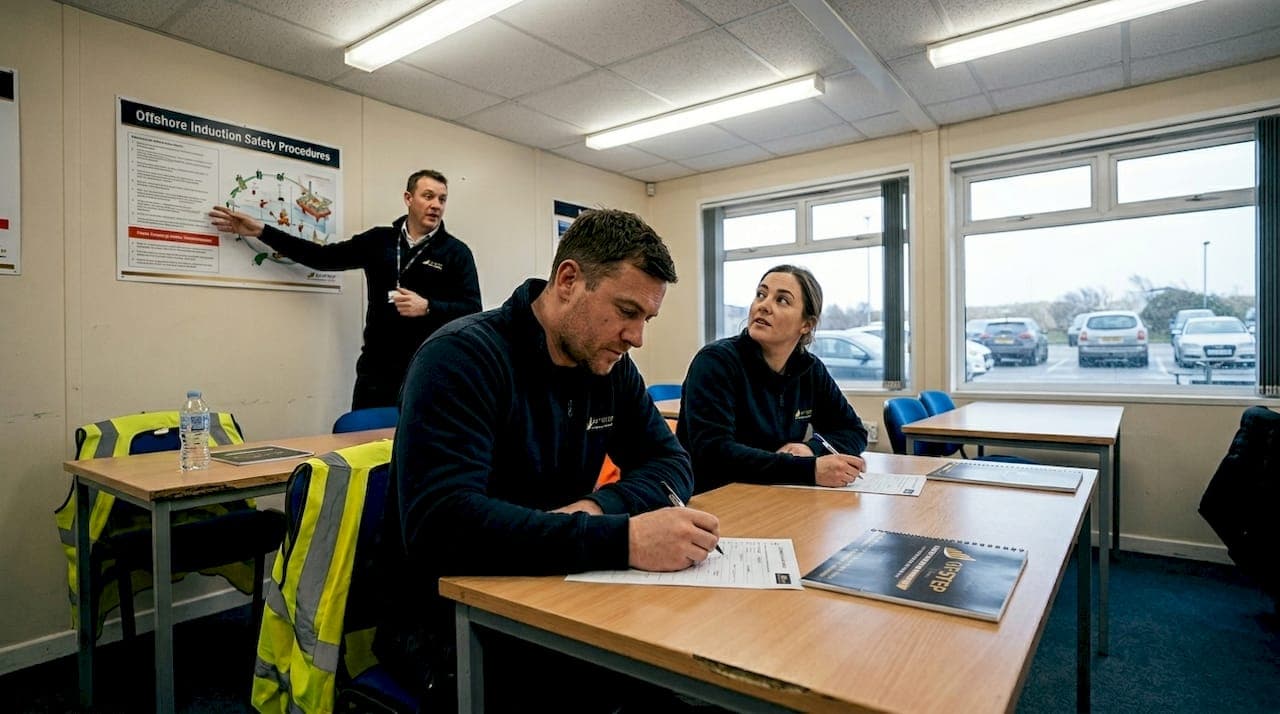
Offshore induction is the mandatory safety and operational training every worker must complete before being permitted to work on an offshore installation. It is not optional, and it is not a formality. The UK offshore sector operates under strict regulatory frameworks, and employers are legally obligated to ensure that every person on their payroll or contractor list has completed the appropriate induction before deployment.
The purpose of offshore induction goes well beyond ticking a compliance box. It genuinely prepares you for an environment that is unlike any onshore workplace. You are working in a remote location, often in harsh weather, surrounded by heavy machinery, flammable materials, and the open sea. The induction is designed to make sure you can respond effectively if something goes wrong.
Typical offshore induction programmes cover the following core areas:
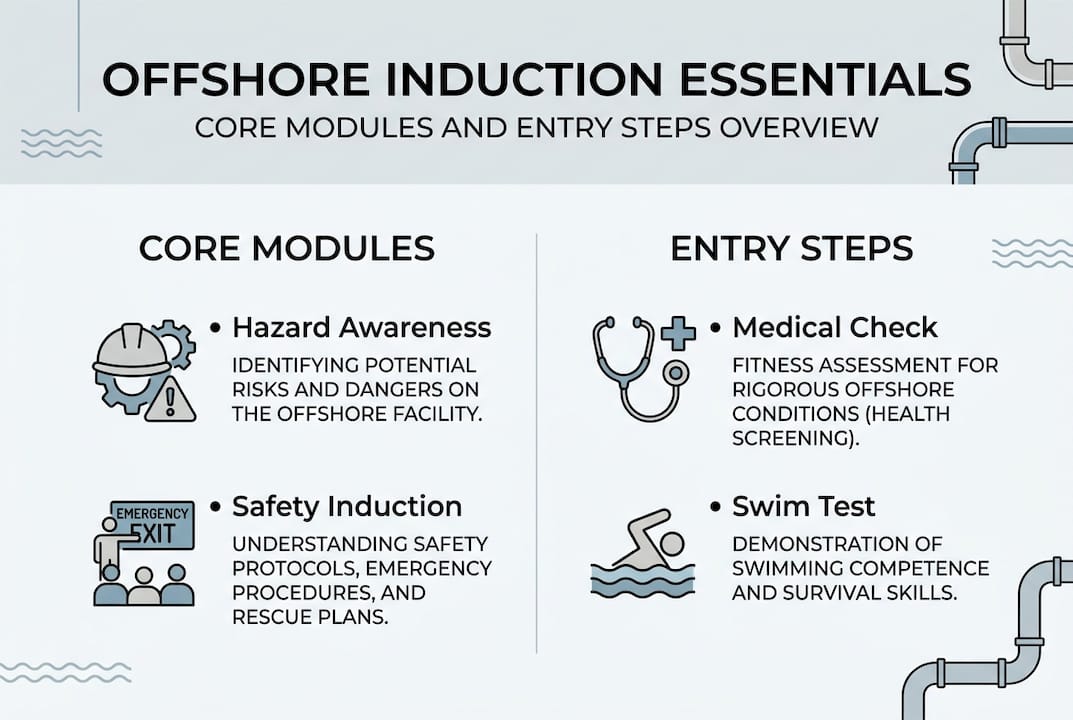
- Safety induction and hazard awareness: Understanding the specific risks present on offshore installations and how to identify them.
- Emergency procedures: What to do in the event of a fire, gas leak, or structural emergency, including muster station protocols.
- Helicopter underwater escape training (HUET): Preparing you for the possibility of a helicopter ditching into the sea during transit.
- Sea survival techniques: Using life rafts, survival suits, and signalling equipment.
- Firefighting and self-rescue: Hands-on training with firefighting equipment and personal escape techniques.
- Basic first aid: Responding to injuries and medical emergencies in a remote setting.
As one widely referenced standard notes, BOSIET covers four core modules: safety induction and hazard awareness, helicopter underwater escape training with CA-EBS, sea survival including life raft procedures, firefighting and self-rescue, and basic first aid.
"Offshore induction is not about scaring you. It is about giving you the confidence and the tools to act decisively when seconds matter."
You can learn more about what to expect from offshore safety induction basics before you book your first course. Understanding the structure ahead of time means you arrive prepared, not overwhelmed.
What are the main offshore induction certifications?
With a basic understanding of offshore induction, it is vital to know which certifications are essential to get started. The most widely recognised and required certification in the UK offshore sector is the BOSIET, which stands for Basic Offshore Safety Induction and Emergency Training.
The BOSIET is the entry-level standard for anyone working offshore in the UK North Sea. It is recognised across operators, contractors, and drilling companies. Without it, you simply will not be permitted to travel to an offshore installation by helicopter.
Here is a summary of the key certifications and how they compare:
| Certification | Full name | Purpose | Validity |
|---|---|---|---|
| BOSIET | Basic Offshore Safety Induction and Emergency Training | Entry-level offshore safety | 4 years |
| FOET | Further Offshore Emergency Training | Renewal of BOSIET after expiry | 4 years |
| MIST | Minimum Industry Safety Training | Onshore/nearshore roles | 4 years |
| GWO BST | Global Wind Organisation Basic Safety Training | Wind energy offshore roles | 2 years |
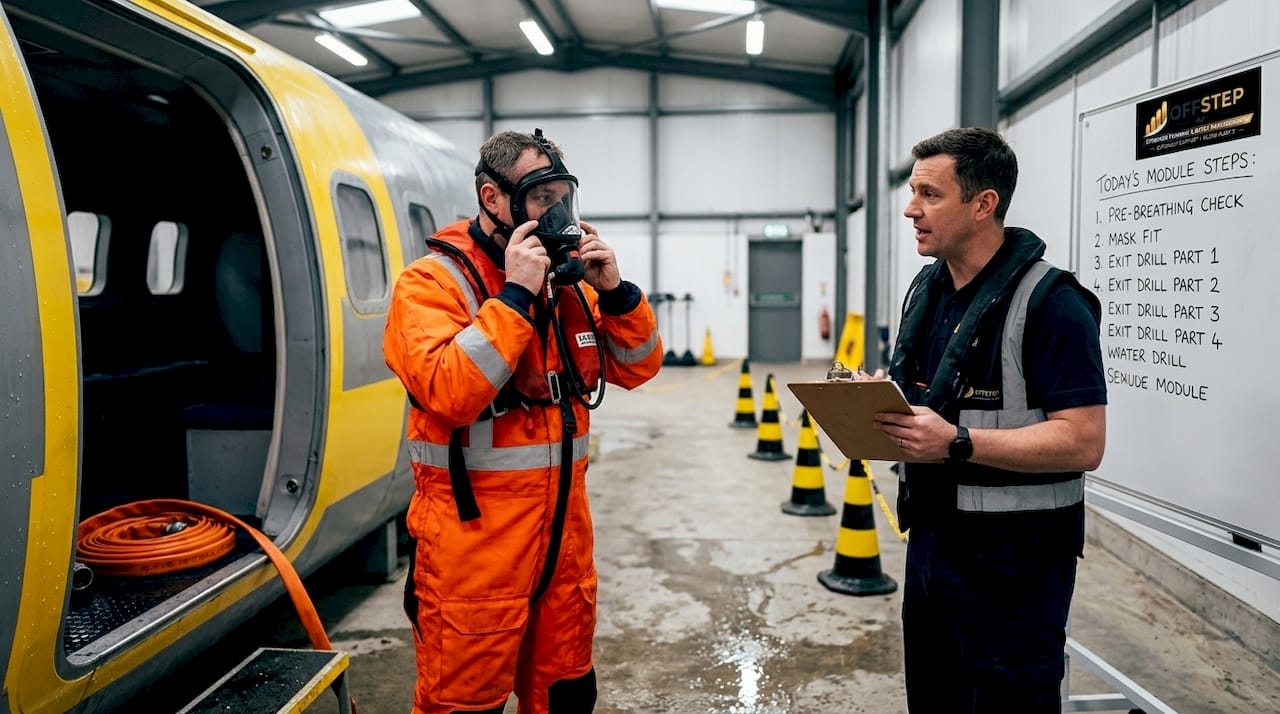
The BOSIET's four core modules, as confirmed by BOSIET requirements, include safety induction and hazard awareness, HUET with CA-EBS, sea survival, firefighting and self-rescue, and basic first aid. These modules ensure you are genuinely prepared for the realities of offshore transit and operations.
Once your BOSIET expires after four years, you do not repeat the full course. Instead, you complete the FOET, which refreshes your skills and updates your knowledge on any regulatory changes. This is important because the industry evolves, and your training should reflect current standards.
Here is a simple numbered pathway for getting your certifications in order:
- Obtain your OGUK/OEUK offshore medical certificate first.
- Book and complete your BOSIET with a recognised provider.
- Ensure your CA-EBS element is included (mandatory for UK North Sea helicopter travel).
- Keep a record of your certificate and expiry date.
- Plan your FOET renewal before your BOSIET lapses.
Pro Tip: Always check that your chosen training provider is approved by an industry body such as OPITO. An unapproved provider's certificate will not be accepted by operators.
Understanding hazard identification procedures is a key part of the BOSIET curriculum, and familiarising yourself with these concepts before your course will give you a genuine advantage.
Who needs to complete offshore induction and what are the entry requirements?
Knowing the certificates is only half the story. Understanding who must complete induction and what you will need to meet the requirements is the next step.
Offshore induction is required for virtually everyone who works on or travels to an offshore installation. This includes:
- Direct employees of oil and gas operators
- Contractors and subcontractors providing technical or support services
- Catering, cleaning, and logistics staff working on installations
- Visitors and inspectors who may spend time offshore
The entry requirements are non-negotiable and exist for very good reason. Working offshore places significant physical and psychological demands on individuals. The medical and age requirements are clearly defined: you need a valid OGUK/OEUK offshore medical certificate confirming fitness for duty, with physical tests including lung function (FEV1/FVC greater than 70 to 80 per cent). The minimum age is typically 16 to 18 depending on the role and employer.
| Requirement | Detail |
|---|---|
| Medical certificate | Valid OGUK/OEUK offshore medical |
| Lung function test | FEV1/FVC ratio greater than 70 to 80% |
| Minimum age | 16 to 18 (role dependent) |
| Educational baseline | No formal qualifications required for BOSIET itself |
| Physical fitness | Able to complete swim test and HUET exercises |
The swim test is worth preparing for specifically. You will need to demonstrate basic swimming ability, as the HUET module involves entering water. If you are not a confident swimmer, practise before your course date.
Pro Tip: Book your offshore medical at least four to six weeks before your BOSIET course. Medical appointments can have waiting times, and you cannot attend the course without a valid certificate in hand.
The fitness requirements are not designed to exclude people unfairly. They reflect the genuine physical demands of emergency procedures offshore, where you may need to swim, climb, or operate equipment under pressure.
How offshore induction works: Formats and latest developments
Once you know you qualify, you will want to understand the options and what the induction process looks like now.
In 2026, offshore induction training is delivered in three main formats:
- Classroom based: Traditional full attendance at a training centre, typically over three to four days.
- Blended learning: Online theory modules completed at home, followed by mandatory in-person practical sessions.
- Digital BOSIET: A newer format where theory is delivered entirely online, but practical assessments including HUET must still be completed in person.
A critical regulatory update that all candidates must be aware of is the CA-EBS requirement. As confirmed by industry standards, CA-EBS became mandatory post-2014 following the CAP1145 review for UK and North Sea helicopter travel. CA-EBS stands for Compressed Air Emergency Breathing System, and it is a device that gives you a short supply of breathable air if a helicopter ditches into the sea. Without training on this device, you cannot legally travel by helicopter to a UK offshore installation.
Digital BOSIET allows online theory but requires in-person practicals, which means you cannot complete the entire course from your living room. The practical elements, particularly HUET, require purpose-built facilities with real water tanks and helicopter mock-ups.
When choosing a provider in 2026, look for the following:
- OPITO approval: The industry's primary accreditation body for offshore training.
- Modern facilities: Particularly for HUET, the quality of the training pool and equipment matters.
- Clear scheduling: Providers should offer flexible booking and clear guidance on what to bring.
- Post-course support: Some providers offer digital records and certificate management.
Pro Tip: If you are completing blended learning, treat the online theory modules seriously. The in-person practical days move quickly, and candidates who have not engaged with the theory often struggle to keep up.
The shift towards digital delivery has made offshore induction more accessible, particularly for candidates in remote areas of the UK. However, the non-negotiable in-person elements ensure that standards remain high.
Why offshore induction is more than a tick-box exercise
Here is something the industry does not always say loudly enough: the candidates who treat offshore induction as a genuine learning experience are the ones who stand out to employers.
We have seen it repeatedly. Two candidates with identical CVs apply for the same entry-level role. One completed their BOSIET and moved on. The other engaged fully, asked questions, practised the drills, and arrived on their first offshore rotation genuinely confident. Supervisors notice that difference within hours.
Emergencies offshore are rare. But the offshore environment is inherently unpredictable, and the industry has shifted significantly towards valuing workers who demonstrate a safety-first mindset from day one. Updated induction programmes, including the CA-EBS requirement and evolving digital formats, reflect the fact that risks and technologies change. Your training should keep pace with that.
Treating induction as a formality is a short-term view. Treating it as the foundation of your offshore career is how you build lasting credibility in a competitive field.
Kickstart your offshore career with expert support
Navigating offshore induction, certifications, and entry requirements on your own can feel like a lot to manage. Knowing which course to book, which medical to get first, and how to present yourself to employers takes time and industry knowledge that most newcomers simply do not have yet.
The Offstep UK platform is built specifically to help you cut through that confusion. From structured guidance on your first certifications to CV optimisation and mentorship from people with real offshore experience, Offstep UK gives you a clear, practical path forward. Book a free strategy call today and find out exactly what your next step should be.
Frequently asked questions
What is offshore induction and why do I need it?
Offshore induction is the mandatory safety and hazard awareness training required before working on offshore facilities. It is essential for legal compliance and personal safety, covering the four core modules of safety induction, HUET, sea survival, and firefighting.
What are the main modules in the BOSIET course?
The BOSIET course covers safety induction and hazard awareness, helicopter underwater escape training with CA-EBS, sea survival including life raft procedures, firefighting and self-rescue, and basic first aid.
Do I need to be physically fit to take offshore induction?
Yes, you need a valid OGUK/OEUK offshore medical certificate showing you are fit for duty, including passing lung function tests with an FEV1/FVC ratio above the required threshold.
What's the difference between in-person and digital BOSIET?
Digital BOSIET delivers theory online but still requires an in-person practical assessment for safety-critical skills such as HUET and sea survival exercises.