
TL;DR:
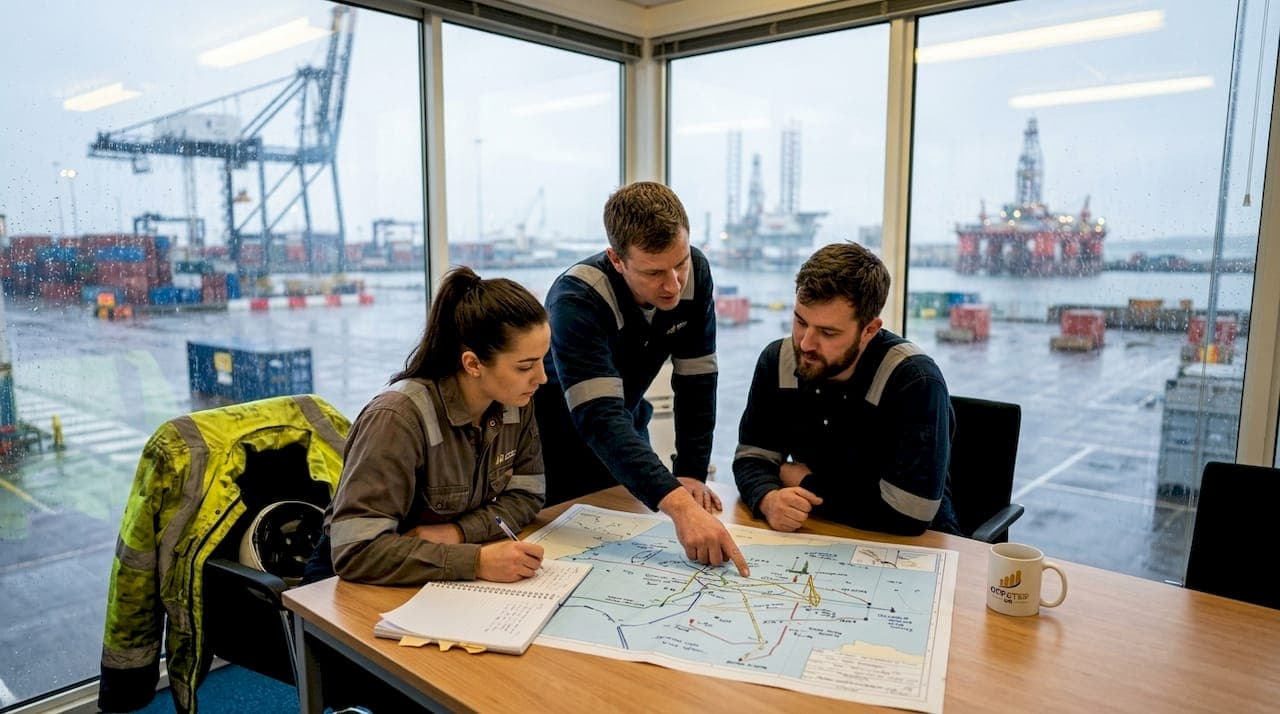
- More than half of UK offshore firms reduced staff last year due to fiscal and technological pressures. The energy transition offers mostly transferable skills but lacks fast-tracked pathways and clear policy support. Emerging technical challenges in floating wind and deepwater operations will require new specialized competencies.
Over half of UK offshore firms cut jobs last year, yet the myth of rock-solid offshore job security persists. The reality is more complicated, and more urgent. Fiscal policy shifts, the renewable energy transition, and emerging technical demands are reshaping the sector faster than most workers realise. If you are currently working offshore, or trying to break in, understanding these forces is not optional. It is the difference between getting ahead and getting left behind. This article cuts through the noise, explaining what is actually happening, why it matters, and what practical steps you can take right now to protect and advance your offshore career.
Table of Contents
- Understanding the current offshore landscape
- The renewable transition and workforce fears
- Skills passports and career pathways
- Emerging technical challenges in offshore work
- What most guides miss about offshore careers
- Building your future offshore: Next steps
- Frequently asked questions
Key Takeaways
| Point | Details |
|---|---|
| Job market is volatile | More than half of firms are reducing offshore jobs, so staying informed is crucial. |
| Skills are transferable | Up to 90% of oil and gas skills transfer to renewables, making reskilling a wise move. |
| Support tools exist | Frameworks like the Energy Skills Passport and apprenticeships help guide career transitions. |
| Technical skills evolving | Emerging trends like floating wind require new expertise and adaptability. |
| Proactivity pays off | Taking action on upskilling and using support puts you ahead of industry shifts. |
Understanding the current offshore landscape
The offshore energy sector has always had its cycles. But what is happening right now feels different. This is not just a market dip. It is a structural shift driven by overlapping pressures, and workers who treat it like a temporary slowdown are taking a serious risk.
The most striking evidence comes from the recent workforce report, which found that over 55% of firms reduced headcount in the past year directly due to the fiscal regime. That is not a minority trend. That is the majority of companies actively making workers redundant because the financial environment makes it too expensive to keep them on.
So what is driving this? Several forces are colliding at once:
- Fiscal regime pressure: The Energy Profits Levy and associated tax changes have reduced operator confidence, leading firms to cut costs aggressively.
- Global market volatility: Oil and gas prices remain unpredictable, making long-term workforce planning difficult for operators.
- Technology displacement: Automation and remote monitoring are reducing the need for certain on-site roles, particularly in inspection and maintenance.
- Energy transition uncertainty: Many firms are holding off on new hires until the policy direction for renewables becomes clearer.
A common misconception is that offshore jobs are inherently more stable than onshore roles because of the specialist nature of the work. This overlooks how exposed offshore workers are to regulatory decisions made in Westminster or Brussels that have nothing to do with their individual performance or skill level.
Here is a snapshot of where things stand across different role types:
| Role type | Short-term outlook | Long-term outlook |
|---|---|---|
| Drilling and well operations | Declining | Moderate if skills transfer |
| Subsea engineering | Stable | Strong, especially in wind |
| Safety and compliance | Stable | Strong across all energy types |
| Marine and logistics | Mixed | Growing in offshore wind |
| Inspection and NDT | Under pressure from automation | Moderate with upskilling |
The workforce reductions overview facing the sector is significant, but it is not uniform. Understanding which roles are under the most pressure, and which offer long-term resilience, is the first step in building a career strategy that actually holds up.
The renewable transition and workforce fears
When workers hear "energy transition," many feel a quiet dread. The assumption is that oil and gas jobs will simply disappear, replaced by a different kind of industry that has no room for people with traditional offshore experience. That fear is understandable, but it is also largely unfounded.
The evidence from energy jobs of the future research is clear: 90% of skills are transferable from oil and gas to renewable energy roles. Rigging, lifting operations, safety management, confined space work, and marine survival skills do not become irrelevant because a platform is generating wind power instead of extracting hydrocarbons.
"The transition is not about replacing offshore workers. It is about redeploying them. The challenge is building the bridges to make that happen."
But the fear exists for a reason. The bridges are not being built fast enough. Without clear policy support for a "just transition" (a managed shift that protects workers rather than abandoning them), many experienced professionals fall through the cracks. They are told their skills transfer, but nobody shows them how to leverage that in practice.
Here is what a genuine transition pathway looks like for most offshore workers:
- Audit your current skills against offshore wind job descriptions. Most workers are surprised by how much already matches.
- Identify the gaps. For many, it is specific certifications like GWO BST (Global Wind Organisation Basic Safety Training) or familiarity with floating wind infrastructure.
- Target roles that straddle both sectors, such as hook-up and commissioning, offshore logistics, or HSE management, where your background is an immediate advantage.
- Engage with your employer's transition plans. Many operators have internal retraining programmes that workers never ask about.
The impact on professional services within the sector is considerable too. Project managers, technical advisors, and procurement professionals face similar pressures and similar opportunities.
Pro Tip: Do not wait for your employer to manage your transition. Build your renewable energy knowledge now by taking one focused course or certification this year. It signals adaptability to any future employer, in any part of the energy sector.
Skills passports and career pathways
Knowing that your skills are transferable is one thing. Proving it to a hiring manager in a completely different part of the energy sector is another. That is where practical tools and formal frameworks become genuinely valuable.

The Energy Skills Passport is one of the most important developments in offshore career management in recent years. In simple terms, it is a recognised framework that records and validates your skills across energy sectors, so employers in wind, hydrogen, or carbon capture can see exactly what your oil and gas background means in their context. Think of it as a translation tool between industries. Instead of rewriting your CV from scratch every time you apply to a renewables firm, the passport does the heavy lifting.
According to career advancement guidance from OEUK's 2025 workforce insight, pathways including the Energy Skills Passport, apprenticeships, and cross-skilling are the most effective routes for workers seeking to move within or across energy sectors.
Here is a comparison of the main pathways available to offshore workers in 2026:
| Pathway | Time investment | Cost | Career impact |
|---|---|---|---|
| Energy Skills Passport | Low, documentation-led | Minimal | High for cross-sector moves |
| GWO BST certification | 2 to 3 days | £300 to £500 | High for offshore wind roles |
| Formal apprenticeship | 12 to 36 months | Funded options available | High for long-term progression |
| Cross-skilling courses | Weeks to months | Variable | Medium to high |
If you are not sure where to start, here is a simple sequence to follow:
- Register for the Energy Skills Passport and input your current qualifications.
- Compare your profile against live job postings in your target sector.
- Identify the one or two certifications that appear most frequently in gaps.
- Complete those certifications, prioritising ones with funded options.
- Update your CV and passport profile, then approach employers directly.
Pro Tip: When applying for roles in renewables, frame your oil and gas experience in terms of outcomes rather than job titles. "Managed safety compliance for a 40-person offshore team" lands better than "Offshore HSE advisor."
Emerging technical challenges in offshore work
Beyond career planning, there is a whole layer of technical and operational change coming that will directly affect what skills are in demand, and which workers will be most sought after.
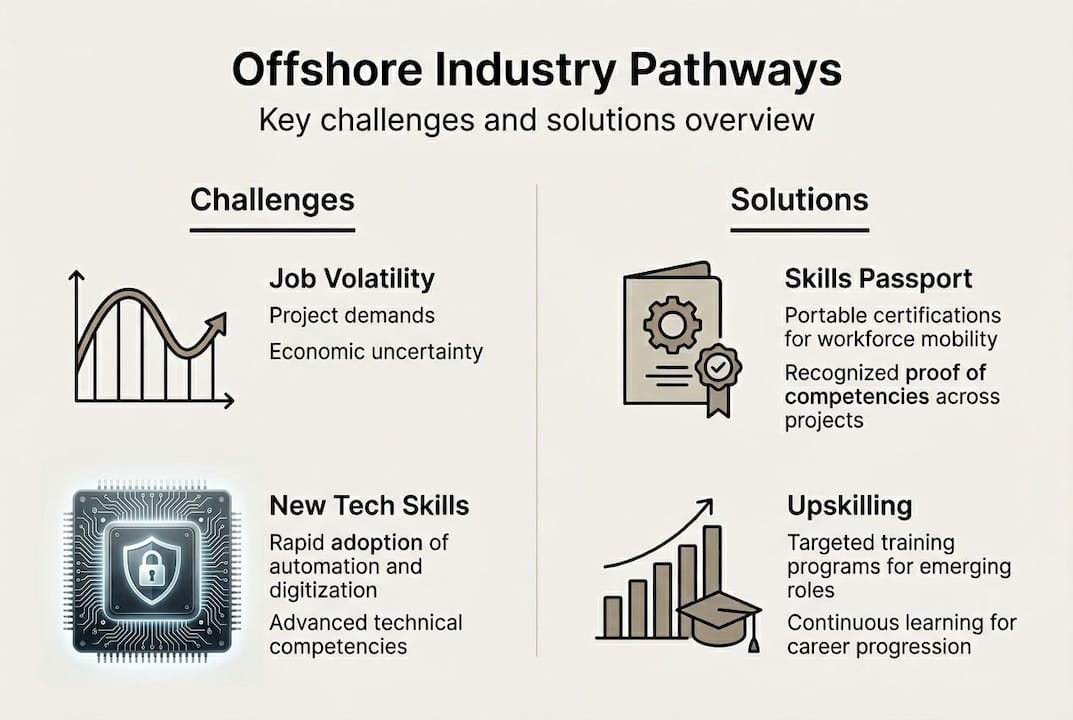
The clearest signal comes from the growth of floating wind and deeper water operations. Fixed-bottom wind turbines are already well established in the UK. But the next wave involves floating platforms in much deeper water, and this creates an entirely different set of engineering and operational challenges. Supply chains are not yet fully equipped to handle this, and there are significant data gaps in geotech and environmental surveys that must be filled before large-scale deployment becomes viable.
One detail that surprises most people is that wake effects exceed climate change as the primary technical concern for wind farm performance. Wake effect refers to the turbulence created by one turbine that reduces the efficiency of others nearby. Solving this at scale requires sophisticated modelling, data analysis, and engineering expertise that currently sits in a niche community.
Key technical areas where skills gaps are already emerging:
- Geotechnical survey and analysis for floating platform anchor systems
- Environmental data collection and interpretation for consenting and planning
- Wake modelling and turbine performance optimisation
- Subsea cable installation and maintenance at greater depths
- Digital twin technology for remote asset monitoring
Here is a snapshot of how these emerging areas compare to traditional offshore roles in terms of skills overlap:
| Technical area | Overlap with oil and gas skills | New skills required |
|---|---|---|
| Floating wind installation | High | Mooring systems, dynamic cables |
| Geotechnical surveys | Medium | Specialist software, marine geology |
| Wake effect analysis | Low | Data science, CFD modelling |
| Subsea cable systems | Medium | High-voltage, fibre optic knowledge |
For workers wanting to stay relevant, the most practical move is to start engaging with at least one of these technical areas now, even informally. Reading industry reports, attending webinars, or connecting with engineers already working in these areas builds the awareness that employers notice in interviews.
What most guides miss about offshore careers
Most career guides for offshore workers focus heavily on certifications and job boards. Both matter. But they miss something more fundamental: the workers who consistently navigate industry disruption well are not the ones with the most qualifications. They are the ones who stay engaged, ask questions, and actively use every support mechanism available to them.
Advocacy matters more than most people realise. Unions, professional bodies, and industry groups are actively shaping the policies that will determine your career options for the next decade. Workers who engage with these groups, even minimally, gain early access to information and influence over outcomes that passive observers never get.
Adaptability is also consistently undervalued. Offshore employers are not just hiring for what you know today. They are assessing whether you can learn quickly in unfamiliar environments. Demonstrating that you have already taken steps to understand floating wind or skills passport frameworks tells an employer more about your future value than a polished CV does.
The hidden advantage in all of this? The workers who engage with emerging technical challenges now are positioning themselves as early experts in areas where the industry will desperately need people within five years. That is not luck. That is strategy.
Building your future offshore: Next steps
The offshore sector is changing fast, but change creates opportunity just as much as it creates uncertainty. You now have a clearer picture of the pressures, the pathways, and the practical steps available to you.
Offstep UK exists to help you turn that clarity into action. Whether you are trying to enter the offshore industry for the first time, or you are an experienced worker looking to adapt your career to the energy transition, Offstep UK's resources provide structured guidance, CV support, certification advice, and direct mentorship from people who have navigated these same challenges. Book a free strategy call and get a personalised plan built around where you are right now, and where you want to be.
Frequently asked questions
What are the biggest threats to job security in the UK offshore sector?
The main threats are fiscal regime changes, shrinking firm budgets, and the absence of a clear policy framework for the renewable transition. The 55% of firms that cut headcount last year did so primarily because of tax and regulatory pressure, not market demand alone.
How can offshore workers transfer their skills to renewables?
Ninety percent of skills are considered transferable, but workers often need targeted upskilling and formal recognition through tools like the Energy Skills Passport to make that transfer credible to new employers.
What is the Energy Skills Passport?
It is a framework that officially records and validates your skills across energy sectors, helping workers demonstrate their value when moving from oil and gas into renewables or other parts of the energy workforce insight landscape.
Which technical trends will shape offshore jobs in the next decade?
Floating wind, deeper water operations, and supply chain digitalisation will reshape technical skill requirements significantly, with offshore wind challenges around geotechnics and wake modelling creating new specialist roles that currently have very few qualified candidates.