

Skilled candidates miss offshore roles every single day, not because they lack the right experience, but because their CV fails to communicate it clearly. With 55% of UK offshore firms having recently reduced headcount, the competition for every available position has sharpened considerably. Recruiters are processing hundreds of applications at speed, and a CV that does not immediately signal relevance gets set aside. If you are serious about breaking into offshore work or making a career change within the UK energy sector, your CV is not a formality. It is your first and often only chance to make the cut.
Table of Contents
- Why offshore recruitment relies so heavily on your CV
- What recruiters look for: transferable skills and offshore readiness
- How to tailor your CV for offshore roles
- Common pitfalls that sink promising applications
- How Offstep UK can support your offshore job journey
- Frequently asked questions
Key Takeaways
| Point | Details |
|---|---|
| Tailored CVs win interviews | A well-structured, role-specific CV is the key to breaking into offshore roles in a competitive UK sector. |
| Transferable skills matter | Reframing your existing oil and gas experience for renewables can showcase up to 90% relevant skills. |
| Avoid one-size-fits-all | Customising your CV to each job, including certifications like GWO and NEBOSH, boosts interview chances. |
| Mind the screening process | Understanding automated and manual CV screening helps you sidestep common rejection pitfalls. |
Why offshore recruitment relies so heavily on your CV
Understanding the scale of the challenge helps. Offshore recruitment teams are not leisurely browsing applications over a coffee. They are managing high volumes under real time pressure, often with outsourced or automated screening tools doing the initial filtering. Manual CV screening costs firms roughly £80,000 per year when processing around 500 CVs monthly, which is precisely why companies have invested in faster, more systematic filtering. If your CV does not pass that first filter, no one ever reads about your decade of rig experience.
The importance of a well-structured CV cannot be overstated in this context. With headcount reductions across the sector, firms are hiring fewer people but expecting more from each hire. That means the bar for what counts as a relevant, credible application has risen sharply. A single CV must now demonstrate both your current competencies and your ability to adapt to evolving offshore needs, whether that is traditional oil and gas operations or the growing renewables sector.
"Recruiters are not looking for the most experienced candidate. They are looking for the most clearly relevant one." This distinction matters enormously when you are tailoring your application.
| Screening method | Average time per CV | Annual cost estimate |
|---|---|---|
| Manual human review | 6 to 8 minutes | ~£80,000 per year |
| Automated ATS filtering | Under 10 seconds | Significantly lower |
| Hybrid (ATS then human) | 2 to 3 minutes | Moderate |
The table above illustrates why your CV must perform well at every stage. An ATS (Applicant Tracking System) scans for keywords and structure before a human ever sees your name. A recruiter then spends only minutes deciding whether to progress you. Both stages demand precision.
What recruiters look for: transferable skills and offshore readiness
Now that we know why your CV is the gatekeeper, let us break down what recruiters are actually seeking from it. The good news for career changers is significant. Career changers leverage 90% transferable skills from oil and gas into renewables roles by reframing their experience and upskilling with targeted certifications. The technical foundation you have built in one part of the energy sector is far more portable than most people realise.
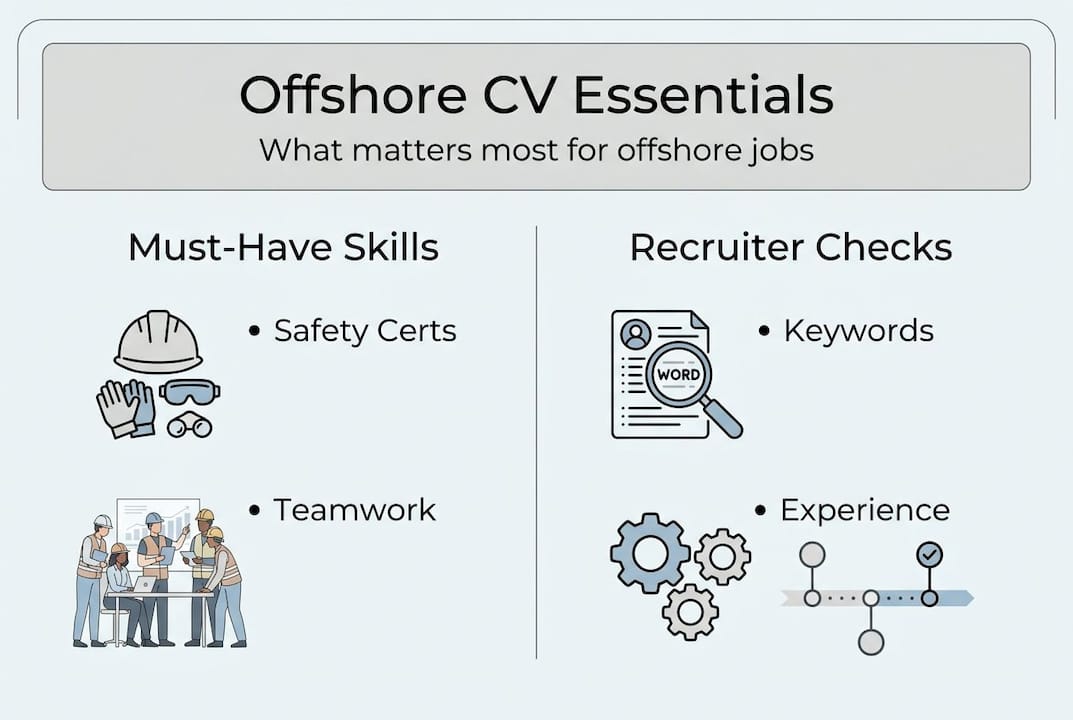
Recruiters in offshore roles are scanning for a combination of hard skills, safety awareness, and cultural fit. Certifications like GWO (Global Wind Organisation) Basic Safety Training and NEBOSH (National Examination Board in Occupational Safety and Health) are not just nice to have. They signal that you understand the offshore safety environment and have invested in your own readiness. Highlighting relevant experience on your CV in a way that connects your background to these requirements is what separates shortlisted candidates from the rest.

Core versus secondary skills: what to prioritise
| Core skills (must appear prominently) | Secondary skills (support your case) |
|---|---|
| Safety certifications (GWO, BOSIET, NEBOSH) | Project management experience |
| Technical trade qualifications | Communication and reporting skills |
| Offshore or marine environment experience | Problem solving under pressure |
| Compliance and risk awareness | Teamwork and crew coordination |
Beyond the hard skills, recruiters are also assessing softer indicators of offshore readiness:
- Adaptability: Can you work in rotating shift patterns and remote environments?
- Safety culture: Do you demonstrate a proactive approach to hazard identification?
- Team outcomes: Have you contributed to measurable improvements in safety or efficiency?
- Upskilling: Are you actively developing your qualifications for the evolving sector?
Pro Tip: If you are transitioning from a land-based role, use your CV summary to explicitly state your offshore career intent and list any offshore-relevant certifications you hold or are currently pursuing. Recruiters appreciate clarity over ambiguity.
How to tailor your CV for offshore roles
Understanding the skills that matter is just the start. Here is how you can reshape your CV to stand out in a crowded field. The single most effective technique is mirroring the language used in the job description. Offshore job postings use specific terminology, and your CV should reflect that terminology back. If a posting mentions "dynamic positioning awareness" or "permit to work systems," those exact phrases need to appear in your CV if they genuinely apply to your background.
Effective CV structures for offshore roles typically lead with a focused professional summary, followed by a certifications block, then a reverse-chronological work history with quantified achievements. Burying your BOSIET or GWO certification on page two is a common and costly mistake. Put your most relevant credentials where they are impossible to miss.
Here is a practical sequence to follow when tailoring your CV for each offshore application:
- Read the job description carefully and highlight every skill, certification, and experience requirement mentioned.
- Map your own background against those requirements, noting where you have direct experience and where you have adjacent or transferable skills.
- Rewrite your professional summary to reflect the specific role, not a generic overview of your career.
- Move your certifications section to the top third of your CV, directly beneath your summary.
- Quantify your achievements wherever possible. "Reduced incident rate by 18% over 12 months" is far stronger than "responsible for safety compliance."
- Remove irrelevant experience that does not support your offshore candidacy. A leaner, more focused CV outperforms a lengthy one every time.
- Check for ATS compatibility by using standard section headings and avoiding tables, graphics, or unusual fonts in the main body.
"Reframing experience is key," as noted in OEUK's Workforce Insight 2025, with professionals successfully transitioning FPSO operations skills directly into foundation installation roles in offshore wind.
Pro Tip: Create a master CV containing all your experience and skills, then build tailored versions from it for each application. This saves time while ensuring every submission is genuinely targeted.
Common pitfalls that sink promising applications
While you apply these strategies, it is just as vital to sidestep the pitfalls catching too many strong candidates out. The most damaging errors are often the most avoidable ones. Poorly targeted CVs are filtered out swiftly by both automated tools and experienced recruiters, particularly when outsourced screening is involved. A generic CV signals a lack of genuine interest in the specific role.
Here are the most common mistakes we see from offshore applicants:
- Sending the same CV for every role. Each offshore position has distinct requirements. A subsea engineer role and a deck operations role demand different emphasis, even if your background spans both.
- Missing or buried certifications. If a recruiter cannot find your BOSIET or GWO within the first glance, they may assume you do not have it.
- Vague job descriptions. Listing "responsible for safety" tells a recruiter nothing. Describe what you actually did, how you did it, and what the outcome was.
- Poor ATS formatting. Complex layouts, headers in text boxes, and graphics can cause ATS software to misread or skip your CV entirely.
- Unexplained employment gaps. Offshore recruiters understand that contract work creates gaps, but unexplained ones raise questions. A brief note is all it takes.
- No evidence of upskilling. In a sector undergoing rapid transition, candidates who show active investment in new certifications stand out from those who do not.
Structuring CVs for offshore jobs with these pitfalls in mind is not about gaming the system. It is about communicating your genuine value as clearly and efficiently as possible.
Pro Tip: Before submitting any CV, paste the job description and your CV into a free keyword comparison tool. If fewer than 60% of the key terms from the job description appear in your CV, revise before sending.
How Offstep UK can support your offshore job journey
With pitfalls avoided and a stronger CV taking shape, the next step is making sure your entire application strategy is working as hard as you are. Building a competitive offshore CV is one piece of the puzzle, but knowing how to position yourself across the full recruitment process is what consistently gets people hired.
At Offstep UK, we work directly with job seekers and career changers in the UK energy sector to sharpen their CVs, identify the right certification pathways, and build recruitment strategies that actually open doors. Whether you are pursuing your first offshore role or repositioning your oil and gas experience for the renewables market, our offshore CV and job support programmes are built around the realities of how offshore hiring actually works. Book a free strategy call and find out exactly where your CV stands and what it would take to get you shortlisted.
Frequently asked questions
How do I highlight transferable oil and gas skills for offshore renewables?
Reframe your experience to match renewables requirements and add upskilling qualifications like GWO or NEBOSH. Career changers leverage 90% transferable skills from oil and gas to renewables by reframing experience and adding targeted certifications.
What is the most common CV mistake in offshore recruitment?
Generic or untailored CVs that fail to spotlight relevant certificates or skills are quickly filtered out. Manual CV screening filters poorly targeted CVs swiftly, especially when automated or outsourced tools are involved.
Should I include every past offshore job or just the most relevant?
Focus on roles that align with the job description, using specifics and measurable achievements rather than a full career history. A targeted CV consistently outperforms a comprehensive one in offshore recruitment.
Why do UK offshore recruiters prioritise CV-based screening?
It allows firms to efficiently filter hundreds of candidates for essential skills and compliance before investing time in interviews. Manual screening costs ~£80k per year for 500 CVs monthly, which shows how essential efficiency is to the process.
Do I need offshore certifications before applying for entry-level roles?
Not always, but holding or actively pursuing certifications like BOSIET or GWO BST significantly improves your chances of being shortlisted, even for entry-level positions.