
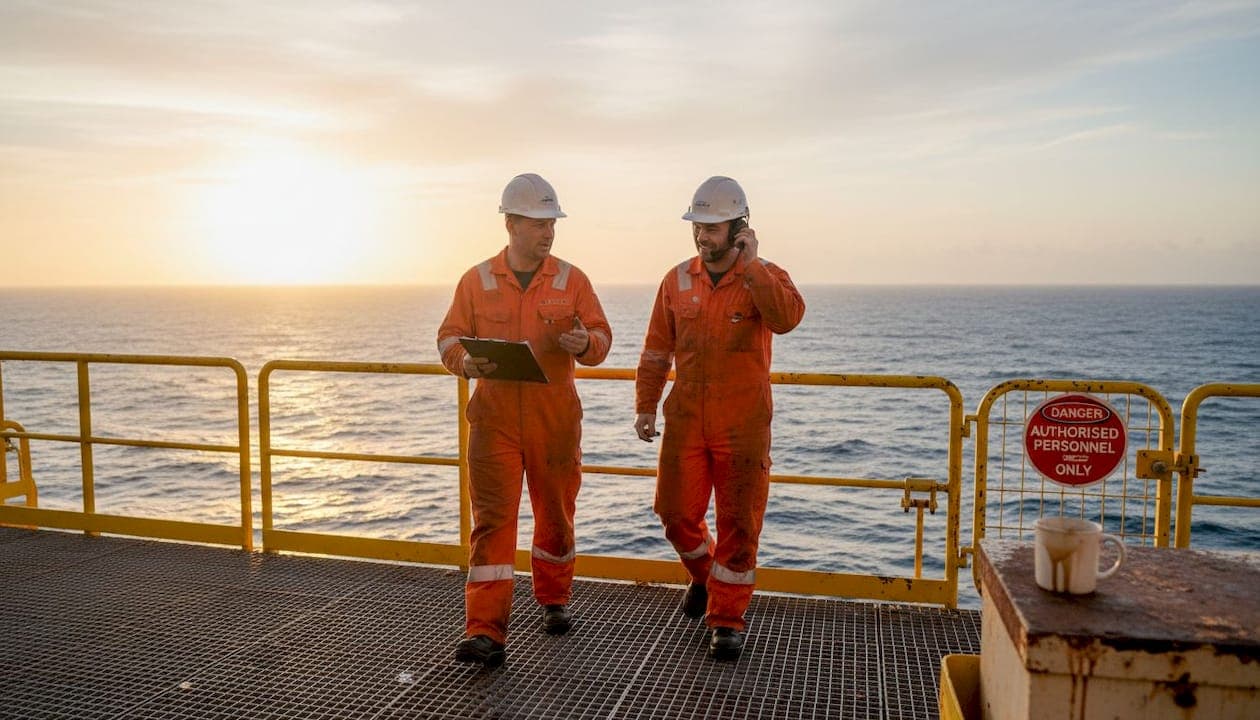
TL;DR:
- Offshore work involves structured shifts, routine tasks, and a combination of oil, gas, and renewable energy roles.
- Entry requires certifications like BOSIET and medical checks, with progression possible through experience and additional training.
- Despite high pay, offshore life presents challenges such as isolation, physical demands, and mental health considerations.
Most people picture offshore work as one of two extremes: a punishing slog in brutal conditions, or a well-paid holiday with the odd spanner thrown in. Neither version is accurate. The reality is a structured, demanding, and genuinely rewarding career path that suits people who can handle routine, isolation, and physical work in equal measure. The UK offshore sector is also changing fast, with renewables reshaping what jobs exist and who is needed to fill them. This article walks you through the real picture: what the industry looks like now, what a typical day involves, how to get in, and what the honest trade-offs are.
Table of Contents
- The modern offshore industry: Key facts and UK context
- A typical day offshore: Routine, shifts, recreation, and facilities
- Entry and progression: Training, requirements, and getting started
- Benefits and challenges: Pay, time at sea, health and wellbeing
- Our perspective: Why understanding offshore life is crucial (and often overlooked))
- Next steps: Resources to help you prepare for offshore life
- Frequently asked questions
Key Takeaways
| Point | Details |
|---|---|
| Structure matters | Offshore life runs to a strict routine, with work, sleep, and play carefully scheduled. |
| Upfront preparation | All UK offshore jobs demand BOSIET training, fitness, and a clear understanding of what the environment requires. |
| Shifting opportunities | With the North Sea in transition, new jobs in renewables offer similar lifestyles to traditional oil and gas. |
| Balancing benefits and challenges | High pay and time off attract many, but the isolation and shift demands require personal resilience. |
The modern offshore industry: Key facts and UK context
The North Sea remains central to UK energy, even as output from traditional oil and gas fields gradually declines. 75% of UK energy still comes from oil and gas, which means the industry is far from finished. What is changing is the mix of work available and the long-term direction of travel.
Offshore wind is growing rapidly, and many of the roles in that sector mirror what you would find on an oil and gas platform. Technicians, maintenance engineers, catering staff, and logistics coordinators are all needed on wind installations just as they are on drilling rigs. The lifestyle similarities are significant: rotational shifts, helicopter transfers, shared accommodation, and extended periods away from home.
Here is a snapshot of the main work environments you might encounter:
| Work environment | Primary activity | Typical role types |
|---|---|---|
| Oil and gas platform | Drilling, production | Roustabout, technician, engineer |
| Floating production vessel | Processing, storage | Maintenance, safety, catering |
| Offshore wind installation | Turbine operation | Technician, rigger, logistics |
| Construction support vessel | Installation, survey | Diver, surveyor, crane operator |
The range of roles is broader than most people assume. You do not need to be an engineer to work offshore. Catering, cleaning, administration, and safety support roles are all part of the crew complement on most platforms and vessels.
Key sectors currently active in the UK offshore space:
- Oil and gas production on ageing North Sea fields
- Offshore wind across the Scottish, English, and Welsh coasts
- Decommissioning of older platforms, which is a growing area of work
- Cable laying and subsea construction supporting the energy transition
"The North Sea is not dying. It is transforming. Workers who understand both the traditional and renewable sides of the industry will have the most options over the next decade."
The energy transition creates genuine opportunity, but it also creates uncertainty. Fields are being extended while new wind farms are commissioned. For anyone considering an offshore career, that means the window for entry is open, but the skills you build today should ideally transfer across both sectors.
A typical day offshore: Routine, shifts, recreation, and facilities
Understanding the industry's direction helps frame what daily life is actually like on a platform or vessel. And the honest answer is: structured, repetitive, and more comfortable than most outsiders expect.
A standard offshore day begins around 05:30 to 06:00. You eat breakfast, attend a safety briefing, and start your 12-hour shift. Meals are provided throughout the day, and the galley (the onboard kitchen and dining area) is typically open around the clock. After your shift ends, you have time to shower, eat again, use the gym, watch television, or connect to the internet before lights out around 22:00.
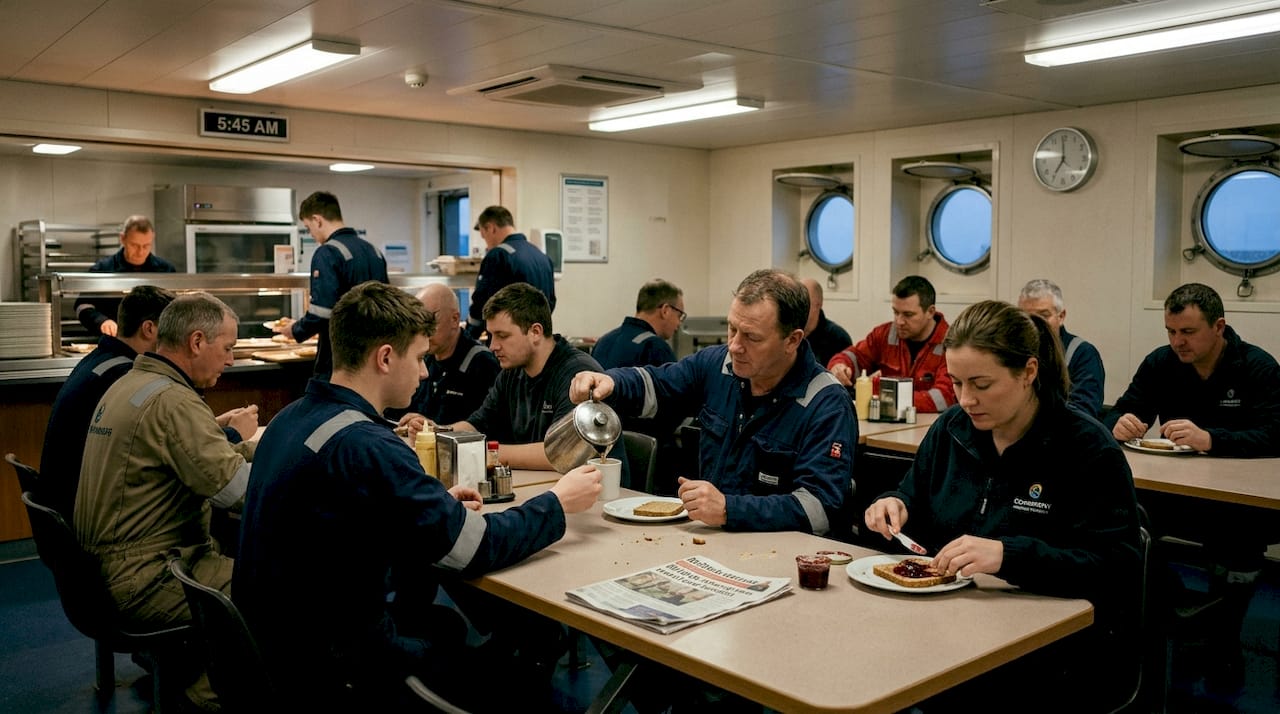
Shift systems vary by company and location, but the most common rotation is two weeks on, two weeks off. Some roles run on a three-weeks-on, three-weeks-off pattern. During your time offshore, every day follows the same rhythm. That predictability is either a comfort or a challenge depending on your personality.
Here is how an oil and gas rotation compares to an offshore wind role:
| Factor | Oil and gas platform | Offshore wind installation |
|---|---|---|
| Typical rotation | 2 on / 2 off or 3 on / 3 off | 2 on / 2 off or shorter trips |
| Shift length | 12 hours | 12 hours |
| Accommodation | Shared cabin, onboard | Shared cabin or shore-based |
| Transfer method | Helicopter | Helicopter or crew transfer vessel |
| Internet access | Usually available | Usually available |
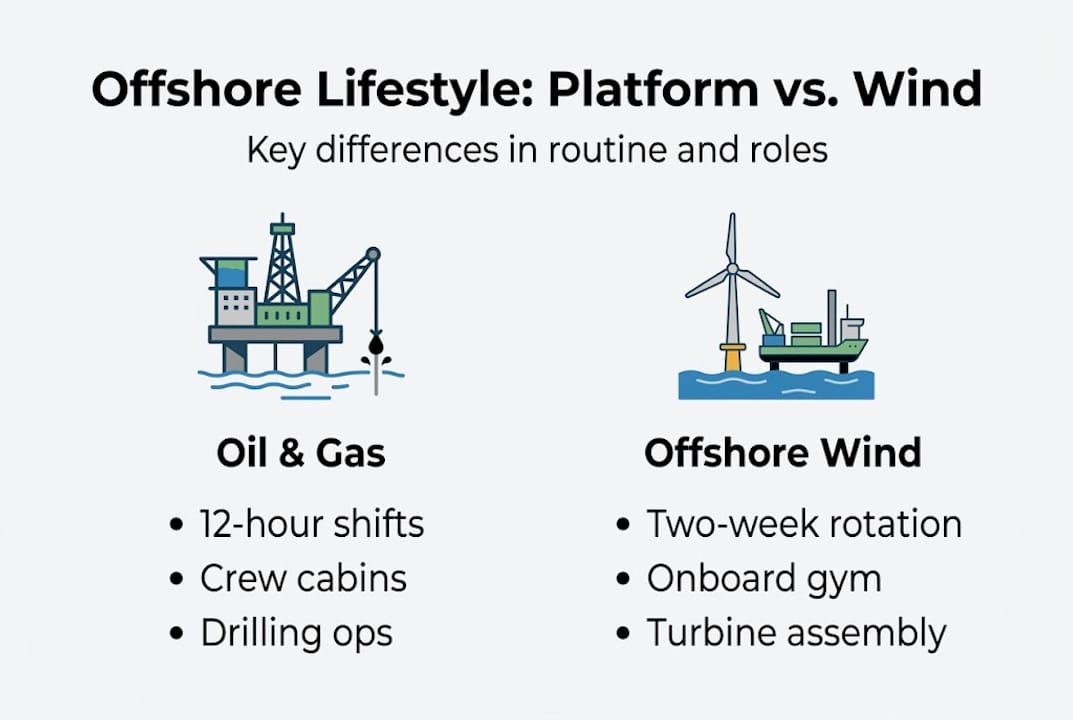
Living conditions have improved considerably over the past two decades. Most modern platforms and vessels offer single or double-occupancy cabins, well-equipped gyms, cinema rooms, and reliable Wi-Fi. You are not roughing it. That said, the space is limited, privacy is minimal, and you are sharing your environment with the same group of people for weeks at a time.
Common leisure activities available during downtime include:
- Gym sessions and cardio equipment
- Streaming services and onboard cinema
- Card games, board games, and pool tables
- Video calls home via Wi-Fi
- Reading and personal study
Pro Tip: Use your offshore rotation deliberately. Many workers study for additional qualifications or certifications during downtime. Two weeks offshore with structured free time is a genuine opportunity to advance your skills without the distractions of home life.
Managing sleep is more important than most newcomers realise. A consistent bedtime routine, limiting screen time before sleep, and staying physically active all make a meaningful difference to how you feel by week two of your rotation. Exploring offshore crew facilities before you start can help you plan what to bring and what to expect.
Entry and progression: Training, requirements, and getting started
Now that you know what daily life involves, let's look at the critical first steps to starting your offshore career.
Every person who works offshore in the UK must hold a BOSIET certificate. BOSIET stands for Basic Offshore Safety Induction and Emergency Training. It is valid for four years and covers helicopter underwater escape training (HUET), firefighting, sea survival, and first aid. Without it, you cannot board a platform or vessel. Full stop.
Alongside BOSIET, you need a valid OGUK medical certificate. OGUK (Offshore Energies UK) sets the medical fitness standard for offshore workers. The examination checks your cardiovascular health, vision, hearing, and general fitness. It is not a gruelling test, but it is thorough, and some conditions may restrict your eligibility.
Here is a summary of the core entry requirements:
| Requirement | Details | Validity |
|---|---|---|
| BOSIET | Safety induction including HUET | 4 years |
| OGUK medical | Full fitness examination | 2 years |
| Enhanced DBS check | Background check for some roles | Ongoing |
| Role-specific training | Depends on trade or discipline | Varies |
A typical entry pathway looks like this:
- Research roles that match your existing skills or background
- Book and complete your BOSIET training (typically 2 to 3 days)
- Obtain your OGUK medical certificate
- Build a targeted CV that reflects offshore requirements
- Apply directly to contractors, operators, or through specialist recruiters
- Complete onboarding and any site-specific inductions
Pro Tip: Do not wait until you have a job offer to get your BOSIET. Completing it in advance signals seriousness to employers and removes a common barrier to being hired quickly.
Progression from entry-level roles is achievable with time and the right certifications. A roustabout (a general labourer on a drilling rig) can move into roughneck roles, then into more technical positions with additional training. Catering staff can progress to catering supervisor. Safety roles can lead to offshore safety officer positions. The ladder exists, but you have to be intentional about climbing it.
Benefits and challenges: Pay, time at sea, health and wellbeing
You've got the entry requirements. Now it's time for the honest pros and cons of making offshore life work.
The financial rewards are real. Entry-level offshore roles typically pay significantly more than equivalent onshore positions, partly because of the conditions and partly because of the compressed working pattern. When you are offshore, your accommodation and food are covered, which means your salary goes further than it might appear on paper. Extended leave periods also allow some workers to take on other projects, study, or simply spend quality time with family.
The challenges are equally real:
- Isolation from family and friends during rotations is consistently cited as the hardest part of offshore life
- Physical demands of 12-hour shifts in industrial environments accumulate over time
- Mental health can suffer without proactive management, particularly for those new to the lifestyle
- Relationship strain is common, especially in the early stages when routines are still being established
- Unpredictable rosters due to weather, operational changes, or emergencies can disrupt planned leave
The industry has made genuine progress on mental health support. Most operators now provide access to employee assistance programmes and confidential counselling services. But the culture offshore is still one where asking for help does not always feel easy, particularly for newer workers.
"The debate around new North Sea fields reflects a broader tension: the industry provides livelihoods for tens of thousands of UK workers, while also contributing to carbon emissions that the country has committed to reducing."
For families, the offshore rotation can actually work well once everyone adjusts. Two weeks off is genuine, uninterrupted time at home. Many offshore workers describe being more present during their leave than colleagues who commute daily but are mentally elsewhere. The adjustment period, however, is not trivial and should not be underestimated.
Our perspective: Why understanding offshore life is crucial (and often overlooked)
Here is something we see repeatedly: people arrive at their first offshore rotation having prepared their certifications but not their mindset. They have the BOSIET, they have the medical, and they have absolutely no idea how they will handle 14 days of the same faces, the same corridors, and the same routine.
The ones who thrive are not necessarily the toughest or the most experienced. They are the ones who went in with realistic expectations, a plan for their downtime, and a willingness to build relationships with their crew. Offshore life rewards people who are adaptable and self-aware, not just technically competent.
We also think the energy transition is being underestimated as a career opportunity. Skills built on oil and gas platforms transfer directly to offshore wind. The workers who position themselves across both sectors now will have far more security and choice in the years ahead. Waiting to see how things develop is a strategy, but it is not a particularly good one.
Preparation is not just about ticking boxes. It is about knowing what you are walking into and being honest with yourself about whether it fits your life.
Next steps: Resources to help you prepare for offshore life
Ready to act? Here's where you can build on what you've learned and take your next step.
Knowing what offshore life involves is only the beginning. The gap between understanding and actually getting hired is where most people get stuck, and that is precisely where structured support makes the biggest difference.
At Offstep UK, we work with people at every stage of the offshore journey, from those who have never set foot on a platform to workers looking to move into supervisory roles. Our offshore career resources include certification guidance, CV coaching, and one-to-one mentorship from people who have actually worked offshore. If you are serious about making this career work, a free strategy call is the most efficient first step you can take.
Frequently asked questions
What does a typical offshore work schedule look like?
Most offshore workers follow 12-hour shifts on a two-weeks-on, two-weeks-off rotation, with days built around work, meals, and leisure time in the evenings.
What qualifications do I need to work offshore in the UK?
At minimum, you need a BOSIET certificate and a valid OGUK medical, both of which confirm your safety training and physical fitness for offshore environments.
Is offshore work only about oil and gas?
No. While oil and gas remain dominant, offshore wind jobs are growing steadily and offer very similar rotations, facilities, and working conditions to traditional platforms.
How do I cope with life away from home when working offshore?
Building a consistent daily routine, staying in regular contact with family via onboard Wi-Fi, and using gym and leisure facilities are the most effective ways to manage the adjustment.