

TL;DR:
- Offshore pay combines salary, allowances, bonuses, and rotas affecting annual earnings.
- Oil and gas still pays more, but the gap is narrowing as offshore wind increases its rates.
- Career progression depends on certifications, experience, and sector switches, impacting long-term pay.
If you think offshore pay is simply a number on a job advert, you're leaving serious money on the table. Offshore pay structures in the UK energy sector combine base salary, offshore allowances, bonuses, and overtime, with rotational schedules like 2/2 or 3/3 shaping your real annual income in ways that surprise most newcomers. Many aspiring offshore workers focus purely on the headline rate, unaware that the full package can look very different once every component is factored in. This guide breaks down each element clearly, so you can read a contract with confidence, compare sectors honestly, and build a career that pays what you're actually worth.
Table of Contents
- Understanding the offshore pay package: Components and terms
- Comparing oil & gas with offshore wind: Pay rates and market trends
- How contracts, rotation, and benefits impact your net earnings
- Career progression: Maximising pay through skills, experience, and sector switches
- A fresh perspective on offshore pay: What most guides miss
- Next steps: Let Offstep UK help you unlock offshore opportunities
- Frequently asked questions
Key Takeaways
| Point | Details |
|---|---|
| Pay structure complexity | Offshore pay combines salary, allowances, bonuses and benefits—never judge a job by base rate alone. |
| Sector differences | Oil & gas pays most, but offshore wind careers are catching up and may outpace in future. |
| Contracts and rotation impact | Your contract and rotation schedule can change your real earnings by 10–30% or more. |
| Skills boost pay | Upskilling with industry certifications is the quickest route to higher offshore pay. |
Understanding the offshore pay package: Components and terms
To clarify what makes up offshore pay, let's break down its core components.
The base salary is your fixed annual or daily rate before anything else is added. On top of that, most offshore roles include an offshore allowance, sometimes called a hardship allowance, which compensates for the remote, demanding, and often uncomfortable nature of working at sea or on a rig. This allowance can range from a modest top-up to a substantial sum, depending on the operator and the role.
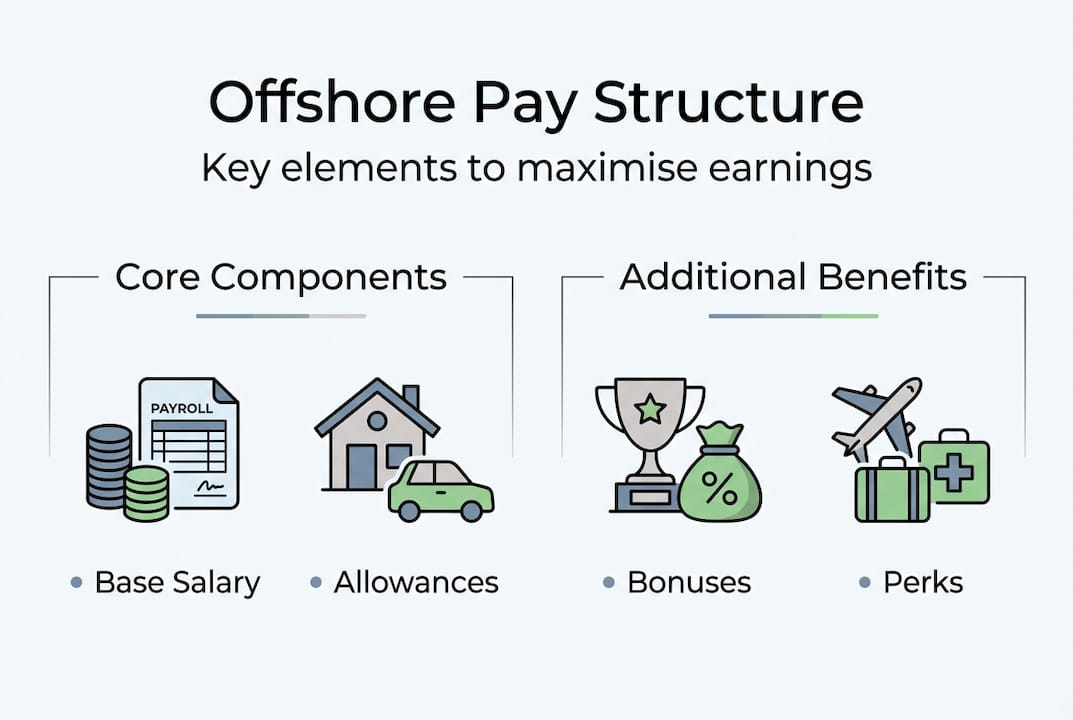
Bonuses can be performance-related, safety-related, or tied to project completion. Overtime is common offshore because shifts are long and schedules rarely follow a standard nine-to-five. For tax purposes, some allowances are treated differently from base pay, so understanding the tax treatment of each element matters when you're comparing offers.
Rotational schedules define how many weeks you work followed by how many weeks you're off. Common patterns include:
- 2/2: Two weeks on, two weeks off
- 3/3: Three weeks on, three weeks off
- 2/3: Two weeks on, three weeks off
- Ad hoc: Variable schedules, often for specialist contractors
These patterns directly affect your annual earnings. A worker on a 2/2 rotation may accumulate significantly more working days per year than someone on a 3/3, boosting total income even if the day rate looks identical on paper.
| Pay element | Typical inclusion | Notes |
|---|---|---|
| Base salary | All contract types | Fixed; taxable |
| Offshore allowance | Most perm and seasonal | Partially tax-free in some cases |
| Overtime | Contract and ad hoc | Varies by operator |
| Performance bonus | Mainly permanent | Linked to KPIs or project goals |
| Travel and subsistence | Usually all types | Flights, transfers, meals covered |
| Pension contributions | Permanent and some seasonal | Operator-funded element |
Contract types matter enormously. Permanent contracts typically include the full benefits package: pension, insurance, paid leave, and guaranteed rotation. Seasonal contracts offer fewer protections but can pay well for defined project periods. Ad hoc or zero-hours contracts give flexibility but shift risk to the worker, often with no guaranteed rotation or benefits.
For anyone serious about offshore career progression, comparing total annual compensation rather than just the basic rate is essential. A role with a slightly lower day rate but full benefits, paid leave, and a reliable rotation pattern can pay significantly more over twelve months.
Pro Tip: Always ask for a written breakdown of every pay element before signing. A base rate comparison between two roles can be misleading if one includes flights and meals and the other doesn't.
Comparing oil & gas with offshore wind: Pay rates and market trends
With the pay components clear, the next question is which sector offers the most competitive package.
Oil and gas has traditionally dominated offshore pay. Technical roles in oil and gas pay 15 to 30% more than equivalent positions in offshore wind, with North Sea rates recognised as the highest globally. That premium exists for real reasons: harsh operating conditions, complex regulations, powerful union agreements, and decades of established pay norms.
| Role type | Oil & gas (typical annual) | Offshore wind (typical annual) |
|---|---|---|
| Entry-level technician | £35,000 to £45,000 | £28,000 to £38,000 |
| Experienced engineer | £65,000 to £90,000 | £50,000 to £72,000 |
| Senior/management | £90,000 to £130,000+ | £70,000 to £100,000 |
| Contract day rate (mid-level) | £500 to £800/day | £380 to £600/day |
However, the gap is narrowing. As offshore wind matures and competition for skilled workers intensifies, operators are raising rates to attract experienced personnel from oil and gas backgrounds. Several wind farm developers now offer packages that rival entry-level oil and gas positions.
Factors driving pay differences across both sectors include:
- Remoteness and environmental exposure
- Strength of trade union representation
- Level of technical certification required
- Operator size and financial backing
- Project phase (construction vs. operational maintenance)
The gender pay gap is also worth noting. Progress is happening, though slowly. The gap currently sits at around 19%, with operators under increasing pressure to publish pay equity data and close the disparity through structured recruitment and progression policies.
For those weighing up certification requirements for offshore roles, it's worth knowing that the certificates you hold often determine which sector you can enter and at what level, making your choice of training a direct financial decision.
How contracts, rotation, and benefits impact your net earnings
Now, let's explore how your contract and working pattern turn gross figures into real money in your account.

Rotation schedules look straightforward on paper, but they create significant variation in actual annual earnings. A 2/2 rotation gives you 26 working weeks per year. A 3/3 gives you roughly 17 to 18. The day rate on a 3/3 contract often looks higher to compensate, but the maths doesn't always balance out in the worker's favour.
Here's how contract type changes your net position:
- Permanent contract: Salary plus full benefits. Employer handles tax and National Insurance. You benefit from paid leave, pension, and job security. Permanent North Sea contracts can add 20 to 30% effective pay above the gross salary figure through benefits alone.
- Seasonal contract: Defined project period. Pay often slightly above permanent equivalents to compensate for the lack of continuity. Effective uplift of around 10 to 20% over base, depending on the operator.
- Ad hoc or short-term contract: Higher apparent day rates, but no guaranteed rotation, no paid leave, and often no pension. Tax obligations frequently fall to the individual.
- Zero-hours arrangements: Rare in core offshore roles but exist in support functions. Unpredictable income with no guaranteed minimum hours.
"Permanent North Sea contracts deliver 20 to 30% effective pay uplift through benefits; seasonal contracts add roughly 10 to 20% above base." OEUK Workforce Insight 2025
Overtime, perks, and deductions all shape the final figure. Travel costs covered by the operator, free meals offshore, and employer-paid insurance each have a real monetary value. Conversely, short-term contracts sometimes involve umbrella company arrangements that carry fees reducing your take-home pay unexpectedly.
For those exploring offshore management careers, moving into senior roles on permanent contracts tends to offer the most stable and lucrative overall package, especially when pension contributions are factored in over a full career.
Pro Tip: With short-term contracts, always request a worked example of take-home pay after fees, tax, and National Insurance. The headline day rate can look excellent until you do the full calculation.
Career progression: Maximising pay through skills, experience, and sector switches
Having looked at pay structures, it's essential to see how career choices influence your earning trajectory.
Most offshore careers follow a recognisable path. Entry-level workers typically begin as roustabouts or assistant technicians, earning in the lower range of the pay scale while building site-specific knowledge. From there, the route leads through specialist technical roles, supervisory positions, and eventually into engineering or management with significantly higher compensation.
The certifications you hold are the most direct lever you can pull on your pay. Key qualifications that unlock higher-paying roles include:
- BOSIET (Basic Offshore Safety Induction and Emergency Training): Required for virtually every offshore role
- GWO BST (Global Wind Organisation Basic Safety Training): The equivalent entry standard for offshore wind
- OPITO-accredited technical certificates: Role-specific qualifications that validate competency and command higher rates
- First aid and medical response qualifications: Often required for team leader or supervisory positions
- Rigging, lifting, and operations certificates: Valued across both oil and gas and wind sectors
Career advancement from roustabout to engineer or manager via certifications and accumulated experience is the established route in both oil and gas and offshore wind. Workers who hold multiple certifications consistently command higher day rates and are more attractive to operators offering permanent roles.
One often overlooked opportunity is the skills transfer between sectors. Oil and gas experience is highly valued in offshore wind, particularly for roles involving mechanical systems, safety leadership, and rope access. As the renewables sector expands, experienced oil and gas workers who cross over bring expertise that wind-specific candidates simply can't match yet.
Senior and specialist technical roles in renewables are currently in strong demand, and the shortage of qualified candidates means pay is rising faster in those positions than across the sector generally. For those investing in professional development for offshore workers, timing a sector switch to coincide with a new certification can unlock a meaningful pay increase.
A fresh perspective on offshore pay: What most guides miss
With the fundamentals laid out, here's a candid perspective that most career guides overlook.
The obsession with headline rates blinds many offshore workers to what actually builds long-term financial security. Yes, oil and gas currently pays more. But a narrowing pay gap between sectors tells a deeper story: the North Sea premium is a product of specific market conditions, and those conditions are shifting. Energy transition, regulatory pressure, and changing operator economics mean the premium won't hold indefinitely.
Workers who have built their identity around one sector's pay scale often find themselves exposed when that sector contracts. The smarter approach is to treat skills as your primary asset, not the current rate in a single market. Offshore wind, marine renewables, and carbon capture are all creating roles that reward the same competencies that oil and gas trained into you.
There's also the question of safety culture and working environment. A role paying 10% more on a platform with a poor safety culture isn't a better deal once you factor in stress, risk, and the mental load of working somewhere that doesn't prioritise its people. These non-monetary factors shape your performance, your longevity in the industry, and ultimately your earning potential over a decade, not just your next payslip. Seek out employers who invest in their workforce as deliberately as they invest in their equipment.
Next steps: Let Offstep UK help you unlock offshore opportunities
Ready to take action with your new understanding of offshore pay?
Knowing how offshore pay works is one thing. Knowing how to position yourself to earn at the top of the range is another. At Offstep UK, we work with aspiring and experienced offshore workers to map out realistic, achievable routes into the industry and upward within it.

Whether you're working out which certifications to pursue first, comparing sectors, or trying to negotiate a better contract, our offshore job opportunities platform and career support resources give you the tools and guidance to make informed decisions. Explore our programmes, book a free strategy call, and take the next step towards a career that pays what you're worth.
Frequently asked questions
What is included in a typical offshore pay package?
A standard package covers base salary, an offshore or hardship allowance, overtime, performance bonuses, and non-cash benefits such as travel, meals, and insurance. The full offshore pay structure varies by operator and contract type.
How do offshore rotation schedules impact annual earnings?
A 2/2 rotation gives more working days per year than a 3/3, which directly raises total annual income even when the day rate is identical. Rotational schedules like 2/2 or 3/3 are one of the most underestimated factors in offshore pay calculations.
Which offshore sector pays the most in the UK?
Oil and gas roles currently pay 15 to 30% more than offshore wind for comparable technical positions, with North Sea contracts commanding the highest rates globally. The gap is narrowing as wind sector pay rates continue to rise.
How can I increase my offshore pay long term?
Pursuing certifications such as BOSIET and GWO BST and progressing from entry-level roles to engineering or management positions is the clearest route. Career advancement via certifications is the established pathway to significantly higher offshore earnings.
Are UK offshore pay gaps between genders still large?
The gap has improved but remains around 19%, with operators under growing pressure to address it. Ongoing gender pay gap improvements are expected as diversity initiatives take hold across both oil and gas and offshore wind.