

TL;DR:
- Offshore project management is accessible to newcomers through structured training, mentorship, and entry-level roles.
- Adopting proven frameworks improves cost, schedule, and safety performance, making projects more efficient.
- Success relies on cultural intelligence, clear communication, and adaptive leadership in a globally distributed environment.
Offshore project management is not the exclusive domain of seasoned engineers with decades of experience. That assumption has quietly discouraged thousands of motivated UK workers from pursuing one of the most rewarding career paths available today. In reality, modern training programmes, structured frameworks, and mentorship schemes have transformed access to this field. Whether you are transitioning from a trades background, leaving the armed forces, or simply seeking a career with real impact and strong earnings, offshore project management now offers a clearly navigated route in, even if you are starting from scratch.
Table of Contents
- The appeal of offshore project management careers
- Core frameworks and methodologies used offshore
- Real-world benefits: Cost, schedule, and safety performance
- Navigating challenges: Communication, culture, and real project nuances
- Pathways for UK newcomers: Training, first steps, and career progression
- What most newcomers miss about offshore project management careers
- Ready to begin your offshore management journey?
- Frequently asked questions
Key Takeaways
| Point | Details |
|---|---|
| Structured frameworks matter | Following proven project management methodologies leads to better safety, schedules, and cost outcomes offshore. |
| Training opens doors | Structured training and mentorship programmes make it much easier for UK newcomers to launch rewarding offshore careers. |
| Communication is crucial | Success offshore depends on mastering cross-cultural, asynchronous communication and team collaboration. |
| Practical entry steps exist | You can start onshore, train for key skills, and use networking to move into offshore project management roles. |
The appeal of offshore project management careers
There is a reason so many UK workers are turning their attention towards offshore project management. The combination of competitive pay, genuine purpose, and expanding opportunity is difficult to ignore. But the appeal runs deeper than the salary alone.
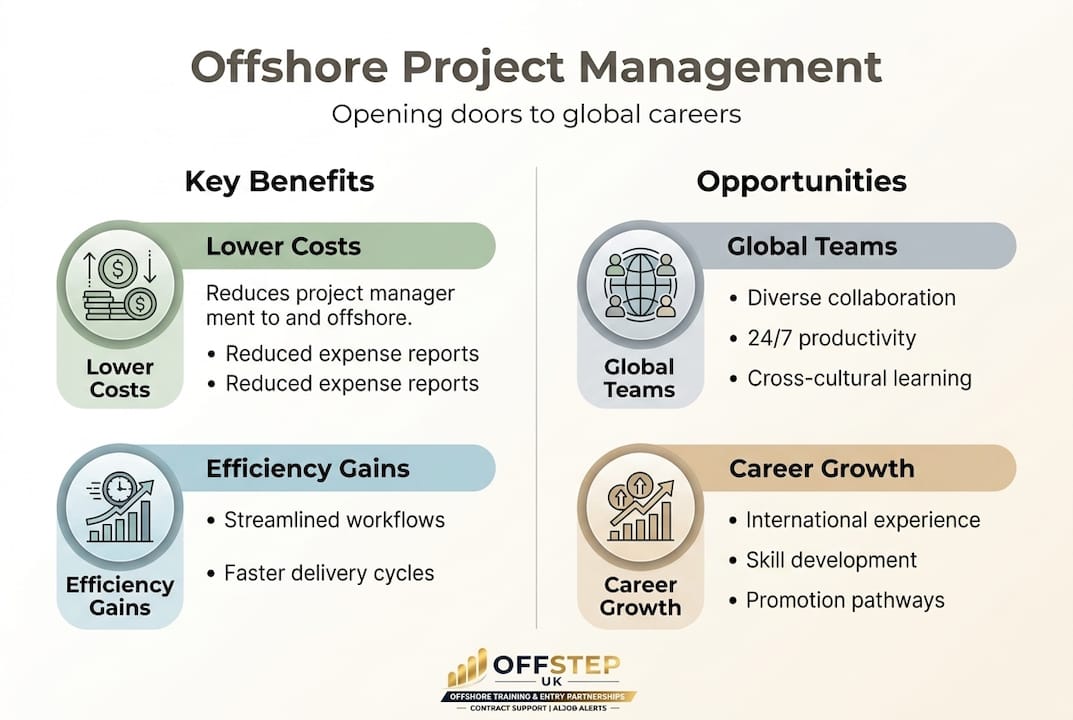
Offshore project management helps businesses lower costs and improve efficiency, offering cost savings, access to global talent, round-the-clock productivity, and scalability. For UK firms facing high local employment costs, offshore models represent a genuinely attractive solution. This creates sustained demand for capable project managers who can coordinate work across distributed teams and locations.
The UK's commitment to net-zero energy targets has also added significant momentum to the sector. Wind, tidal, and hydrogen energy projects are expanding rapidly around the UK coastline, and each one requires structured project delivery. Aspiring UK workers now benefit from structured training schemes like NextWave, which provide entry-level candidates with mentorship in safety protocols, teamwork, and offshore-specific communication skills. The career appeal is substantial, combining high earnings with the knowledge that your work contributes directly to the energy transition.
A common misconception holds that only highly technical specialists can enter this field. That simply is not accurate. Many entry points exist across both oil and gas and the fast-growing renewables sector. You might enter as a document controller, a planning coordinator, or a junior safety officer. These roles are genuine stepping stones into broader offshore project management responsibilities, provided you pursue the right training and mentorship from the outset.
Key benefits that attract UK workers to offshore project management include:
- High earning potential with tax advantages for offshore contract roles
- Rapid career progression compared to many onshore industries
- Genuine contribution to the UK's net-zero and energy security goals
- Exposure to international teams, developing skills that transfer globally
- Structured entry pathways that reward ambition over prior experience
The offshore sector is growing, it is well-funded, and it is actively seeking motivated newcomers. That is a rare combination in any industry.
Core frameworks and methodologies used offshore
Understanding how offshore projects are actually run gives you an enormous advantage before you ever set foot on a vessel or platform. The frameworks used in this sector are learnable, structured, and specifically designed to keep complex, distributed projects on track.
Key methodologies include structured communication frameworks, risk assessments, Agile, Scrum, Kanban adapted for distributed teams, Waterfall for projects with stable requirements, and more specialised approaches like Integrated Project Delivery (IPD) and Construction Manager at Risk (CMAR) for optimal risk allocation in offshore construction environments.
Here is how the main frameworks compare in an offshore context:
| Framework | Best used for | Key strength |
|---|---|---|
| Waterfall | Stable, sequential projects | Clear milestones and documentation |
| Agile/Scrum | Iterative, fast-changing work | Flexibility and rapid feedback loops |
| IPD | Collaborative multi-party contracts | Shared risk and aligned incentives |
| CMAR | Construction-heavy offshore projects | Early contractor involvement |
For newcomers, the reassuring truth is that project management methodologies follow repeatable patterns. Once you understand the logic behind one framework, the others become much easier to learn. Entry-level training programmes typically cover these frameworks in detail, giving you a working vocabulary before your first assignment.
Here is how a typical structured offshore workday looks under these frameworks:
- Daily stand-up meeting, usually fifteen minutes, covering what was done, what is planned, and any blockers
- Risk register review, ensuring emerging hazards are flagged and assigned to an owner
- Asynchronous documentation update, capturing decisions and progress for team members in different time zones
- Communication log, noting any cross-team dependencies or escalations required
- End-of-day handover note, ensuring continuity across shift changes or international handoffs
Pro Tip: Learning to write precise, jargon-free handover notes is one of the most underrated skills in offshore project management. It signals professionalism immediately, especially to senior managers reviewing your work.
The structured nature of these frameworks is actually a significant advantage for newcomers. Rather than requiring intuition built over decades, they provide a clear roadmap that lets ambitious starters contribute meaningfully from day one.
Real-world benefits: Cost, schedule, and safety performance
Frameworks are only valuable if they produce measurable results. In offshore project management, the data is compelling, and understanding it helps you make the case for structured training to future employers.
Empirical benchmarks confirm that structured frameworks yield a 13.4% reduction in cost variance, an 11.8% improvement in schedule performance, and a 24% reduction in safety incidents compared to projects without formal management structures.
| Performance metric | Without frameworks | With structured frameworks |
|---|---|---|
| Cost variance | High, often exceeding estimates | 13.4% reduction |
| Schedule overruns | Common in complex projects | 11.8% improvement |
| Safety incidents | Unpredictable and costly | 24% reduction |
That safety figure deserves particular attention. In offshore environments, a safety incident is not merely a statistic. It represents real risk to real people working in physically demanding, isolated conditions. When you enter this field and apply structured risk management, you are making a direct contribution to the wellbeing of your crew.
The cost data is equally striking. Without structured project management, over 60% of megaprojects exceed their budget estimates by 30% or more. That scale of overrun does not just affect company profits. It delays energy infrastructure, disrupts supply chains, and undermines investor confidence in the sector. Good project management directly counteracts this trend.
"Structured frameworks do not just make projects run better. They make the offshore industry safer, more reliable, and more attractive to the investment it needs to keep growing."
Remote monitoring best practices have further strengthened the ability of project managers to track real-time progress from onshore control rooms, reducing the need for constant physical presence while maintaining accuracy. For newcomers, this means that some project management responsibilities can be performed in hybrid or onshore settings, making career entry even more accessible than it was five years ago.
Understanding these performance figures also helps you speak credibly in interviews and with clients. When you can articulate why frameworks matter, using real numbers, you stand out as someone who understands the business case, not just the technical process.
Navigating challenges: Communication, culture, and real project nuances
Offshore project management is structured and rewarding, but it is not without its complications. Being aware of these challenges before you enter the field is one of the most useful things you can do for your career.
Time zone overlaps become bottlenecks without asynchronous documentation. Cultural gaps create friction when teams from different countries operate under different assumptions about authority, disagreement, and communication. Weather windows impose hard constraints on installation schedules, and first-of-kind projects such as Hywind Tampen routinely overrun by 30% or more because novel challenges cannot be fully anticipated.
These are not reasons to avoid the field. They are skills gaps that structured training can genuinely address. The project managers who succeed offshore are those who develop:
- Cultural intelligence (the ability to adapt communication style and expectations across different national and professional cultures)
- Asynchronous communication skills (writing clearly and concisely so that team members in other time zones can act on information without a meeting)
- Weather and logistics awareness (understanding how environmental constraints shape scheduling decisions)
- Risk identification habits (spotting emerging problems early, before they become costly)
Rigid leadership styles that suppress feedback are a major source of silent project failures. When junior team members feel unable to flag concerns, small problems compound into serious overruns. Conversely, leaders who actively seek input from every level of the team create projects that self-correct early and often.
Pro Tip: Practise "upward communication" from your first offshore role. If you notice a potential risk or inefficiency, raise it clearly and constructively. Senior project managers value new perspectives precisely because they are unaffected by assumption and habit.
Communication in offshore projects requires a different skill set than most onshore roles. Learning to document decisions clearly, to hand over information across shift changes, and to navigate cultural expectations around disagreement will set you apart, especially in a sector where distributed teams are the norm rather than the exception.
Pathways for UK newcomers: Training, first steps, and career progression
You do not need to wait until you have years of offshore experience to begin building your career in project management. The most effective approach is to start building relevant skills and networks now, then move into the sector through one of several well-established pathways.
If direct offshore entry is not immediately available, start onshore and network via LinkedIn and specialist agencies. The renewables sector in particular is growing faster than almost any other area of the offshore industry, supported by government-funded Green Skills initiatives that provide training and entry-level placements for career changers.
Here is a practical progression pathway for UK newcomers:
- Identify your transferable skills. Former military personnel bring risk awareness and team coordination. Trades workers bring technical understanding. Graduates bring analytical capability. All of these are valued.
- Complete foundational safety certifications. BOSIET (Basic Offshore Safety Induction and Emergency Training) and GWO BST (Global Wind Organisation Basic Safety Training) are the standard requirements for offshore site access.
- Enrol in a structured training programme. Look for schemes that cover project management frameworks alongside offshore-specific safety and communication skills.
- Build your network actively. Connect with project managers, recruiters, and other career changers in the offshore space through LinkedIn, industry events, and professional associations.
- Target entry-level roles in planning, document control, or site coordination to build your offshore CV.
- Pursue mentorship from someone already working in offshore project management. A mentor shortens your learning curve dramatically.
Career pathways offshore are genuinely diverse. Within five years, a committed newcomer can move from a junior coordination role to a project management position with full responsibility for schedule, budget, and team safety. The sector rewards people who combine technical competence with strong interpersonal skills, and that combination is rarer than most employers would like.
Pro Tip: Do not overlook smaller offshore contractors when applying. Large operators get thousands of applications. A mid-sized contractor working on a specific wind farm installation may be actively seeking motivated candidates who have completed relevant training and can demonstrate cultural and communication awareness.
What most newcomers miss about offshore project management careers
Here is something worth saying plainly: most people who explore offshore project management careers focus almost entirely on the technical side. They research certifications, study frameworks, and prepare for technical interviews. That preparation matters, but it is rarely what separates candidates who thrive from those who struggle.
The element most newcomers underestimate is cultural intelligence. Offshore projects routinely involve teams from five or more countries, each with different assumptions about hierarchy, feedback, and professional communication. Research into IPD collaboration confirms that frameworks like IPD deliver exceptional results when leadership actively supports inclusive teamwork and feedback disciplines, but fall short when cultural dynamics are ignored.
The candidates who advance quickly are not always the most technically qualified. They are the ones who listen well, communicate clearly across cultural divides, and actively seek feedback rather than waiting for it. They are also the ones who embrace mentorship without ego, recognising that the offshore environment is full of tacit knowledge that no training manual can fully capture.
Frameworks prevent overruns and save budgets. But the human dimensions of trust, communication, and adaptive leadership are what actually hold offshore projects together when conditions change suddenly, which they always do.
Ready to begin your offshore management journey?
If this article has shown you anything, it is that offshore project management is neither closed off nor beyond reach. The sector is expanding, the training pathways are structured, and the rewards are genuinely substantial for those willing to commit to the process.
At Offstep UK, we work specifically with people who are in exactly your position: motivated, ambitious, and ready to make a career move into offshore work, but uncertain about where to begin. Our programmes cover certification guidance, CV optimisation, mentorship, and strategic planning tailored to the offshore industry. Whether you are transitioning from another sector or starting from scratch, start your offshore journey with a free strategy call and find out exactly which pathway fits your background and goals.
Frequently asked questions
What entry-level skills are most valuable for offshore project management?
Structured communication, cultural awareness, and willingness to learn core frameworks are highly sought after from new starters. Employers particularly value candidates who can write clear documentation and adapt their communication style across distributed team environments.
Are there training programmes in the UK designed for offshore newbies?
Yes, structured training and mentorship schemes like NextWave and government-funded Green Skills initiatives are available specifically for entry-level candidates seeking offshore careers in renewables and oil and gas.
What are common challenges in offshore project management?
Main challenges include communication across time zones, cultural differences, unpredictable weather, and risk of project overruns if frameworks are not followed consistently from the outset.
Do offshore project management roles pay more than onshore roles?
Offshore project management roles are generally highly paid, particularly in renewables and oil, due to the greater responsibility, physical demands, and complexity of international collaboration involved.