
TL;DR:
- Offshore rotations typically involve scheduled periods of work offshore followed by rest at home, varying from 2/2 to 4/4 weeks.
- Pay is based on daily rates, with potential tax benefits like the Seafarers' Earnings Deduction.
- Certifications such as BOSIET and OGUK medical are mandatory, and proper training prepares workers for offshore life.
Most people hear "offshore work" and picture big wages landing in your bank account every month. The reality is more structured, more demanding, and frankly more interesting than that. Offshore employment runs on a rotation system, a fixed cycle of working days followed by rest days, and understanding it changes everything about how you plan your career, your finances, and your personal life. Whether you're coming from construction, the military, or a completely unrelated field, this guide walks you through how rotations work, what they pay, which certifications you need, and what daily life actually looks like on a rig or vessel.
Table of Contents
- What is an offshore rotation?
- How offshore rotations affect pay, tax, and lifestyle
- Training and certifications: How to get offshore ready
- What to expect: Life during and after an offshore rotation
- Offshore rotation: What most people miss
- Get expert support for your offshore career
- Frequently asked questions
Key Takeaways
| Point | Details |
|---|---|
| Rotation cycles explained | Offshore rotations structure work and rest for safety, earnings, and life balance. |
| Certification is crucial | BOSIET or GWO training is necessary for most new offshore roles. |
| Tax and pay benefits | Many UK workers qualify for the Seafarers’ Earnings Deduction for offshore income. |
| Sector resilience | Despite industry changes, offshore jobs and support remain strong in the UK. |
| Support for newcomers | Mentoring and structured support are available to help new workers adapt quickly. |
What is an offshore rotation?
An offshore rotation is a structured work cycle where you spend a set number of days working offshore, followed by a set number of days at home. It's not a rota in the traditional sense. You're not popping in for a shift and heading home at five. You live and work on the installation for your entire working period, then return home for your rest period.
The most common pattern in the UK oil and gas sector is 2 weeks on, 3 weeks off, though this varies considerably. Some roles run on a 2/2 (two weeks on, two weeks off), others on a 3/3 or even 4/4 for more remote locations. Renewables roles, particularly offshore wind, sometimes use shorter rotations due to different vessel logistics.
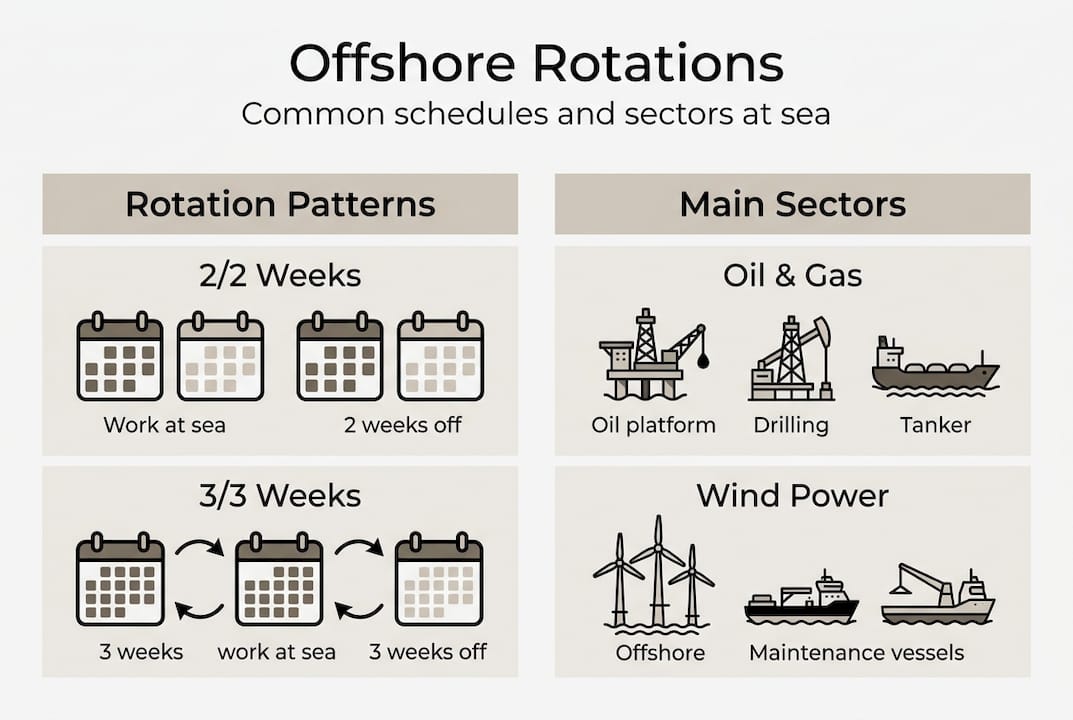
Here's a quick overview of the most common rotation types:
| Rotation type | Weeks offshore | Weeks onshore | Typical sector |
|---|---|---|---|
| 2/2 | 2 | 2 | Oil and gas, wind |
| 2/3 | 2 | 3 | Oil and gas (North Sea) |
| 3/3 | 3 | 3 | Remote oil and gas |
| 4/4 | 4 | 4 | Deep water, international |
Why does this system exist? Primarily because of fatigue management. Working 12-hour shifts in a harsh marine environment, often in poor weather, is physically and mentally demanding. Rotations are designed to give workers genuine recovery time, not just a weekend. Safety regulators and operators alike recognise that a rested worker is a safer worker.
The offshore sector is broader than most people realise. While oil and gas is the dominant employer, the UK offshore sector supports 150,000+ jobs across drilling, maintenance, catering, logistics, and increasingly, renewable energy. Offshore wind alone is adding thousands of new roles each year.
Rotations also solve a practical logistics problem. Helicopters and crew transfer vessels can only carry so many people, and coordinating changeovers for large installations requires precision scheduling. Your rotation isn't arbitrary. It's engineered around safety, wellbeing, and operational efficiency.
If you're new to the sector and unsure how to navigate these schedules, support and consultancy services can help you understand which rotation type suits your circumstances before you commit to a role.
How offshore rotations affect pay, tax, and lifestyle
Let's talk money, because it's usually the first question. Offshore pay is genuinely competitive, but it's structured differently from onshore employment. You're typically paid a day rate for every day you work offshore, not a monthly salary. This means your annual earnings depend directly on how many rotations you complete.
Here's a rough comparison of entry-level versus experienced offshore pay:
| Role level | Typical day rate | Annual estimate (2/3 rotation) |
|---|---|---|
| Entry-level (roustabout, catering) | £150 to £220 | £27,000 to £40,000 |
| Skilled technician | £300 to £450 | £55,000 to £82,000 |
| Senior/specialist | £500 to £800+ | £90,000 to £145,000+ |
One significant financial benefit is the Seafarers' Earnings Deduction (SED). If you qualify, your UK earnings from offshore work may be entirely free from income tax. Eligibility depends on spending a qualifying period outside the UK, and the rules are specific, so it's worth understanding them early. The oil and gas sector's high pay combined with potential tax relief makes offshore work financially attractive, but only if you track your days carefully.
Here's how to approach your rotation finances:
- Record every day you spend offshore and every day you spend onshore.
- Calculate your qualifying days for SED purposes at the end of each tax year.
- Speak to an accountant familiar with maritime tax rules.
- Factor in your rest period when budgeting, since you won't be earning during those weeks.
- Review your day rate contract annually, especially as you gain experience.
Pro Tip: Keep a dedicated diary or spreadsheet of your rotation dates from day one. Many workers miss out on the Seafarers' Earnings Deduction simply because they didn't track their qualifying days accurately.
The lifestyle impact is real too. Long rest periods are a genuine perk. You get extended time at home, which many workers use for travel, family time, or running a side business. The downside is missing birthdays, school events, and the general rhythm of home life during your offshore stints. Accessing offshore lifestyle guidance before your first trip helps you set realistic expectations for both you and your family.
Training and certifications: How to get offshore ready
You cannot simply walk onto an offshore installation. Every worker, regardless of role, must hold specific safety certifications before they're allowed to travel. This isn't bureaucracy for its own sake. The North Sea is one of the most demanding marine environments on the planet, and the training reflects that reality.
The two core certifications for UK offshore entry are:
- BOSIET (Basic Offshore Safety Induction and Emergency Training): Covers helicopter underwater escape, sea survival, firefighting, and first aid. Mandatory for oil and gas roles.
- OGUK Medical: A fitness assessment confirming you're physically capable of working offshore. Required by all operators.
For offshore wind roles, the GWO BST (Global Wind Organisation Basic Safety Training) is the standard equivalent. Some employers, particularly those operating across both sectors, may ask for both BOSIET and GWO certifications.
The BOSIET certification must be renewed every four years, and GWO modules typically require renewal every two years. Letting either lapse means you cannot work offshore until they're renewed, which can cost you weeks of income and your place on a crew.
Here's the typical certification pathway for a new entrant:
- Complete your OGUK medical (book early, as appointments fill quickly)
- Book a BOSIET course through an OPITO-approved training centre
- For wind roles, add GWO BST modules
- Obtain any role-specific training your employer requires
- Register with an offshore employment agency or apply directly
Pro Tip: Start your OGUK medical at least eight weeks before your intended start date. Doctors sometimes flag conditions that need further assessment, and delays at this stage can push back your entire timeline.
North Sea conditions make this training genuinely critical, not just a tick-box exercise. Helicopter ditching drills, for example, are conducted in water tanks that simulate real emergencies. Workers who've done the training report feeling far more confident offshore. Accessing offshore training support early in your journey helps you navigate the booking process and avoid costly paperwork mistakes.
What to expect: Life during and after an offshore rotation
Your first offshore trip will feel overwhelming. That's normal. The environment is unlike anything most people have experienced, and the adjustment takes time. Knowing what to expect reduces the shock considerably.
A typical offshore day runs on 12-hour shifts, either days or nights, with a handover period between crews. Your tasks depend on your role, but most workers spend their shift on a mix of active work, safety checks, and documentation. Mealtimes are communal and structured. Accommodation is shared cabins, usually two to four people, with basic but functional facilities.
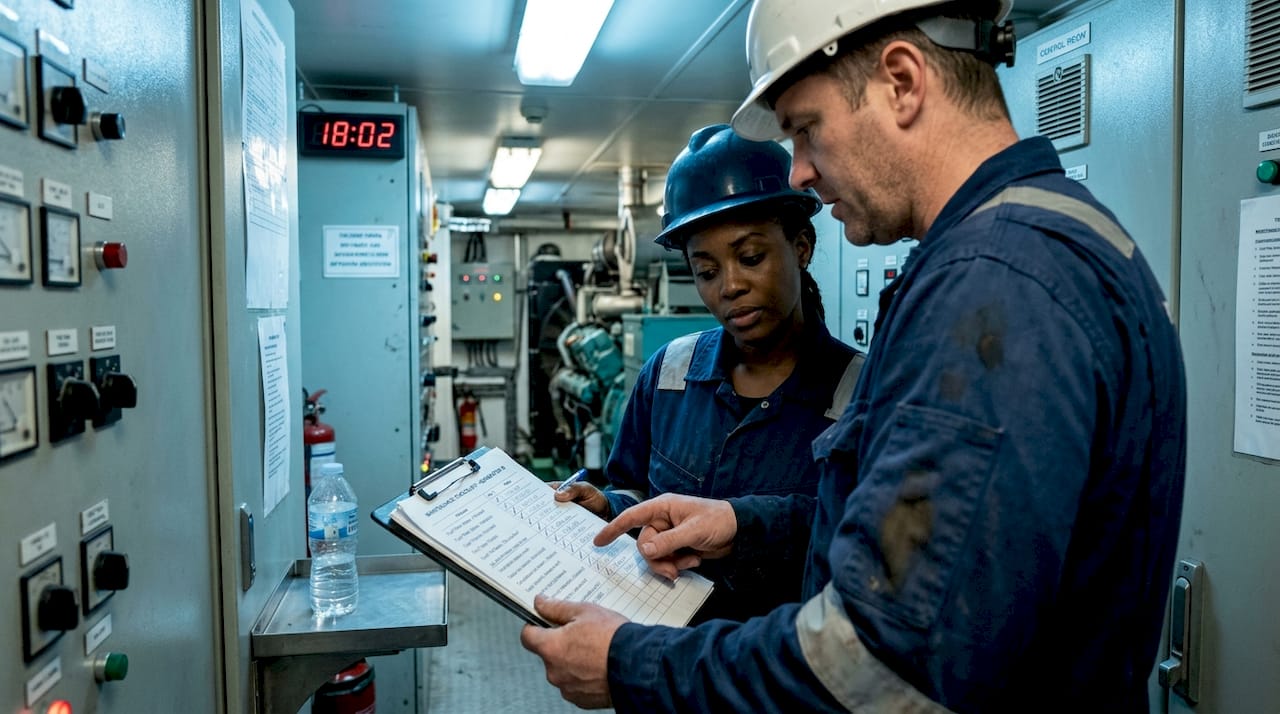
Downtime is limited but real. Most installations have a gym, a TV lounge, and internet access, though connectivity can be patchy. Social dynamics matter enormously. You're living and working with the same group of people for two to four weeks, so the ability to get along, stay calm under pressure, and support your teammates is as important as any technical skill.
As OEUK's workforce data confirms, sector pressures exist but sustained employment remains robust with the right policy support, meaning the jobs are there for those who prepare properly.
Survival tips for your first rotation:
- Bring more entertainment than you think you'll need (books, downloaded films, podcasts)
- Sleep when you can, especially during your first few days
- Ask questions rather than guessing. Senior colleagues expect it from new starters
- Limit caffeine on night shifts to avoid sleep disruption on your rest days
- Stay in contact with home, but set boundaries so you can focus during your shift
Coming back onshore has its own adjustment curve. The quiet of home can feel strange after weeks of structured noise and routine. Many workers report a day or two of disorientation before settling back in. Connecting with offshore employee support networks helps both you and your family manage these transitions more smoothly.
Offshore rotation: What most people miss
Here's something the job adverts don't tell you: the rotation schedule isn't a perk designed to give you a nice holiday. It's a carefully calculated safety mechanism. The offshore industry learned, sometimes through tragedy, that fatigued workers make fatal mistakes. The weeks at home aren't a bonus. They're a requirement for the system to function safely.
Most newcomers focus entirely on the money and the time off. They underestimate the psychological adjustment of living in a confined space, the discipline required to maintain certifications, and the importance of building genuine professional relationships offshore. The workers who thrive long-term are rarely the ones chasing the highest day rate. They're the ones who invest in their training, show up consistently, and treat the rotation as a professional discipline rather than a lifestyle choice.
The energy sector is changing, and that creates both uncertainty and opportunity. Renewables are growing, oil and gas is adapting, and the skills you build in one area transfer more readily than you might think. Seeking real-world offshore advice from people who've navigated these transitions gives you a genuine edge over candidates who rely solely on generic career guidance.
Get expert support for your offshore career
Understanding rotations, certifications, and offshore life is one thing. Actually landing your first role is another challenge entirely. OffstepUK exists specifically to bridge that gap for UK candidates.
Whether you need help choosing the right certifications, preparing your CV for offshore employers, or understanding which entry-level job opportunities suit your background, OffstepUK provides structured, practical guidance built around real offshore experience. The platform offers free strategy calls, mentorship programmes, and employer connections that give you a realistic path into the sector rather than a generic checklist. If you're serious about offshore work, getting expert support from the start saves you time, money, and a great deal of frustration.
Frequently asked questions
What is the typical offshore rotation for UK oil and gas workers?
Most UK oil and gas rotations follow a 2 weeks on, 3 weeks off pattern, though this varies by company, rig type, and location.
Do I need BOSIET for offshore wind as well as oil and gas?
Oil and gas roles require BOSIET, while many wind roles use GWO instead of BOSIET, though some employers operating across both sectors ask for both certifications.
How does the Seafarers' Earnings Deduction apply to offshore workers?
If you meet the qualifying criteria, the Seafarers' Earnings Deduction can make your UK offshore income entirely free from income tax, provided you track your qualifying days accurately.
What support is there during my first offshore rotation?
Many installations offer informal mentoring from experienced crew, and industry support networks provide additional guidance for workers adjusting to their first rotation.
Is offshore work still a good career despite energy sector changes?
Yes. Sector jobs remain robust with sustained policy support, and workers with current certifications and transferable skills are well-positioned across both oil and gas and renewables.