
TL;DR:
- Offshore technical trades require strict safety certifications, medical clearance, and relevant trade qualifications.
- Building industry reputation and relationships is crucial for career advancement offshore.
- Ongoing compliance with certifications and safety standards is vital for career longevity and safety.
Breaking into offshore technical trades is genuinely tough. The roles are governed by strict safety regulations, and the certification maze can feel impossible to navigate without a clear map. Whether you are an electrician eyeing a platform posting or a mechanical engineer weighing up your first offshore contract, the path from land-based work to offshore employment demands precise preparation. This guide cuts through the noise. It covers what the roles involve, what you need to qualify, how to apply, and how to stay compliant once you are working. By the end, you will have a realistic, actionable framework you can put to work immediately.
Table of Contents
- Understanding technical offshore trades and opportunities
- Preparing for an offshore trade role: prerequisites and requirements
- Step-by-step process to secure an offshore technical trade job
- Troubleshooting, safety standards and verification
- Expert insight: what most guides miss about offshore trades
- Connect with expert support and resources
- Frequently asked questions
Key Takeaways
| Point | Details |
|---|---|
| Know your options | Understanding job types and technical trades helps you target the right role. |
| Get the right certificates | Safety and compliance certifications are essential for offshore work in the UK. |
| Follow proven steps | Use a clear sequenced approach to secure and keep offshore technical jobs. |
| Stay compliant | Regular verification and updating of credentials ensures career longevity in offshore trades. |
| Seek expert support | Professional resources improve your chances of success and advancement in offshore careers. |
Understanding technical offshore trades and opportunities
Offshore technical trades sit at the heart of the North Sea energy sector. Without qualified engineers, maintenance technicians, and safety specialists, platforms simply cannot operate. These are not generic industrial jobs. They are highly specialised roles that carry significant responsibility, generous remuneration, and genuine career longevity for those who commit to them properly.
At the entry level, you are typically looking at positions such as trainee maintenance technician, deck hand, or assistant electrician. These roles exist to build you up while you contribute real value under supervision. Mid-level positions include instrument technician, mechanical technician, and scaffolder, all of which require trade qualifications plus offshore survival training. Senior roles such as offshore installation manager (OIM), lead engineer, or safety officer demand years of verified experience and advanced credentials.
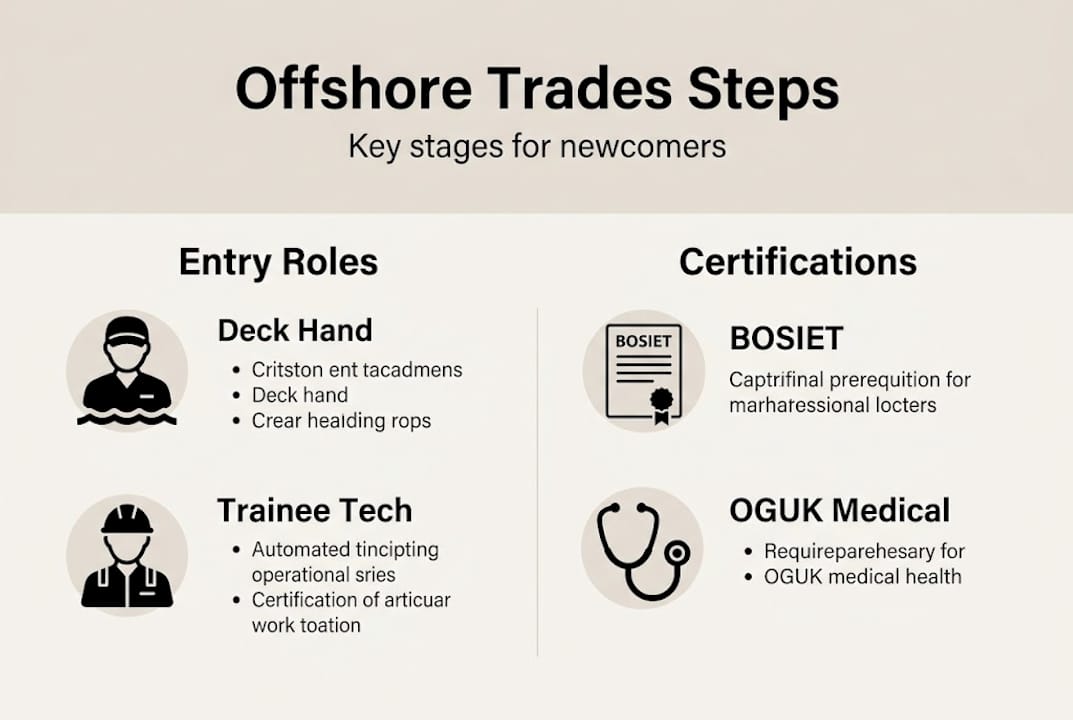
The UK offshore sector remains a significant employer. Common trade roles and what they typically offer in 2026 are outlined below:
| Job title | Typical requirements | Salary range (annual) |
|---|---|---|
| Trainee maintenance technician | NVQ Level 2, BOSIET | £28,000 to £35,000 |
| Instrument technician | HNC/HND, OPITO survival cert | £45,000 to £60,000 |
| Mechanical technician | City and Guilds, 2+ years exp | £42,000 to £58,000 |
| Offshore electrician | 18th Edition wiring regs, BOSIET | £48,000 to £65,000 |
| Safety officer | NEBOSH, offshore medical, 5+ years | £55,000 to £75,000 |
Key opportunities to note:
- Maintenance and inspection roles are among the most in-demand across North Sea platforms
- Safety-critical trades carry premium rates because of the specialist knowledge required
- Rotating shift patterns (typically two weeks on, two or three weeks off) make offshore work attractive for work-life balance
- Contract and permanent positions are both widely available, giving you flexibility in how you structure your career
For a fuller picture of routes into the sector, offshore trade legal resources can help you understand your rights and obligations as you transition into this environment.
Preparing for an offshore trade role: prerequisites and requirements
Once you know which trade suits your interests, preparation begins with understanding essential requirements. The offshore sector has zero tolerance for under-qualified personnel. Every person stepping onto a platform must meet defined safety, medical, and technical standards before they ever reach the helipad.

The most fundamental certification is BOSIET (Basic Offshore Safety Induction and Emergency Training), which covers survival at sea, firefighting, first aid, and helicopter underwater escape. It is non-negotiable for virtually every offshore role. Beyond BOSIET, many operators require OPITO-approved emergency response training and specific trade certifications relevant to your discipline.
Here is a breakdown of common prerequisites by role type:
| Role type | Mandatory certifications | Medical requirement |
|---|---|---|
| General trades | BOSIET, OPITO EBS | Offshore medical (OGUK standard) |
| Electrical roles | 18th Edition, BOSIET, IPAF | OGUK medical |
| Safety roles | NEBOSH, BOSIET, first aid at work | Full OGUK medical |
| Engineering | HNC minimum, BOSIET, relevant trade cert | OGUK medical |
Key requirements across all roles include:
- A valid OGUK offshore medical certificate (renewed every two years)
- Trade-specific qualifications aligned to OPITO or equivalent frameworks
- Current BOSIET or FOET (Further Offshore Emergency Training, the refresher taken every four years)
- Background checks and, in some cases, security clearance for certain installations
Pro Tip: Book your offshore medical early. Slots at approved clinics fill fast, and your application cannot progress without it. Clinics accredited by the Oil and Gas UK (OGUK) standards are the only ones whose certificates operators will accept.
The medical itself assesses cardiovascular health, vision, hearing, and general fitness. Certain conditions, such as uncontrolled diabetes or severe claustrophobia, may restrict access to specific roles. It is worth getting an informal health check with your GP before investing in training costs.
For tailored guidance on meeting regulatory requirements, offshore compliance advice is a useful starting point for understanding what your specific situation demands.
Step-by-step process to secure an offshore technical trade job
With prerequisites met, the next stage is navigating the hiring and onboarding process step by step. The offshore recruitment process has its own rhythm, and understanding it in advance gives you a meaningful advantage over candidates who approach it without preparation.
- Audit your current certifications. List everything you hold and note expiry dates. Identify gaps against the target role's requirements before you apply anywhere.
- Research reputable job boards. Platforms such as Rigzone, OilCareers, and Energy Jobline are established sources for verified offshore vacancies. Avoid unlisted or unverifiable postings.
- Tailor your CV for offshore roles. Generic CVs fail offshore recruiters. Lead with your certifications, offshore-relevant trade experience, and any time spent working in regulated environments. Quantify your achievements where possible.
- Apply through direct operator websites. Larger operators such as Equinor, Harbour Energy, and Shell UK post directly on their sites. Direct applications often bypass the recruiter queue.
- Prepare for a competency-based interview. Offshore employers use structured interviews heavily. Practise STAR-format answers (Situation, Task, Action, Result) with examples from safety-critical or regulated environments.
- Complete pre-employment checks. Once offered a role, expect drug and alcohol screening, medical verification, and reference checks before your start date is confirmed.
- Attend induction and onboarding. Every installation has its own safety induction. Treat it seriously. Asking questions and demonstrating diligence at this stage sets your reputation on the platform.
Pro Tip: Network actively within industry associations such as OPITO and Offshore Energies UK. Informal referrals carry enormous weight in offshore hiring, and many roles are filled before they are ever publicly advertised.
Common mistakes to avoid:
- Submitting a CV with expired certifications listed as current
- Neglecting to prepare for technical competency questions specific to your trade
- Overlooking soft skills such as teamwork and communication, which supervisors assess constantly
For more targeted guidance, offshore job application tips can help you sharpen your approach before you submit your first application.
Troubleshooting, safety standards and verification
After your initial steps, ongoing compliance and troubleshooting are crucial for safety and career longevity. The offshore sector operates under evolving regulatory frameworks, and staying current is a professional responsibility, not an optional extra.
Common issues that stall careers include:
- Expired certifications. BOSIET is valid for four years. OGUK medicals run for two. Missing renewal windows can ground you mid-rotation and damage your reputation with operators.
- Changes to regulatory standards. The Health and Safety Executive (HSE) periodically updates requirements for offshore operations. Following HSE guidance and OPITO framework updates is essential.
- Verification failures. Some candidates present certificates from unapproved providers. Operators cross-check credentials against OPITO's Vantage Online system, and discrepancies can result in immediate disqualification.
- Lapses in medical status. If your OGUK medical expires mid-contract, you cannot legally remain offshore. Plan renewals well in advance of expiry.
Regarding safety standards, the UK offshore sector is governed primarily by the Offshore Installations (Safety Case) Regulations, which require every installation to maintain a current, approved safety case. As a worker, your obligation is to understand and comply with the safety management system (SMS) specific to your installation.
"Safety offshore is not a department. It is everyone's job, every shift, every decision."
Practical tips for maintaining compliance:
- Set calendar reminders 90 days before each certificate expiry
- Register on OPITO's Vantage Online portal to manage and verify your own training records
- Keep physical and digital copies of all certificates in a dedicated folder
- Attend annual refresher briefings where your operator offers them
- Stay connected with industry bodies that circulate regulatory updates
For structured support on offshore safety training, using a recognised platform can make the difference between a career that stalls and one that grows steadily.
Expert insight: what most guides miss about offshore trades
Most articles on offshore trades give you lists of certifications and leave it there. What they rarely say is that the industry runs on reputation and relationships to a degree that few other sectors match. Platforms are small, self-contained communities. Your attitude, reliability, and the way you treat your crewmates matter as much as any piece of paper in your wallet.
We see candidates arrive with impeccable CVs who struggle because they underestimate the social dimension of the work. Conversely, candidates with modest qualifications who demonstrate genuine professionalism and a willingness to learn often outpace them within two or three rotations.
The practical advice most guides skip: spend time before your first offshore role understanding the culture. Talk to people already working in the sector. Ask about unwritten expectations. Understand that on a platform, hierarchy is respected but so is competence. A junior who spots a safety concern and raises it properly earns more respect than one who stays quiet to avoid attention.
For grounded, experience-based guidance, offshore trade real-world advice reflects the kind of insight that only comes from time spent in the industry.
Connect with expert support and resources
Building knowledge is the first step, but putting that knowledge to work in a competitive hiring market is where many candidates struggle alone.
OffstepUK resources are designed specifically for people at your stage, whether you are preparing your first offshore application or looking to advance from an entry role into something more senior. The platform offers structured career programmes, CV optimisation tailored to offshore recruiters, certification pathway guidance, and one-to-one mentorship from professionals who have actually worked in the sector. If you want a free strategy call to map out your next move, that option is available too. This is expert support built around the realities of offshore employment in the UK, not generic career coaching.
Frequently asked questions
What certifications are mandatory for UK offshore trades?
BOSIET, OPITO-approved emergency training courses, and a valid OGUK offshore medical certificate are typically required before you can begin any technical offshore role in the UK.
How do I verify my offshore qualifications?
Contact the issuing training provider or log in to OPITO's Vantage Online portal, which operators use to confirm certification records and training histories.
What is the fastest way to enter an offshore technical trade?
Obtain your BOSIET and trade-specific certifications, complete your OGUK medical, and apply through established job boards such as Rigzone or OilCareers while simultaneously reaching out to operators directly.
Can I work offshore without prior experience?
Entry-level roles do exist for candidates new to the sector, but you must still hold approved safety certifications and a valid offshore medical before any operator can deploy you to an installation.