
TL;DR:
- Offshore workers often work for multiple employers, including contractors and umbrella companies, not just major brands.
- Understanding who your legal employer is crucial for safety, pay, and legal protections offshore.
- Multiple employers share responsibility for safety and compliance, requiring active cooperation on offshore installations.
Many people entering the UK offshore industry assume they will work directly for a household name like BP, Shell, or TotalEnergies. That assumption is almost always wrong, and it can cost you in ways you might not expect. Your safety training, your pay, your tax deductions, and your legal protections all depend on understanding exactly who your employer is and what type of entity they are. This guide breaks down the full picture of offshore employment in the UK sector, from operators and contractors through to umbrella companies and recruitment agencies, so you can make informed decisions at every stage of your career.
Table of Contents
- What is an offshore employer?
- Key responsibilities of offshore employers
- Who manages pay, tax, and insurance offshore?
- Cooperation and safety management: multiple employers on offshore installations
- Why career newcomers should look beyond the brand names offshore
- Next steps: guidance and support for your offshore career
- Frequently asked questions
Key Takeaways
| Point | Details |
|---|---|
| Employer types vary | Offshore workers may be employed by operators, contractors, or umbrella/agency companies, each with different responsibilities. |
| Legal duties are strict | All offshore employers must ensure safety training, medical certification, and full compliance with UK law. |
| Payroll and tax differ | How your pay and tax is handled offshore depends on your legal employer, especially if hired via an agency or umbrella company. |
| Safety demands cooperation | Every employer offshore must cooperate and share safety information to protect all workers on site. |
What is an offshore employer?
The UK offshore industry does not run on a simple one-employer model. When you step onto a platform in the North Sea, there could be five, ten, or even more separate employers operating in the same space. Understanding who sits in each role is the first step to protecting your career, your pay, and your safety.
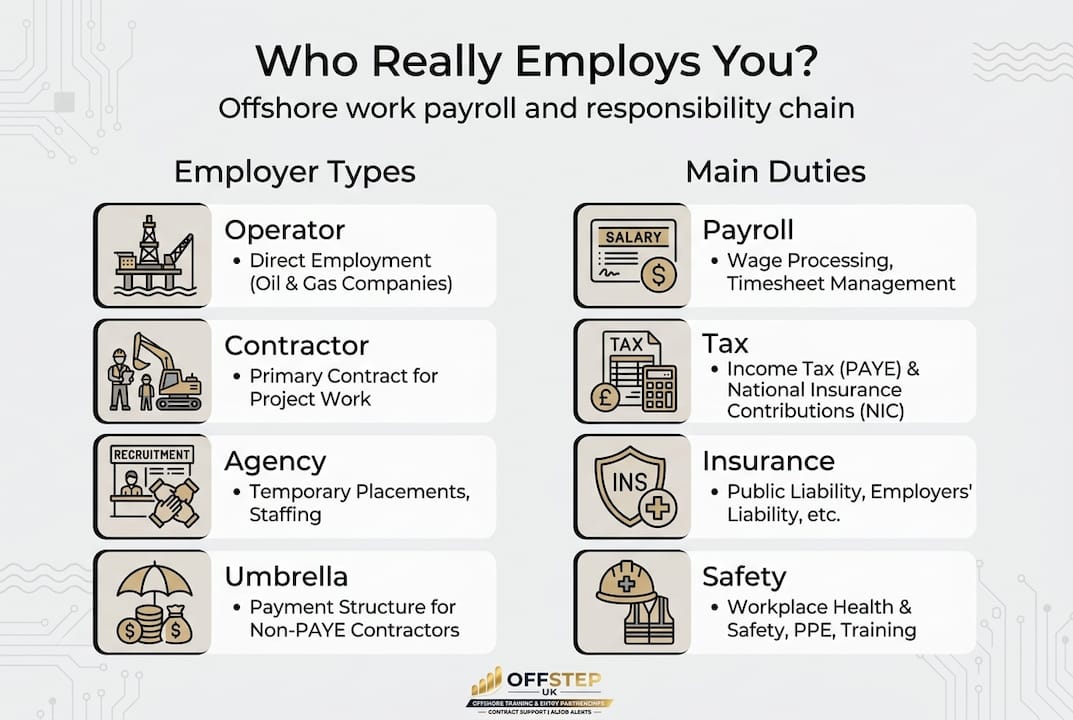
The main employer types you will encounter are:
- Operators are the companies that hold the licence to extract oil or gas. Think of names like Harbour Energy or Repsol Sinopec. They oversee the entire installation but rarely employ every worker directly.
- Owners are companies that own the physical installation, such as a drilling rig or a production platform, and may be separate from the operator.
- Contractors and subcontractors supply specialist services, from drilling to catering to inspection. Most entry-level offshore workers are employed by contractors rather than operators.
- Recruitment agencies source workers on behalf of operators and contractors. They may place you with a client, but they are not always your legal employer.
- Umbrella companies and PEO (Professional Employer Organisation) companies act as the legal employer on paper, handling your payroll and tax obligations while you work on-site for another business.
Offshore employers, including operators, owners, and contractors, have legal duties under the Health and Safety at Work etc Act 1974 to ensure the health and safety of employees and others affected by their activities offshore. This means the responsibility for your welfare does not rest with just one party. It is distributed across multiple organisations, each with defined obligations.
Recruitment agencies and umbrella companies often act as legal employers for contractors, handling payroll, tax compliance under PAYE and IR35, and all relevant deductions. This arrangement is common in the UK offshore sector, especially for contractors working on short rotations.
Here is a comparison of the main employer types to help you see the landscape clearly:
| Employer type | Main function | Payroll responsibility | Core duties |
|---|---|---|---|
| Operator | Manages licence, oversees platform | Sometimes direct | Safety management, permit to work |
| Installation owner | Owns physical asset | Rarely direct | Structural safety, maintenance |
| Contractor | Delivers specialist services | Yes, for direct hires | Trade supervision, workforce management |
| Recruitment agency | Sources and places workers | Often via umbrella | Candidate vetting, contract issuance |
| Umbrella/PEO company | Acts as legal employer | Yes | PAYE, NIC, IR35 compliance |
Understanding this structure matters because it shapes your rights. The entity cutting your cheque each month is not necessarily the same entity responsible for your safety training or your medical fitness assessment. Knowing which employer type you are dealing with, and what they owe you, is non-negotiable before you sign any contract. You can find professional services for offshore employers that help clarify these distinctions and connect workers with reputable structures from the outset.
Key responsibilities of offshore employers
With the main employer types defined, it is vital to understand what responsibilities these employers must uphold. Knowing your rights puts you in a far stronger position when evaluating job offers or contracts.
The Health and Safety at Work etc Act 1974 is the bedrock of all offshore employer duties in the UK. It requires employers to ensure the health, safety, and welfare of their employees so far as is reasonably practicable. Offshore, where the environment is inherently hazardous, this is not a checkbox exercise. It is a live, daily commitment.
Employers must provide safety training such as BOSIET (Basic Offshore Safety Induction and Emergency Training), medical fitness clearance, risk assessments, appropriate insurance, and coordination with installation operators for all entry-level roles. Each of these items is mandatory, not optional, and any employer who cannot confirm them in writing before you mobilise should raise serious concern.
A practical checklist of what a reputable offshore employer should provide:
- A valid BOSIET certificate arranged and funded before your first trip
- An offshore medical certificate from an approved examiner
- Written confirmation of your employment status and payroll arrangement
- Details of your employer's liability insurance
- Access to risk assessments relevant to your role
- An emergency contact protocol and muster station briefing
- Written coordination arrangements with the installation operator
Operators and owners bear primary responsibility for controlling health risks on installations, with overlapping duties requiring cooperation among multiple employers. This overlap is intentional. It creates a network of accountability rather than a single point of failure.
"No single employer can guarantee safety on an offshore installation alone. Safety is a shared responsibility distributed across every entity with workers on board, from the operator to the smallest subcontractor."
In practice, this means your employer must not only look after their own crew but actively engage with other employers on the installation. Shared safety meetings, joint toolbox talks, and coordinated permit-to-work systems are all part of this. If you are new to offshore, understanding this multi-employer safety culture is as important as learning the technical aspects of your role.
You can explore regulatory compliance support to understand how reputable operators and employers structure these arrangements and what to expect as a new entrant.
Pro Tip: Before you mobilise for your first offshore trip, ask your employer in writing to confirm that your BOSIET and offshore medical are current and company-approved. If they cannot provide this confirmation quickly, that tells you something important about how they manage compliance.
Who manages pay, tax, and insurance offshore?
Now that the core responsibilities are clear, let us address the important issue of who actually pays offshore workers and manages tax and insurance. This is the area where the most confusion, and the most costly mistakes, tend to occur.
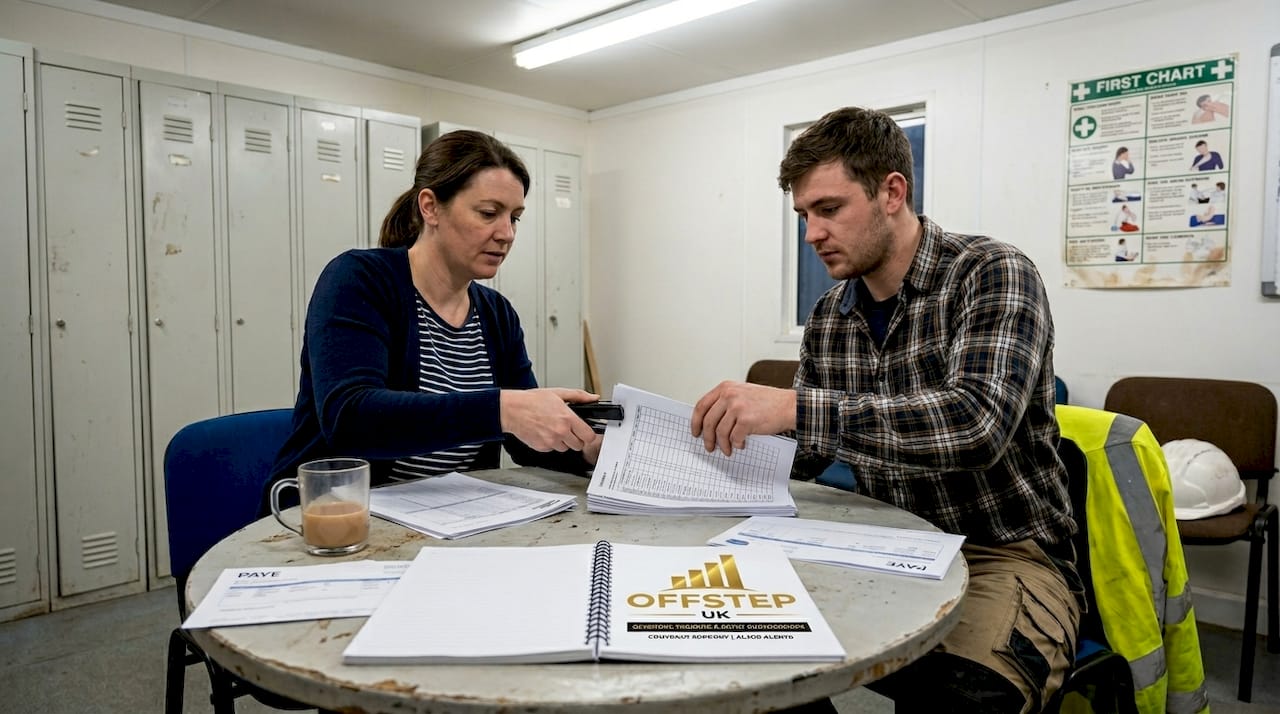
Pay As You Earn (PAYE) is the system through which your income tax and National Insurance Contributions (NIC) are deducted at source. Most offshore workers operating through an umbrella company or directly employed by a contractor will be paid under PAYE. IR35 is the set of rules that determines whether a contractor working through a limited company should be treated as an employee for tax purposes. If IR35 applies, your take-home pay is calculated differently, and the consequences of getting this wrong can be severe.
For non-UK resident employers, UK host employer rules apply on the UK Continental Shelf, making UK entities such as platform operators responsible for PAYE and NIC if the actual employer does not operate payroll. This is a critical point for anyone coming into the UK offshore sector from overseas or working for a foreign-based contractor. The UK platform operator essentially becomes your tax host if your actual employer falls short.
Umbrella and PEO companies act as legal employers for contractors, managing payroll, tax compliance under PAYE and IR35, and all deductions. Their role is specifically designed to simplify compliance in complex, multi-employer environments like offshore installations.
Here is a breakdown of how pay, tax, and insurance responsibilities typically fall across employer types:
| Area | Operator (direct) | Agency | Umbrella/PEO | Overseas contractor |
|---|---|---|---|---|
| PAYE payroll | Yes | Via umbrella | Yes | UK entity takes over |
| IR35 assessment | Yes | Yes | Yes | Operator liable |
| NIC deductions | Yes | Via umbrella | Yes | Host employer rules |
| Employer liability insurance | Yes | Shared | Yes | Must confirm |
| Holiday pay | Yes | Sometimes | Yes | Varies |
Common pitfalls to watch out for:
- Assuming your agency is your employer for tax purposes when an umbrella company is the legal entity
- Working for an overseas contractor without confirming that PAYE and NIC are being managed by a UK entity
- Double deductions occurring when there is confusion between employer types
- Failing to confirm IR35 status before starting a contract, leaving you liable for a tax bill later
For a thorough grounding in tax and social security compliance in complex multi-employer scenarios, it is worth consulting a specialist before you sign. You can also access offshore payroll compliance guidance tailored to the UK offshore sector.
Pro Tip: Before your contract begins, ask for written confirmation of your employment status, the name of the legal employer responsible for your PAYE, and whether your NIC contributions are being made correctly. This takes five minutes and can save you thousands of pounds.
Cooperation and safety management: multiple employers on offshore installations
Understanding pay and tax is essential, but safety is life-or-death offshore. Here is how multiple employers handle this critical responsibility in practice, and what it means for you day-to-day.
Operators and owners bear primary responsibility for controlling health risks on installations, with overlapping duties requiring cooperation among multiple employers, especially for contractors. The law is clear: responsibility does not end at the boundary of your employer's contract. Every employer with workers on an installation must cooperate with every other.
Multiple employers on installations must maintain coordinated safety management. Operators oversee the overall safety case, but contractors retain their own duties for their workers. This dual-layer accountability is what makes offshore safety management genuinely robust when it works well, and genuinely dangerous when it breaks down.
In a typical workday on an offshore installation, safety responsibilities are divided like this:
- Morning briefing: The installation manager (usually the operator's representative) outlines the day's activities and active permits to work.
- Toolbox talk: Each contractor's supervisor holds a specific briefing for their crew covering the tasks, hazards, and controls for that shift.
- Permit to work sign-off: Both the operator's authorised person and the contractor's responsible person must sign before any high-risk work begins.
- Simultaneous operations check: If multiple contractors are working near each other, the operator coordinates a SIMOPS review to manage conflicting risks.
- Shared emergency drills: All employers participate in muster drills and emergency exercises together, regardless of which company they work for.
- End-of-shift handover: Supervisors from each employer log hazards and outstanding issues in a shared system, ensuring continuity across rotations.
"The duty to cooperate is not a courtesy offshore. It is a legal requirement. Employers who share a worksite share a duty of care, and that is non-negotiable under UK law."
A practical example: if a contractor discovers a chemical substance on the installation that could affect the health of workers from another employer, they are legally required to share that information. COSHH (Control of Substances Hazardous to Health) surveillance data does not belong to just one company. It must flow between employers to keep everyone safe.
For those seeking offshore compliance solutions to navigate multi-employer safety arrangements, specialist platforms exist to support both employers and workers through the complexity.
Why career newcomers should look beyond the brand names offshore
Here is what most newcomers and career advancers genuinely miss when entering the offshore world: they chase the logo on the platform rather than examining the legal structure behind the opportunity.
It is entirely natural to want to work for BP or Shell. Those names carry weight, offer perceived job security, and look impressive on a CV. But the uncomfortable reality is that the vast majority of entry-level offshore workers never work directly for an oil major. They work for contractors, agencies, or umbrella structures that supply services to those operators. And that is not a bad thing, provided you understand what it means.
Contractors and agencies often offer more rapid progression for entry-level workers than operators do. You can rotate across different platforms, gain exposure to varied equipment and processes, and build a broader skill set faster. Workers employed through reputable agencies frequently hold more bargaining power when their contract comes up for renewal than their directly employed counterparts who are tied to a single employer's pay grade.
The key is asking the right questions early. Who is my legal employer? Who is responsible for my PAYE and NIC? Who provides and funds my BOSIET renewal? What happens to my employment if the operator changes contractor? These questions are not awkward. They are essential due diligence.
Exploring your offshore HR and payroll service overview options before you accept a contract means you understand the landscape before you are on the helicopter. The workers who advance fastest offshore are not the ones with the biggest names on their CV. They are the ones who understood the system from the start and used it deliberately.
Next steps: guidance and support for your offshore career
If you are ready to take charge of your offshore journey, expert help is available.
Navigating offshore employer structures, payroll compliance, safety training requirements, and contract terms is genuinely complex. Getting it wrong at the start of your career can set you back months or cost you significantly in tax penalties or missed entitlements.
Offstep UK provides structured guidance for people entering or progressing within the offshore sector. Whether you need clarity on which employer type you are dealing with, support understanding your payroll obligations, or coaching on how to position yourself for entry-level and advancing roles, offshore employment support is available to help. Book a free strategy call and get tailored advice based on where you are now and where you want to be.
Frequently asked questions
Who is responsible for my safety training offshore?
Your direct employer, whether that is an operator, contractor, or umbrella company, must provide approved safety training such as BOSIET before mobilisation. Always confirm this in writing before your first trip.
How is my offshore payroll and tax handled if I am hired via an agency?
Agencies or umbrella companies typically manage your payroll and handle your tax deductions. Umbrella companies act as your legal employer, managing PAYE and IR35 compliance on your behalf.
What if my employer is not based in the UK?
For offshore work in the UK Continental Shelf, a UK entity will usually become responsible for your PAYE and NIC. UK host employer rules place this obligation on the platform operator if your actual employer does not run payroll.
Do all offshore employers have to cooperate on safety?
Yes. All employers on an offshore installation, whether operators, contractors, or others, must legally coordinate their safety efforts and share information under UK law. There are no exemptions based on company size or contract type.