
TL;DR:
- Offshore jobs require strict safety training such as BOSIET and MIST before employment.
- Training ensures safety in the extreme, isolated, and hazardous offshore environment.
- Certification and ongoing skills development are vital for career advancement and industry safety.
Many people assume that offshore jobs are simply a matter of showing up, learning on the job, and collecting a generous pay packet. That assumption can be dangerous. The offshore industry operates under some of the strictest safety and regulatory standards in the world, and every worker, regardless of background or prior experience, must meet mandatory training requirements before setting foot on any platform or vessel. Understanding what that training involves, why it exists, and how it shapes your career from day one is not just useful knowledge. It is the foundation of a successful offshore career.
Table of Contents
- What makes offshore jobs unique
- Essential training requirements for offshore jobs
- Safety: The fundamental reason for training
- Gaining skills for career progression
- What most people overlook about offshore training
- Find your offshore training solution
- Frequently asked questions
Key Takeaways
| Point | Details |
|---|---|
| Training is non-negotiable | All offshore workers need accredited training to ensure their safety and that of others. |
| UK compliance matters | Regulations make training mandatory for anyone joining offshore jobs in the UK. |
| Career growth depends on upskilling | Ongoing training leads to more opportunities and higher pay offshore. |
| Skills are widely transferable | The knowledge gained from offshore training is valued across similar industries. |
What makes offshore jobs unique
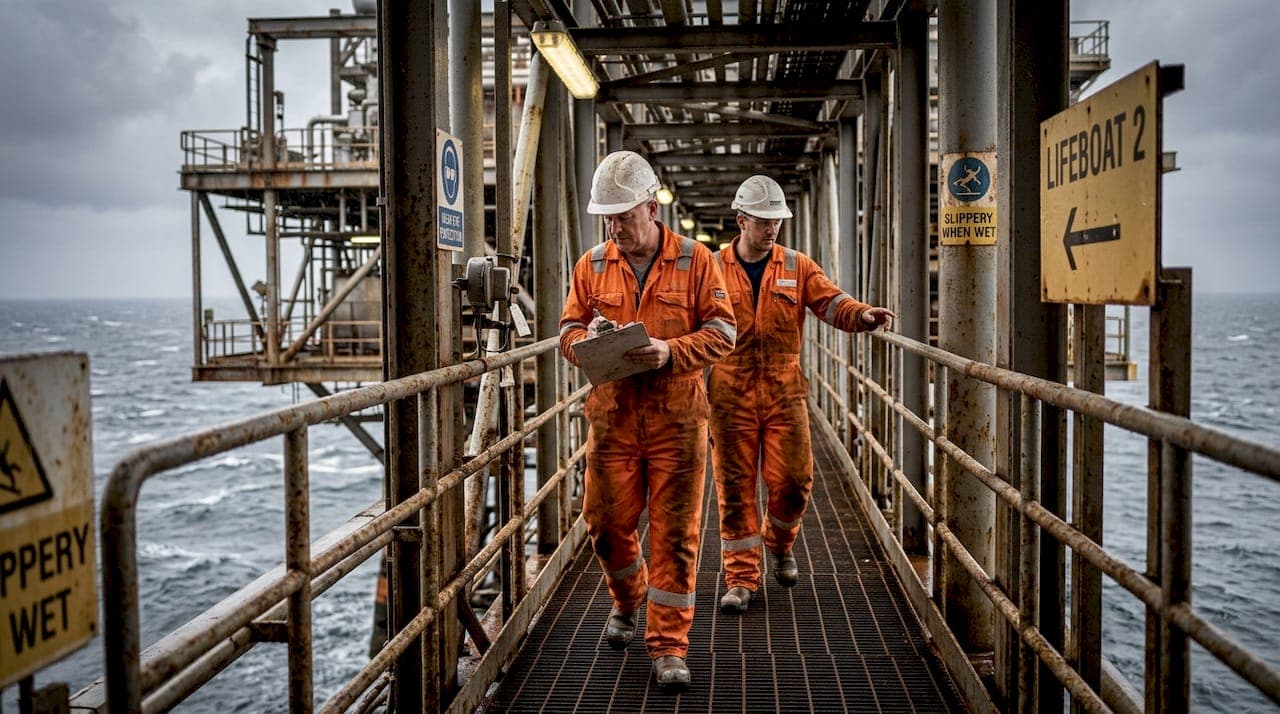
Offshore workplaces are unlike any other environment in British industry. Whether you are working on an oil rig in the North Sea, a floating production vessel, or a fixed offshore wind farm, the conditions you face every day are genuinely extraordinary. Space is limited. Weather can turn severe without warning. Emergency response teams cannot reach you in minutes the way they can onshore. These are not minor inconveniences; they fundamentally change how work is designed, managed, and regulated.
Think about what a typical onshore worker takes for granted: the ability to step outside for fresh air, easy access to emergency services, or simply the comfort of going home at the end of a shift. Offshore workers have none of that. Rotations last weeks at a time, living quarters are shared, and every procedure on the platform has a safety reason behind it.
The distinctive challenges of the offshore workplace include:
- Isolation from shore: Medical help can take hours to arrive, making first-aid competence critical for every crew member
- Extreme weather exposure: High winds, heavy seas, and freezing temperatures create physical and operational hazards daily
- Confined and elevated spaces: Work in enclosed modules or at height demands specific awareness and procedural discipline
- Specialist equipment: Machinery and systems found offshore differ significantly from what is used in most onshore trades
- Round-the-clock operations: Offshore platforms run continuously, so fatigue management and handover protocols carry extra weight
"The offshore sector involves harsh environments, specialist equipment, and high-risk tasks," as OffStep UK outlines when guiding new entrants through what to expect before they apply.
These factors collectively explain why regulators and employers do not treat offshore entry as a casual process. Following offshore compliance guidelines is not bureaucratic box-ticking. It is what keeps people alive. When you understand the environment, the training requirements stop feeling like hurdles and start making complete sense.
Essential training requirements for offshore jobs
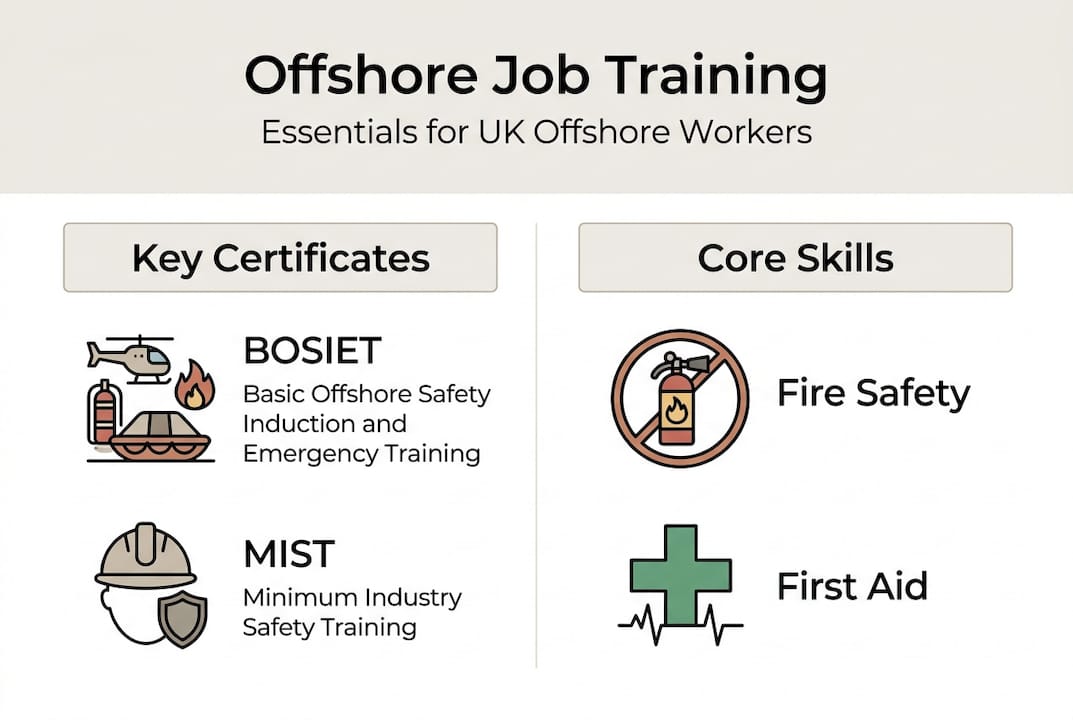
Before any new entrant steps offshore in the UK, they must hold recognised safety certifications. Two of the most fundamental are BOSIET (Basic Offshore Safety Induction and Emergency Training) and MIST (Minimum Industry Safety Training). These are not optional extras; they are non-negotiable for virtually every offshore role in the UK sector.
Here is what a typical training journey looks like for a new entrant:
- Complete BOSIET: Covers helicopter underwater escape, sea survival, firefighting, and first aid. Usually delivered over 3 to 5 days at an OPITO-approved centre
- Complete MIST: Focused on onshore safety awareness, manual handling, and risk assessment. Often completed as an online module before attending physical training
- Obtain a valid medical certificate: An offshore medical examination confirming fitness to work in a remote environment
- Role-specific certifications: Depending on your trade, you may also need additional qualifications such as GWO BST (Global Wind Organisation Basic Safety Training) for wind sector roles
- Register with a verification scheme: Schemes such as ARIS (Automated Registration and Information System) help employers verify worker credentials quickly
Mandatory training certifications ensure a basic standard of competence across all offshore workers, protecting individuals and the teams that depend on them.
| Certificate | Duration | Delivered by | Valid for |
|---|---|---|---|
| BOSIET | 3 to 5 days | OPITO-approved centres | 4 years |
| MIST | 1 day / online | OPITO-approved centres | 2 years |
| GWO BST | 5 days | GWO-accredited providers | 2 years |
| Offshore medical | Half day | Approved medical examiner | 2 years |
Training providers are spread across the UK, with major centres in Aberdeen, Great Yarmouth, and Teesside. Online components can often be completed remotely, making initial steps more accessible for those outside these areas.
Pro Tip: Do not treat refresher courses as admin. Letting certificates lapse is one of the most common reasons candidates miss out on work at short notice. Keeping renewals ahead of their expiry dates signals professionalism to every employer who checks your records, and it keeps you meeting regulatory compliance standards without scrambling at the last moment.
Safety: The fundamental reason for training
No conversation about offshore training is complete without confronting the statistics directly. The offshore industry has a significantly better safety record today than it did thirty years ago, and mandatory training is a central reason why. When you understand what has historically gone wrong offshore, you understand immediately why no certification can be treated as a formality.
Fire, gas release, and vessel capsizing are not theoretical risks. They have all claimed lives in real incidents, some of which triggered the entire regulatory framework that new entrants now train within. Proper training reduces offshore accident rates significantly, and the data from regulators such as the Health and Safety Executive consistently supports this.
| Scenario | Without training | With mandatory training |
|---|---|---|
| Helicopter water escape | Survival relies on instinct | Trained muscle memory and correct technique |
| Onboard fire | Panic and poor evacuation | Structured response, designated roles |
| Medical emergency | Delays and confusion | Immediate triage from certified first aiders |
| Gas leak | Incorrect isolation actions | Correct shut-down procedures followed swiftly |
Training covers the scenarios that matter most:
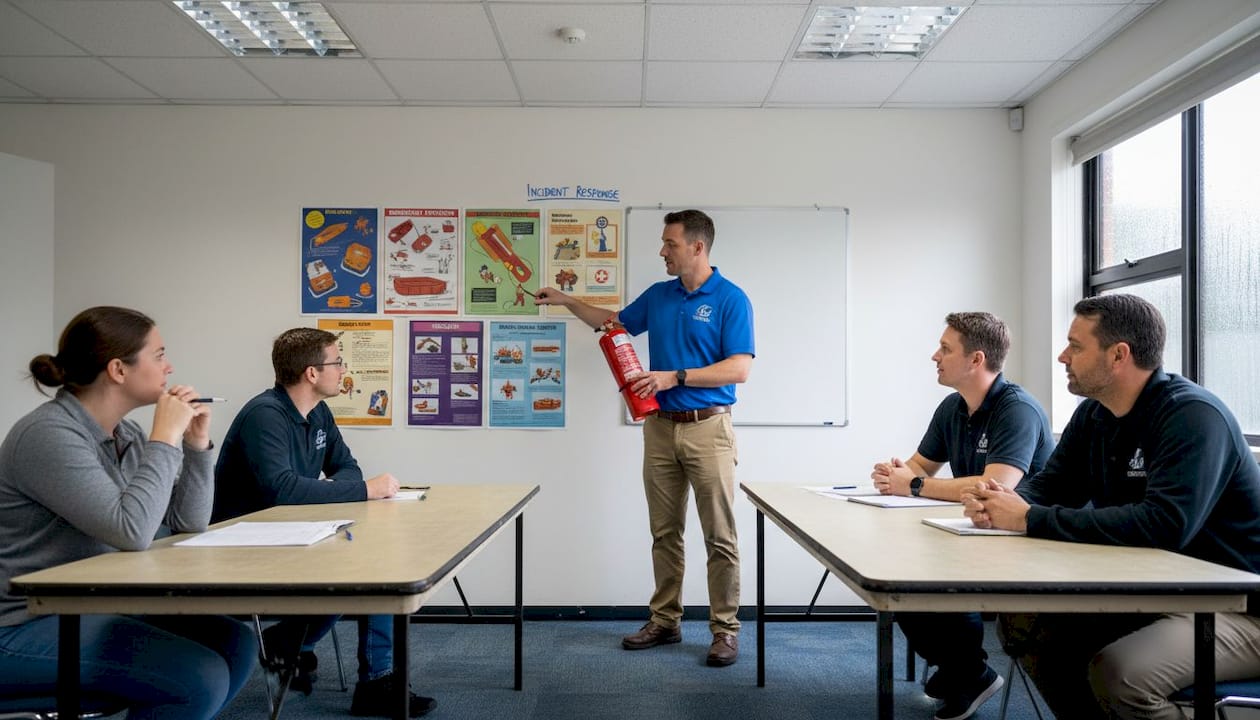
- Fire response and suppression: Practical experience with extinguisher types and evacuation routes specific to offshore platforms
- Helicopter underwater escape: A core BOSIET module that simulates a ditching scenario in a controlled pool environment
- Man-overboard and sea survival: Life raft deployment, personal survival techniques, and signalling
- Basic offshore first aid: Stabilising casualties when a doctor may be hours away by air
The UK Health and Safety at Work Act 1974, combined with the Offshore Installations Regulations, legally enforces these standards for every employer operating in UK waters. There is no exemption for experience. There is no exemption for seniority.
Pro Tip: When evaluating a training provider, ask specifically about their practical assessment pass rates and their accreditation renewal dates with OPITO or GWO. A credible provider will share this information freely. If they are evasive, look elsewhere. Ensuring workplace safety offshore starts before you board the helicopter, with the quality of training you choose.
Gaining skills for career progression
Getting through the door is one thing. What you do once you are inside is another entirely. Training is not just a compliance mechanism; it is the engine of your offshore career growth. The skills you build through structured certification do not stay offshore. They follow you through your entire working life.
Consider the career path of a typical new entrant. Many start as a roustabout or deckhand, performing manual tasks and learning the rhythm of platform life. With experience and additional training, the same person can progress to:
- Roughneck or assistant driller: Requiring technical drilling knowledge and specific safety endorsements
- Safety officer or safety technician: Building on emergency response training with dedicated safety management courses
- Tool pusher or installation supervisor: Combining years of offshore experience with leadership and technical credentials
- Offshore installation manager (OIM): The most senior operational role on a platform, requiring extensive training history and demonstrated competence
"Ongoing training opens doors to higher roles offshore," and the difference between workers who advance and those who stagnate is almost always the investment they make in advanced training opportunities and mentorship throughout their career.
Beyond offshore, the skills transfer remarkably well. Crisis management, technical risk assessment, confined space awareness, and physical resilience are all valued in construction, maritime, emergency services, and engineering roles onshore. The professional discipline that comes from rigorous offshore training is recognised across industries.
Mentorship accelerates this process considerably. Knowing which certifications to pursue and in what order, which employers value which credentials, and how to present your offshore experience on a CV are questions that experienced mentors can answer from direct personal knowledge, not guesswork.
What most people overlook about offshore training
Here is what the standard checklist of certificates does not tell you: training changes how you see yourself. Most people entering offshore training are nervous, uncertain about whether they can handle the physical demands, the emergency simulations, or the sheer unfamiliarity of the environment. By the time they complete their BOSIET pool sessions and walk out of the assessment centre, something has shifted.
You have proved to yourself that you can manage a helicopter inversion in water. You have made decisions under simulated pressure. That is not a box you ticked. That is a version of yourself you have created. The confidence that comes from genuinely hard preparation is not something a CV can fully capture, but employers see it in interviews, and colleagues feel it on the job.
At OffStep UK, we have seen candidates arrive for insider career insights and leave with a completely different picture of what they are capable of. The training itself is the first test of whether you belong offshore, and passing it with genuine preparation rather than minimum effort sets the tone for everything that follows. Do not treat it as a formality. Treat it as your first professional statement.
Find your offshore training solution
If you have read this far, you are already ahead of most people who casually wonder about offshore work. You understand the environment, you know the certifications required, and you see how training connects to real career growth.
At OffStep UK, we work specifically with people at every stage of this journey, from complete newcomers who need guidance on where to begin, to experienced workers ready to move into senior roles. Our mentorship programmes, CV support, and career strategy sessions are built around the realities of the UK offshore industry in 2026. If you are ready to take the next step, discover offshore training with OffStep UK and find out exactly which pathway fits your background and goals.
Frequently asked questions
What training certificates are required for offshore jobs in the UK?
Most offshore roles require BOSIET and MIST certification as a minimum. Mandatory training certifications ensure a basic standard of competence across all workers before they begin any offshore assignment.
Can I get an offshore job without experience?
Yes, entry-level roles such as roustabout positions are open to candidates without prior offshore experience. However, training is compulsory for all new offshore entrants regardless of their background.
How long does offshore training take?
BOSIET typically takes 3 to 5 days to complete, and MIST can often be done online in a single day. Offshore safety training involves several core modules, but additional role-specific certifications will extend the overall timeline.
Are offshore training certificates recognised internationally?
Many are, particularly those issued under OPITO accreditation. OPITO-accredited certificates are recognised worldwide, making UK-earned qualifications valuable far beyond British waters.